
It has to be considered one of the most absurd factoids to emerge in college basketball over the past year. Out of all the players who were named to the Missouri Valley Conference’s first, second, and third all-conference teams, just one – Bradley point guard Duke Deen – remained with the league through this past offseason.
Especially at a time when many veteran players possess extra eligibility in the form of a ‘Covid year’, how could a league lose more than 93% of its consensus best players? Even given how freewheeling roster-building has become due to the prevalence of NIL funds and availability of non-graduate transfers, the task of replacing such production across a variety of teams was a monumental one. After all, the Missouri Valley isn’t full of brand-name blue bloods with the deep coffers to make any old wish a reality.
To make matters tougher, the Valley’s top programs were shorn of a promising batch of quality coaches along with almost all of their best players. In renovating their lineups, the Valley’s teams didn’t by and large have the ability to make big, swaggering hires or acquisitions.
As it turns out, though, the new guys knew what they were doing. As of the writing of this article, the Valley’s top three teams are a combined 24-3. There are rising competitors up and down the league. And most excitingly, a new crop of talented players are starting to make their names. The MVC seems to have added all the pieces needed to keep up what has become a strong reputation for the league and do plenty of damage to opponents far and wide.
Nobody exemplifies the Valley’s legit start to the year as well as Drake. This season was expected by most people out there to be a tremendous challenge for Ben McCollum. In taking over as head coach for Darian DeVries at Drake, the Bulldogs’ new head coach had plenty of work cut out for him. Following the most successful six-year run in program history, DeVries and his Missouri Valley Conference Player of the Year son Tucker DeVries moved on to West Virginia. Nearly the whole roster from last year’s Arch Madness champs departed along with them. Under a new coach who’s making the transition from Division II ball, the Bulldogs were largely expected to take a significant step back.
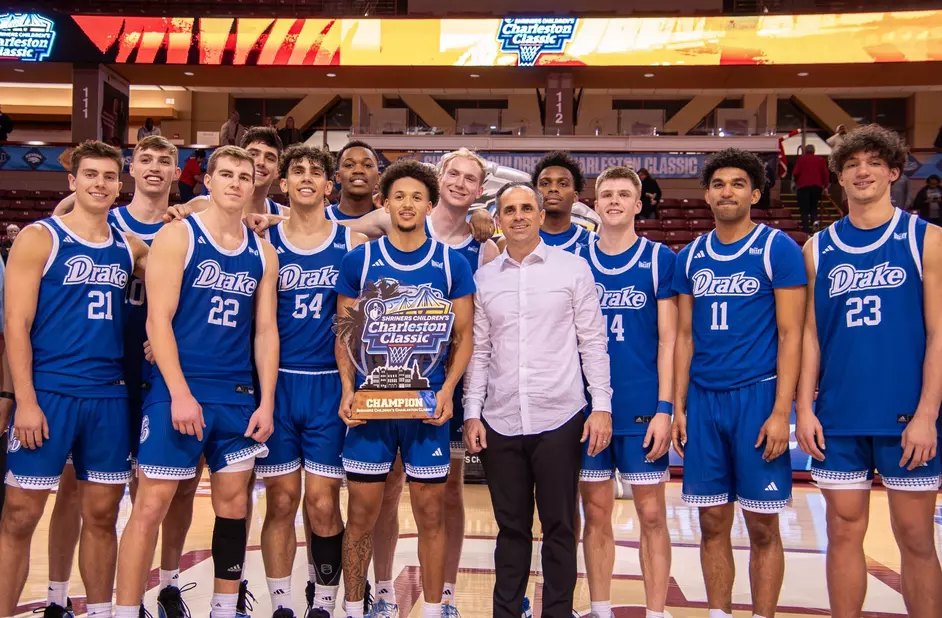
McCollum is no ordinary Division II coach, though. It’s shown – and quickly. The start of his Drake tenure hasn’t been quite as extraordinary as his four national championships at Northwest Missouri State were, but the Bulldogs’ 8-0 start has been outstanding in its own right. He’s already guided Drake to a tournament title, too. The Bulldogs captured the Shriner’s Charleston Classic championship a couple of weeks ago.

“This was good for the kids as they have obviously put a lot of work in,” McCollum declared afterhis team knocked off Vanderbilt in the title game. “They’ve put a lot of work in over the years, put a lot of work in over the summer as well as the preseason. It’s good to win one of these.
The challenge of establishing himself as a quality Missouri Valley coach has been eased by the presence of some guys that McCollum knows well. In addition to having Xavier Kurth and Jaran Richman – faces he knows well from NWMSU – on his first coaching staff, McCollum brought four Bearcat players to Des Moines as well. Isaiah Jackson, Daniel Abreu, Mitch Mascari, and Bennett Stirtz have immediately become centerpieces for the Bulldogs. Not only are they helping McCollum to establish the culture he’s cultivated elsewhere – they’re playing at a very high level as this team’s top options.
Not only has Stirtz played like an MVC Player of the Year contender in his own right; the first Valley game of his career was a memorable one. Stirtz dropped 29 points on Valparaiso this past weekend to run Drake’s record to 8-0 this year. The junior point guard was NWMSU’s biggest threat a season ago, and Stirtz has taken all facets of his game to new levels to start his career with the Bulldogs. In addition to shooting the ball more effectively than ever before, Stirtz is getting to the charity stripe almost seven times per contest and is currently one assist and 0.1 point per game off of the Valley lead. In keeping with a standard established during McCollum’s time at NWMSU, Stirtz is also averaging a Valley-high 38.4 minutes played per game. Jackson has posted quieter stats while helping Stirtz to run Drake’s offense, but his contributions as a quality defender, savvy decision-maker and tenacious rebounder for his size are valuable assets.
Like Jackson, Mascari and Abreu are in their final season of eligibility, and the proven scorers are proving new things in new ways thus far. A sharpshooting wing whose court sense and sixth sense for moving without the ball are outstanding, Mascari has quickly become a vital deep threat for Drake. After making 47.4% of his triple tries over his last two years combined as a Bearcat, Mascari has pretty much kept up the pace despite the jump up in competition. With a 47.2% rate through eight games in Des Moines, Mascari ranks second in the MVC. A tough-minded forward who can also step out to the perimeter, Abreu has been the biggest surprise among Drake’s new guys. It’s not as though he never played for the Bearcats; Abreu started 56 games over the two previous seasons as a Bearcat. He was never really counted on as a significant scoring threat, though. Abreu has changed his reputation as a Bulldog, though. He’s currently among the MVC’s top ten scorers with a 14.2 scoring average, and much of his breakout can be attributed to the fact that Abreu has improved considerably as an outside shooter the past couple of years.
Additionally, the Bulldogs have been beastly on the glass. Drake ranks 27th in the country in offensive rebounding rate, 23rd in defensive rebounding rate, and ninth in the nation in total rebounding percentage, per TeamRankings. They don’t allow opponents to play very fast or create easy opportunities in transition, and by locking down the boards, Drake’s stingy defense seems all the more intimidating. In scoring 80+ in wins over power conference teams like Miami (FL) and Vanderbilt already, the Bulldogs have also shown that they can do more than win ugly. Still, McCollum is expecting his guys to keep improving.
“We have just really struggled to put teams away and I think it’s just from a scoring perspective,” McCollum said following Drake’s win at Valpo. “We need to be a little more dynamic offensively. The teams that we have played have been so good and now we have been scouted a lot. We’re going to get there.”
They’ll still have to prove that their depth is legit as familiar foes test them in conference play, but Cam Manyawu and Nate Ferguson are highly efficient scorers inside and Tavion Banks gives McCollum a matchup problem on the wing. Not only has Drake not faded out of Valley contention, they’re at the fore of a renovated batch of good teams in the conference. McCollum is used to winning big, and it’s obvious that his standards remain firmly in place despite the change of address. Drake may not quite be ready to win McCollum’s next natty just yet, but the Bulldogs look like they’ll be playing for league hardware this March at the least.

With not only Deen but the league’s most proven and cohesive returning roster, expectations for Bradley were very high coming into this year. So far, so good. Head coach Brian Wardle’s bunch is nine-deep and has played very well over the course of an 8-1 start.
As the maestro of the Valley’s most efficient offense, Deen has been at his best. Coming off of a season which saw a fistful of excellent pop-off scoring outbursts, Deen is shooting the ball better and more consistently than ever before this winter while creating for his buddies at a very high level. Part of what’s allowing that to happen is that Deen is the growth of familiar faces around him. He’s built up meaningful chemistry with multi-year teammates Darius Hannah, Zek ‘Marfo’ Montgomery, Christian Davis, and Almar Atlason – each of whom is, like Deen, averaging more than 10 points per game.
Like Malevy Leons before him, Hannah is emerging as a rim-rattling finisher and highly disruptive post defender. Montgomery, who’s long been something of a hot & cold outside shooter, has been on fire to start the year. Not only is he sharing the team lead in scoring with Deen, but Montgomery is doing so while making 55.9% of his three’s so far. The deep threats only get larger from there. In addition to the 6’6″ Montgomery, Davis (6’7″) is making an even 50% from downtown while sharing the team lead in blocked shots with Hannah. Meanwhile Atlason, a skilled sophomore from Iceland, owns a 44.9% mark from the land of trey at 6’8″. Overall, Bradley is shooting 45.3% as a team on three-point attempts this year: that’s the best combined mark in America. As if their efficiency numbers weren’t enough, Wardle’s guys have already won a title of their own as well. They took home the Myrtle Beach Invitational crown a couple of weeks ago, and given that Wardle’s teams have consistently challenged for MVC titles in recent years, it was just the sort of seasoning that he was hoping for.
“That’s what we do this for. We want a tournament feel,” Brian Wardle explained while his team was in Myrtle Beach. “We want the short prep. We want to play sore and tired and get that experience, so in March we can fall back on those things.”
Knowing the rigors of March and importance of depth, the Myrtle Beach experience also allowed Bradley to test its bench against quality competition. Young guards Demarion Burch and Jaquan Johnson are looking like worthy heirs to Deen’s throne, while sturdy 7’1″ center Ahmet ‘Meta’ Jonović is showing that he can be an advantage inside. The freshman Johnson leads Bradley in both made and attempted free throws so far, and his hard-charging style combined with great vision are a great change of pace to find open shooters, and he’s been able to play some minutes alongside Deen.
With their trademark stingy defense and shooters all over the floor, Bradley is showing that they’ve got the mettle to live up to the high hopes set this fall. Not only did the media and league coaches pick Bradley as the preseason Valley champs – that expectation lives in Wardle’s locker room, too.
“When you play in a Bradley jersey every night, you have to play with a chip on your shoulder,” Deen told the Bradley Scout in November. “Everyone is trying to hunt us.”

At Belmont, Casey Alexander is learning more about how to adapt and continue winning each year. Since arriving from Lipscomb – where his final Bison squad won 29 games – Alexander has compiled a .737% winning percentage at Belmont. First in the Ohio Valley Conference and, for the past three seasons a member of the Missouri Valley, Alexander’s Bruins have competed at a very high level – and it hasn’t been easy.
Take the challenge facing Belmont this spring, for example. Despite proving that players will win nearly 75% of their games if they play for Alexander, Belmont isn’t quite as prestigious a destination as Maryland, Mississippi, or North Carolina. The Bruins lost a trio of all-conference players – Ja’Kobi Gillespie, Malik Dia, and Cade Tyson – to the lucrative world of the high-majors this spring.
“I was disappointed. I would have bet we would have kept all three before we would have lost all three. I wasn’t angry, I think we’re long past that part of it. We understand the world we live in, we’re doing the best we can to give them a great experience. I’m very confident we did that…That’s really all we can control.”
The early returns on Alexander and his staff’s work in the portal are worthy of praise. The Bruins are off to an 8-2 start and seem to be building momentum behind the combined breakthroughs of five young veterans. New arrivals Jonathan Pierre, Carter Whitt, Tyler Lundblade, and Brody Peebles are playing the best ball of their careers so far for Alexander. At the same time, Isaiah Walker – who didn’t leave this spring – is stamping his name all over the stat sheet after previously playing a support role to the trio of aces who’ve gone. The additions of redshirt freshmen Sam Orme and Drew Scharnowski to the rotation has been a boost, as well. A stretch big guy who protects the rim, Orme and Richmond transfer Aidan Noyes are nice complements to Brigham Rogers and Scharnowski as more traditional post players. Orme and Scharnowski underscore the productive efforts of Alexander and his staff in developing talented youngsters into highly productive, in-demand players.
Together, the new Bruins are playing terrific offensive basketball. They rank 21st nationally in assists per game – Whitt, Walker, and the 6’9″ Pierre are each averaging well over three helpers per contest, and despite their newness as a unit, Belmont’s guys don’t make many mistakes. Alexander’s squads have traditionally been very capable of raining three’s on opponents to run away with the lead, and Lundblade leads a cohort of threatening outside shooters with his 50.8% rate from distance. The Bruins feature four (or more) guys capable of stretching the defense outside at all times, and the team’s combination of spacing, shooting, and sharing give them a chance to go on a game-changing run at any moment.
“I’m very optimistic,” Alexander told Main Street Nashville this fall. “When you go through it in the beginning, the conversation with yourself is: We’re Belmont and we can’t afford to be bad. And I don’t think we’re going to be bad.” The Bruins are absolutely not bad – in fact, they’re assuming their usual spot as a threat to beat anyone in the Valley and win 20+ games.
Drake, Belmont, and Bradley are just the headliners of a good group of teams. While they’re carrying the Valley’s banner, Missouri State (Cuonzo Martin), Southern Illinois (Scott Nagy), and Indiana State (Matthew Graves) are re-establishing themselves under good new coaches. Northern Iowa will inevitably be a threat under Ben Jacobson, who’s showing that he can also roll with the changes of the portal and keep his Panthers near the top. Oh – and Murray State is looking spooky with a portal-built six-man scoring lineup of their own.
There’s just no way to deny the Missouri Valley Conference. Names, staffs, and rosters have been forced to change but the reality that the MVC can play at a high level remains as evident as ever. The question of just how resoundingly its teams can make their statements in March has yet to be answered, but that the Valley will be well-represented in postseason play yet again seems as likely as ever. In college basketball, it’s about the journey to March just as much as it’s about cashing in with a big run at the end. In the Valley, the tale of that journey is still being written. As usual, this year’s journey is proving to be as entertaining and rich a chronicle as ever.
Leave a Reply