
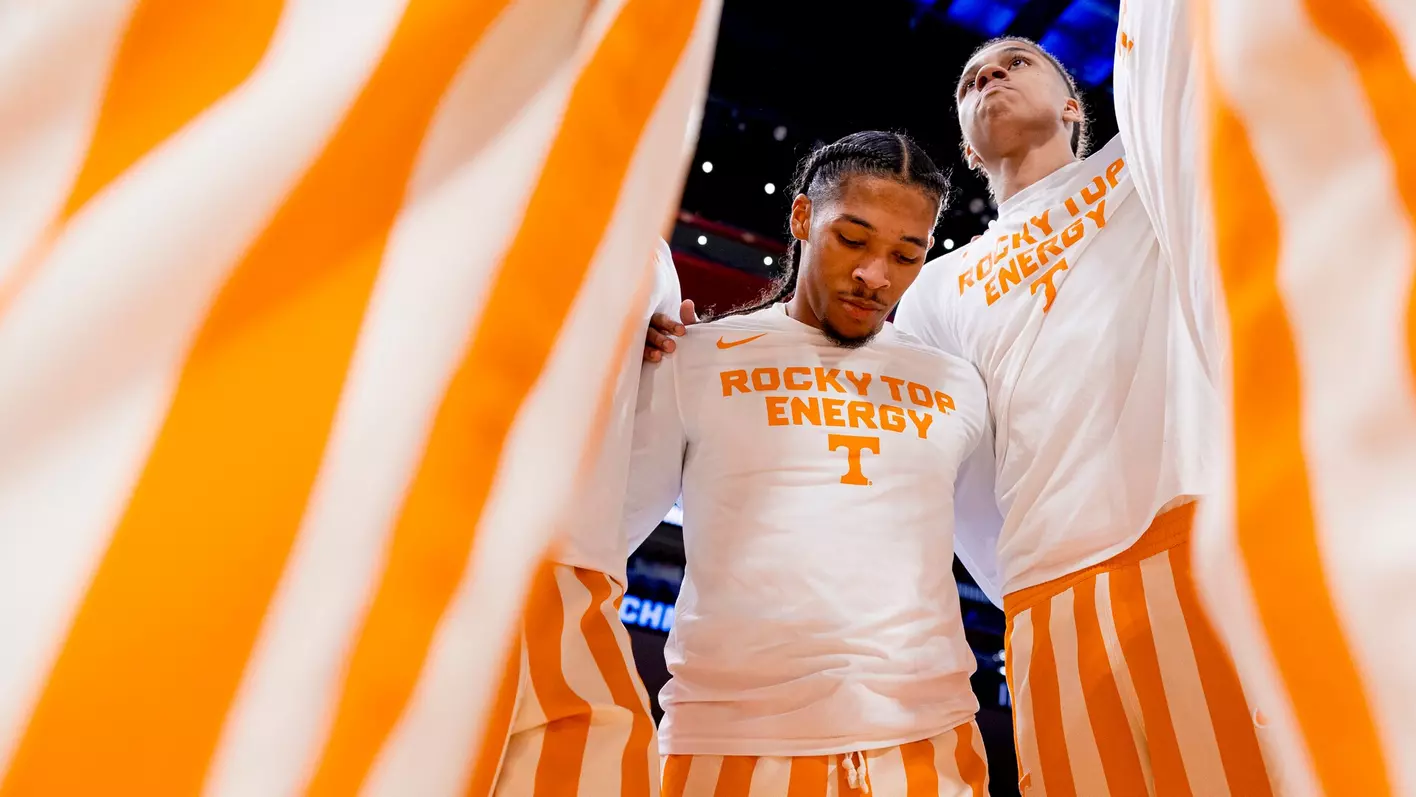
Last Year: 27-9; 14-4, Southeastern Conference regular season champions, lost in the Elite Eight of the NCAA Tournament
Head Coach: Rick Barnes (Tenth Year; 202-101 at Tennessee, with six NCAA Tournament appearances)
Projected Starting Lineup
PG Zakai Zeigler – 5’9″, 172 Senior
G Jordan Gainey – 6’4″, 190 Senior
W Darlinstone Dubar – 6’6″, 220 5th-year Senior
F Igor Miličić, Jr – 6’10”, 225 Senior
C Felix Okpara – 6’11”, 235 Junior
Experienced Reserves
G Jahmai Mashack – 6’4″, 202 Senior
G Chaz Lanier – 6’5″, 207 5th-year Senior
W Cameron Carr – 6’6″, 189 Sophomore
F Cade Phillips – 6’9″, 216 Sophomore
F/C JP Estrella – 6’11”, 250 Sophomore
Freshmen
G Bishop Boswell – 6’4″, 203 / Top 100 recruit

Back in March, Tennessee was oh-so-close to the Final Four they’ve been chasing. Behind a trio of stars and led by the Southeastern Conference Player of the Year – Dalton Knecht – the Volunteers first won the SEC regular season crown. Then, they won a pair of close games to reach the Elite Eight and gave Purdue quite a fight before being knocked out.
It meant a new high water mark in the Vols’ rising tide of NCAA Tournament success each of the past three seasons. Still, it wasn’t the resounding breakthrough that they’ve been hoping for on Rocky Top. You see, the Vols have won at least 25 games in five out of the past seven campaigns. That’s fantastic consistency. All those dubs mean sky-high expectations, though.
Despite featuring some great teams before, last year was the first time since head coach Barnes arrived that Tennessee stepped beyond the Sweet Sixteen. It fits something of a storyline which has followed the long, successful career Barnes has put together. He always has a good team – often very good – but the final weekend of March Madness has been frustratingly elusive.
There will be an opportunity to shake off the familiar consternation this season, as Barnes has put together another terrific roster. And hey, it’s possible that the most consequential positive to take away from their Elite Eight appearance is this: should the water crest higher ’round Rocky Top for the fourth year in a row, the Vols will be Final Four bound.*
*This statement does not constitute a jinx
The biggest reason Tennessee can hope to rise yet higher is the smallest guy on their roster. Senior point guard Zakai Zeigler is one of the nation’s most electric two-way stars, and he’s back to lead a veteran backcourt in chasing Volunteer dreams this winter. A sensational playmaker, Zeigler’s daring in darting precision feeds all over the floor is exhilarating. Whether he’s chucking a tight bounce pass half the length of the floor or bursting into the lane to toss a lob, Zeigler generates an incredible number of quality scoring chances for his teammates. The veterans that Barnes added via the portal this year are all very capable of getting up to hammer down a good lob, and you can be certain that the Vols’ staff had Zeigler’s talents in mind when selecting them. He’s led the SEC in assists and assists per game each of the past two seasons, and his 218 helpers a year ago were the 12th-most in the country.

Zeigler’s elite quickness and audacity on defense are also keys to the Volunteer attack. He’s the defending SEC Defensive Player of the Year, and any concerns which were once harbored about Zeigler’s ability to match up with bigger scorers have been assuaged. He’s one of America’s most intense on-ball defenders, giving opponents of all sizes virtually no chance to get where they’d prefer to go, nor a moment to plan their next move even if they get there. He’s also pilfered 181 steals across his 101 career games, and Zeigler constantly sparks the Vols towards transition opportunities with his live-ball action. Though he’s largely overcome the limitations of his 5’9″ stature in the post, Zeigler will need to be a bit more efficient as a scorer this year. His field goal percentage near the rim has fallen slightly each year of his career, and though Zeigler can rack up triples, his 33.5% career rate could stand to improve. As the primary driver of everything Tennessee does, Zeigler will be in line for more accolades this winter – team and personal ones.
In projecting how well a player from outside the major conferences will fare in translating their skills to the big-time, it’s often helpful to check out their efficiency markers. If a guy can get buckets with great efficiency somewhere, he can probably get things done fairly effectively elsewhere. Due to the work Barnes & Co did in pillaging the nation’s mid-majors for talent, Tennessee will feature two of the nation’s four most-efficient returning scorers. Chaz Lanier ranked first while Darlinstone ‘DStone’ Dubar ranked fourth nationally in points per possession last winter, per Synergy Sports. This fall, they will fill it up for the Vols.
At Hofstra last year, Dubar turned into a monster. He started seven games as a freshman at Iowa State four years ago, but a transfer to the Pride proved to be a great fit for Dubar. Two years of solid improvement as a complementary starter later, it all came together for Dubar last year. He stepped emphatically into a co-starring role alongside sharpshooting star Tyler Thomas and produced a remarkably complete effort. At 6’6″, 220, Dubar can play as a small ball stretch-4 or as more of a traditional off-guard, and he brings his full skillset anywhere he roams. Long capable of a powerful drive or quick post-up for two points, Dubar has also been sharpening his focus from the land of trey. Over the past two seasons, he’s hit 115 deep balls at a combined 40.1% rate, and that type of versatility as a floor-spacer makes Dubar an exciting target for Zeigler’s passes. His defensive skills are impressive, too – as is his plain desire to improve.
“What we’re about, he’s about…He saw what we want to do and he wanted to be a part of it.”
– Rick Barnes on Darlinstone Dubar
“What we’re about, he’s about, Barnes told On3’s ‘VolQuest’ this summer. “He saw what we want to do and he wanted to be a part of it…Special kid, very special kid. And you can tell he is a worker, got a lot of desire. He wants to be able to be really good.” Dubar was strong and switchable defensively when he arrived on Rocky Top, and he’s only gotten stronger and quicker this summer. A quality defensive rebounder, Dubar took the initiative to lead Hofstra in total rebounding as well as stickback buckets – he tried 22 of them last year, per Hoop-Math. He produces turnovers and swats shots whether he’s guarding bigger or littler guys, and Dubar doesn’t mind a challenge. With his combination of skills, size, and toughness, Dubar should make an instant impact in Tennessee’s lineup that goes far beyond the buckets he gets.
Only one Division I player – now-Notre Dame guard Matt Allocco – hit the shooter’s trifecta by making at least 50/40/90% from the floor, downtown, and at the charity stripe last winter. Lanier barely missed out; his 51.0/44.0/88.0% line was the second-best such spread nationally. Across his first three seasons at North Florida, Lanier was largely a reserve. Last fall, he detonated and became one of the nation’s purest buckets. One may be concerned about how a guy who carried a career 4.2 points-per-game average into his senior season will fare in the SEC, but that’s where Lanier’s absurd efficiency comes in. He prioritized high-quality shot attempts last year. Almost 60% of his two-point tries came near the rim last season,and he converted those looks at a 68.6% rate. After sinking 39.1% of his three’s two years ago, he increased his volume hugely while still improving his rate. Lanier’s 106 made triples ranked 19th nationally, and his 44.0% mark was the nation’s fifth-best. If he can prove that there’s more than pure scoring to his game and that he’s ready for SEC competition, Lanier should be one of the nation’s true microwave scorers.
To help get the new guys up on how the Vols do things, Barnes has a couple of solid veteran contributors coming back. Jordan Gainey and Jahmai Mashack are veteran guards who have seen what it takes to win in March, and they’re looking for more net clippings.
| Five Stats Which Tell The Tale (with national ranks) |
| 44.0% – Team FG Percentage (222nd) |
| 38.9% – Opponent 3FG Percentage (5th) |
| 16.7 – Assists Per Game (20th) |
| 20.7 – Opponent FT Attempts Per Game (280th) |
| 4.6 – Blocks Per Game (37th) |
Jordan Gainey, whose father Justin Gainey is an assistant coach for the Vols, brings a combination of guard skills to the floor. After establishing himself as a star at USC Upstate, Jordan Gainey became Tennessee’s 6th man a year ago and fit well with a versatile cast in the Vols’ veteran backcourt. Now, the lanky Gainey is an elder statesman, and he’ll be hoping to show a cleaner, more refined version of the game he played last year. A zig-zagging threat when he puts it on the deck, Gainey gives a bigger look than Zeigler and is almost as quick. His jumper has been fairly streaky over the years, but when Gainey gets cooking he can burn anybody. He averaged 13.5 points across four combined games against UNC, Alabama, Purdue, and Ksnsas last year, and Gainey understands how to give his team a spark. If he can do so more regularly this year, the Vols will have an added dimension to test opponents as they struggle to contain Zeigler.
He may not be as much of a scoring threat as Tennessee’s other guards, but Mashack is a lockdown defender. With the quick feet, height, and sturdily-built frame to handle any perimeter player, Mashack paired with Zeigler is about as good a pair of on-ball stoppers as a team can feature. Not only does Mashack move well and powerfully, he reads the action well and has learned to cleverly anticipate his opponent’s next move. He’ll also crash the boards or reject an ill-planned shot or pass attempt – Mashack brings the ruckus with him wherever he goes. With plenty of other guys who can shoot, he will remain a key piece for the Vols even if his offense doesn’t improve much this year. Still, if he could make just a couple of jumpers per game it would help Mashack to evolve into a guy who’s nearly impossible to keep off the court. The team’s top incoming freshman – 6’4″ playmaker Bishop Boswell – may also factor in right away. He’ll offer a change of pace from the smaller Zeigler, and Mashack figures to see the defensive intensity Boswell brings as a familiar attribute.
With veteran standout Jonas Aidoo gone to man the post for Arkansas this winter, Felix Okpara has arrived from Ohio State to take over. A fantastic shot blocker, Okpara finished second in the Big Ten with 2.4 blocks per contest a year ago and departs the league ranked seventh all-time with a 9.8% career block percentage. Additionally, Okpara finished sixth in the B1G in offensive rebounding percentage last year. Unfortunately, Okpara committed the second-most fouls in the Big Ten, which limited him to just 23.5 minutes per game last winter. He’s still a bit raw, but Barnes hopes to put Okpara on a similar trajectory to the departed Aidoo.

“Felix is an elite shot blocker, high-level defender and terrific rebounder. He possesses the ability to score in the low post, as well as play on the perimeter,” Barnes said upon Okpara’s commitment to the Vols. “A mobile athlete with excellent length who creates space offensively, Felix is a constant threat to get to the rim for a lob. We will do everything we can to help him further develop all aspects of his game.” To start, Okpara will be tasked with doing what he does well already: setting quality screens, hammering down lobs, and protecting the rim. If he can grow as a positional defender and avoid four trouble more regularly, Okpara will have the chance to show off the shooting form he’s worked so hard on this summer.
Another import from outside of the power conferences, Igor Miličić, Jr put up a breakout year last winter for Charlotte. The slick face-up big man has a long frame and some very in-demand skills. A year ago, Miličić finished fourth in the American Athletic Conference in rebounding average, fifth in free throw percentage, swatted 35 shots in 31 games played, and canned 56 triples at a solid 37.6% rate. At 6’10”, Miličić moves fairly well around the halfcourt and, like Okpara, can bust it from end to end. With the ability to play a different version of four-out offense with Miličić on the floor, Barnes will simultaneously feature a defense with two legit rim protectors who can help one another out. If Miličić can add a post move or two to rely upon as a new wrinkle for defenses to consider, he could emerge as a very dangerous complimentary piece and matchup problem.
Back after playing spotty minutes as a freshman, JP Estrella is also going to get his chance to begin growing into a force. Unfortunately, a foot injury has limited the young big man this fall, bit once he’s ready to roll, Estrella may see minutes alongside both Okpara and Miličić. He’s a long, stretchy prospect who has added muscle in the two summers he’s spent in Knoxville, but it remains to be seen exactly how prepared Estrella is for the quality, established post players he will have to contend with in the SEC. He actually fared alright against Purdue’s Zach Edey in last year’s NCAA Tournament when foul trouble forced Estrella onto the floor, so there’s reason to hope he will be just fine. Offensively, Estrella sees the floor very well and retains a number of the guard skills which he honed prior to growing eight inches in the middle of his high school days. If he can add a shooting and facilitating element out of the middle and invert the Vols’ offense on occasion, Estrella’s value could increase quickly.
| Five Out-of-Conference Games to Keep an Eye on |
| N Baylor/St. John’s – November 22 |
| @ Illinois – December 14 |
| N Miami (FL) – December 10 |
| @ Louisville – November 9 |
| vs Syracuse – December 3 |
The coaching staff also has high hopes for Cade Phillips, Estrella’s freshman classmate. He loves to attack the rim and play with physicality inside, and Phillips ought to get his opportunity to rattle rims as the backup to Miličić. He’s added legit, functional strength since joining the Vols, and Phillips has always played a maximum-energy style. An acrobatic shot-blocker who tries to contest absolutely anything around him, Phillips might be young but hevunderstands how to change momentum whether his team has the ball or not. Last year’s top-rated recruit, Cameron Carr, is hoping to show more polish to his game as a sophomore. He still looks like a Top 50 recruit; Carr is big, bouncy, and quick, and he owns better than a seven-foot wingspan. Barnes has spoken of the need to see greater strides from Carr defensively, though, before he’ll be fully unleashed to get buckets. A smooth shooter who’s got a very good start on scoring from all three levels, it’s no wonder Barnes has been insistent on putting Carr through the paces so intensely. If he can grow into a complete two-way player, Carr could be a very good one.
The Vols will be facing their usual tough non-conference matchups early on in order to prepare for another March run. In addition to facing Louisville, Virginia, Baylor or St. John’s, Miami (FL), and Illinois away from home, the Vols will welcome Syracuse and a sneaky-good Middle Tennessee side to Knoxville. It’s part of the approach Barnes has begun taking for this team. Tennessee expects to be great, and they’ve become willing to take on anyone, anywhere.
The way that Barnes has raised Tennessee’s floor as a program is impressive. Even staring down a larger, deeper SEC than at most points through its history, the Vols are going to remain a power. What better time than now for Tennessee to continue their postseason ascent than now, when the lights are brightest. The nation has had a bit of trouble buying Tennessee as a genuine national title contender, but this is a program that has learned to overcome their demons in March more and more lately. Look what happened following their quick exit from the SEC tourney a few months back – the Volunteers put together three straight victories. If this reconfigured squad can build on the confidence an Elite Eight appearance warned them, there’s going to be some party on Rocky Top this March.
Leave a Reply