
Last Year: 8-24; 3-17, last in the Big Ten Conference, No Postseason
Head Coach: Dusty May (First Year; had been 126-69 in six years at Florida Atlantic, with two NCAA Tournament appearances)
Projected Starting Lineup
PG Rubin Jones – 6’5″, 190 5th-year Senior
G Roddy Gayle, Jr – 6’5″, 205 Junior
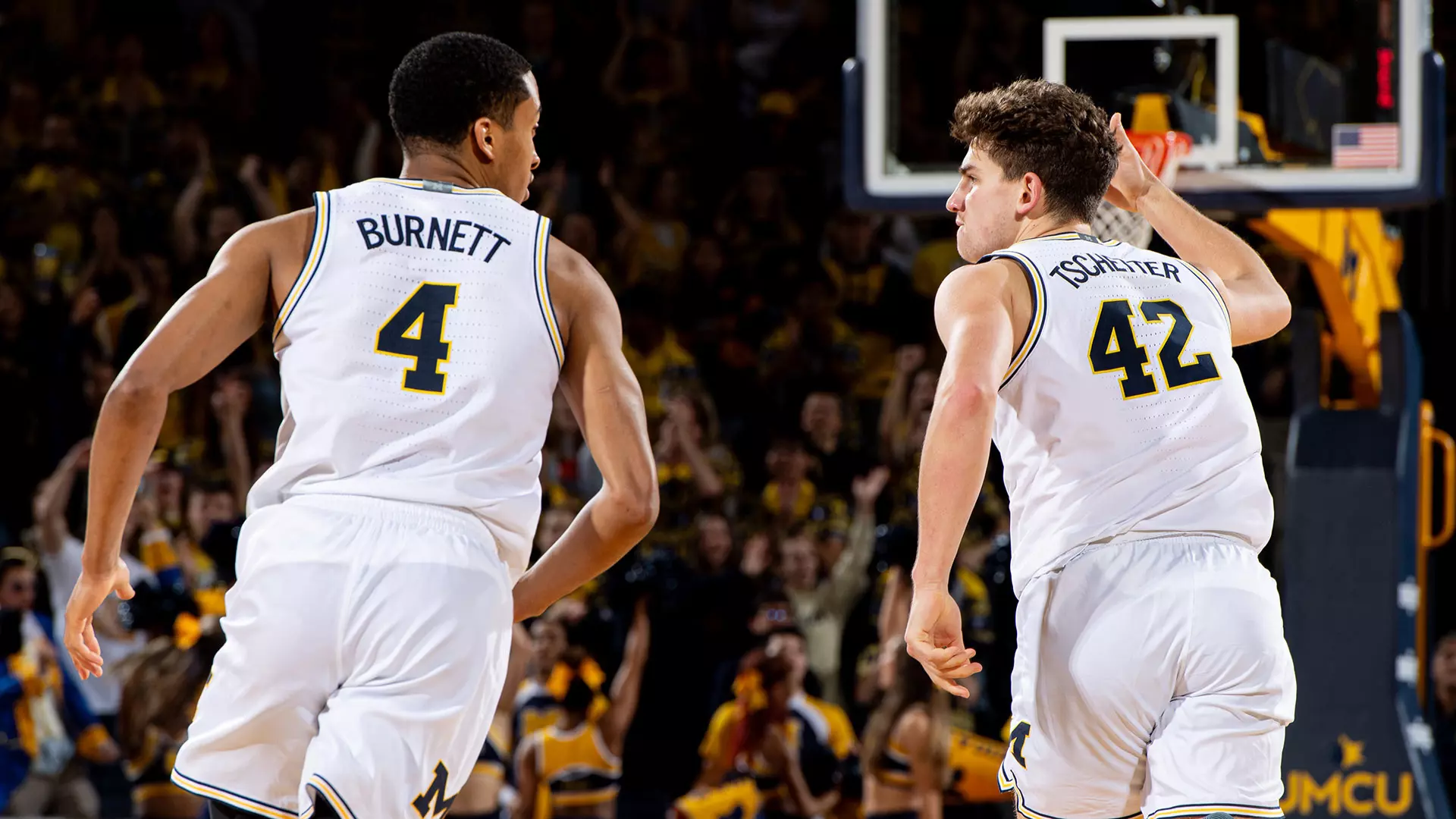
G Nimari Burnett – 6’5″, 200 5th-year Senior
F Will Tschetter – 6’8″, 230 Senior
C Vladislav Goldin – 7’1″, 250 5th-year Senior
Experienced Reserves
G Tre Donaldson – 6’3″, 195 Junior
F Sam Walters – 6’10”, 200 Sophomore
F/C Danny Wolf – 7’0″, 250 Junior
Freshmen
G Justin Pippen – 6’3″ 180 / Top 100 recruit
G LJ Cason – 6’2″, 190
G Durral ‘Phat Phat’ Brooks – 6’2″, 190

Some things had to change for Michigan basketball following an eight-win season. And goodness, did they ever.
The Wolverines parted ways with head coach and headline-grabbing alum Juwan Howard this spring and brought in Dusty May to replace him. A rising star in the profession, May led an exciting Florida Atlantic squad to a pair of NCAA Tournaments the past two years – you may remember their legendary run to the Final Four.
It’s all part of a pretty significant shake-up for a program which prides itself on tradition and having as many ‘Michigan Men’ around the program as possible. To help legitimize his crown, May has assembled a terrific staff. Former Oklahoma State and Team USA coach Mike Boynton has joined May, as has Akeem Miskdeen, one of May’s top lieutenants the past four seasons at FAU. May scored an additional salvo by adding crack recruiter Justin Joyner from Saint Mary’s to be an assistant, too – a move which has paid immediate dividends.
Maybe most comforting of all, May was able to bring his star big man along on the journey from Boca Raton, FL, to Ann Arbor, MI. The roster which May & Co have put together around him comes from everywhere – there’s even a guy who played in – brace yourselves – Columbus, OH, last year.
The talent has been assembled, and is starting to be stitched together. The enthusiasm has been growing among the Maize & Blue faithful to see what it all will look like. Will such bold, new throws work out more successfully than the previous approach, especially in the deepest Big Ten Conference there’s ever been?
“We definitely envision those guys (Goldin & Wolf) playing together for significant minutes and also complementing each other.”
– Dusty May
Leading the way for these Wolverines will be a pair of seven-footers who put up big numbers elsewhere. So far as bookend bigs go, Vladislav Goldin and Danny Wolf are about as contrasting a pair as you are likely to find. That was the intention, though, and May hopes that their different approaches and skills will harmonize beautifully.
As an Owl the past three seasons, Goldin has played the best basketball of his career under May. The 7’1″ Russian pivot is a true low-post player, and often seems like a bit of a throwback. Goldin sets up deep in the paint, uses his strength and length to set up in good position, and goes to work almost exclusively within ten feet or so from the rim. And why not? It’s a strategy which has worked extraordinarily well for Goldin so far. Last season, Goldin ranked third nationally by shooting 67.3% from the floor and fifth among all Division I players in Player Efficiency Rating, per College Basketball Reference.
Under May’s tutelage, Goldin took big, noticeable strides forward each of the past three years. At one time, maybe, the young post could have been described as robotic. That time has passed, as Goldin has acquired a more deft touch near the basket and good footwork approaching it. When he catches inside, Goldin can spin and deke his way into a reliable hook shot or use a surprisingly slick drop step to take it right to the rim. He can also knock down elbow jumpers, and along with his short-range jumper, Goldin’s foul shooting improved considerably over his time as an Owl. Though he isn’t a stretch big, Goldin has genuine athleticism, and he’s become a tough customer with the timing and coordination to be a force defensively. He’s a dangerous rim protector, and Goldin’s awareness of what the opposing bigs are doing changed last year, allowing him to make some key deflections and steals. Projecting his game to the Big Ten, Holdin should fare well because he has the physical tools and stature to hang, and he sticks to what he does best.
May’s second big man isn’t quite the intimidator that Goldin can be, but he brings a tantalizing set of skills to the Maize and Blue. Last summer, Danny Wolf became a minor international celebrity by leading Team Israel to a silver medal at the 2023 FIBA U20 World Championship. Last winter, he developed into an All-Ivy League star and the Ancient Eight’s tournament MVP on the way to helping Yale win the league and beat Auburn in the NCAA Tournament. So, what’s on tap for the third season of Wolf’s career, especially considering that he is now the 1-B to Goldin’s 1-A? May has a plan for his post duo, and he’s detailed parts of it publicly.
| Five Stats Which Tell The Tale (with national ranks) |
| 79.0 – Opponent Points Per Game (328th) |
| 35.9% – Team 3FG Percentage (65th) |
| 36.1% – Opponent 3FG Percentage (319th) |
| 0.464 – Opponent Assists Per Game (61st) |
| 70.7% – Defensive Rebounding Rate (285th) |
“Vlad, I think last year, played 25 minutes a game. In a perfect world, we get him a few more minutes, but we play up-tempo with a lot of possessions so it’s difficult for our players to play 32 to 35 minutes a game if we’re playing the style that we like to play. And so Vlad will probably have around that mid-20s if he’s playing at his best,” May explained at a press conference this summer. “That left us probably playing Danny at 14 minutes a game at the five when Vlad’s not in is how we probably envision it. And we will play stylistically a different brand of basketball with Danny being more of a ‘five out’ facilitator, and Vlad still more of a traditional center. But also he’s expanding his game. So we definitely envision those guys playing together for significant minutes and also complementing each other.”
There is tremendous offensive versatility in Wolf’s game. He can finish creatively near the rim, but Wolf will also need to prove that he can bring the noise against the variety of post players he’ll see in the B1G. He’s also becoming a threat from the outside, as Wolf knocked down 29 triples at a 34.5% rate last season and can take advantage of defenders who start worrying about his range. With his feel for running offense, height, and vision, Wolf can be a very effective playmaker from the high post or perimeter, inverting his team’s offense and finding shooters or cutters with smooth passes. As his post-up game develops, Wolf should take pressure off of Goldin and give the Wolverines different ways to attack the other team’s weakest points.
One of the most dastardly defections in recent college basketball history has worked out in the Wolverines’ favor. Former Ohio State – gasp – Buckeye guard Roddy Gayle, Jr, is coming aboard to be Michigan’s new scoring star on the perimeter. What is the world coming to?
Rivalry rabble-rousing aside, Gayle is one of the Big Ten’s more promising young guards, and he’s already proven that he can play a few different roles offensively. A former 4-star recruit who played very well towards the end of his freshman season, Gayle carried that momentum forward as a sophomore last winter. He’s a creative ballhandler who defies traditional point/shooting guard classification, and Gayle makes all sorts of things happen off the bounce. A strong driver who can hang and hit or finish through contact inside, Gayle converted 63.9% of his shot attempts near the rim last year, per Bart Torvik. His deep jumper comes and goes a bit, but Gayle is confident stepping into an open shot from anywhere and has focused on improving his consistency this summer. The Wolverines are going to feature a bunch of good passers in the backcourt, and with Gayle leading the way as a scoring threat, May’s free-flowing offense should kick into high gear.

One of Michigan’s few holdovers, Nimari Burnett is also already well-acquainted with a couple of the newest Wolverines. A former McDonald’s All-American, Burnett struggled through injuries and coaching changes at both Texas Tech and Alabama before arriving in Ann Arbor. At his previous stops, though, Burnett learned about fighting through adversity – and he had a chance to meet incoming teammates Goldin and forward Sam Walters. Having made the decision to return for another year – he graduated in the spring – Burnett is now focused on his teammates and establishing a new outlook for the new year.
“Me and Will [Tschetter, another returnee], guys that have been around the college experience and who are pretty vocal, I feel like we can do a good job heading into this year getting a new group ready,” Burnett told Michigan’s ‘Defend the Block’ podcast this summer. “I think the best teams are the ones that everybody is a leader, so I’m looking for where everybody can have a say in producing this year and doing whatever it takes to win.” Burnett is a big, strong guard whose experience shows. Last season was the best of his career, as Burnett posted career-best averages virtually across the board. He’s developed into a solid shooter and skilled passer, and like Gayle, Burnett can play on or off the ball. The team’s poor performance last winter will drive him this year, and with committed veterans like Burnett around, Michigan’s ascent back up should be smoother.
May saw plenty of Rubin Jones while they were both in the American Athletic Conference, and Conference USA before that. Upon taking over at Michigan, one of May’s priorities was to get in touch with the former North Texas guard. Though he was in and out of the lineup and missed 11 games total, Jones was better than ever last year. A key part of the rotation over his first three years, Jones took control of the Mean Green’s offense last fall following a spate of departures. New UNT coach Ross Hodge put the ball in his hands and set Jones to attack ball screens, and in that role as a decision-maker and distributor, the veteran thrived. Jones uses his size and length to make a big impact defensively, as well. That Jones can cover all sorts of perimeter scorers should allow May real lineup flexibility, and if he so chooses, Michigan’s new coach can trot out a three-guard lineup which features no one under 6’5″. He doesn’t shoot it often from outside, but Jones is a solid 36.6% career shooter on triples and sank 41.6% of his deep heaves last season. If he can pick up this year where he left off at UNT, Michigan will have its primary point guard.

To add more quality at the point, May signed Tre Donaldson as a transfer from Auburn. The former two-sport star brings a football mentality on the defensive end, and has the strength and attitude to make his mark on the Big Ten. Though he didn’t quite average 20 minutes per game last year for the Tigers, Donaldson nearly doubled his run from the year before and solidified his approach on both sides of the court. He’s not a volume shooter, but Donaldson has made 40+% of his triple tries in both seasons of his career. He’s put in extra work from the outside this summer and will look to continue that growth as a Wolverine. He handed out 112 assists against 46 turnovers last year, a strong mark which only adds to the notion that Donaldson may not be very far away from a genuine breakout in Ann Arbor. May has spoken of his desire to play two point guards at the same time, just as he will occasionally use both centers on the floor at once, so it’s very possible that Donaldson will see starter’s minutes, whatever the starting lineup looks like.
He may be a bit spindly, but with the silky jumper he’s got, Walters will earn the run to add strength and flesh out his game. A 6’10” bombardier out of Florida, Walters hit multiple three’s in a dozen different games as a rookie. He can move, but Walters is still growing into his frame. He’s very capable of blocking shots, and Walters has good rebounding and passing instincts. Though he could be exploited defensively as a freshman, Walters still earned more than 12 minutes per game for the Crimson Tide as they advanced to the Final Four. He played less and less as rotations shrank in the postseason, but Walters has worked hard to improve his lateral quickness and brawn this summer. May trusts the flashes that Walters showed earlier in the year and his vast offensive potential, and sees the young forward becoming a big contributor very soon.
The aforementioned Tschetter is considerably bigger and wider than Walters, but the veteran forward plays a similar stretch game offensively. It’s something of a question whether he’ll play as much for May as he did for Howard, but Tschetter made 58.2% of his shots overall and an astounding 51.9% of his three-point shots last winter. If he can keep up numbers like that, Michigan’s staff will have no choice but to keep Tschetter involved. It’s even possible that Tschetter will slot in as a spot-starter next to Goldin due to his ability to space things out.
| Five Out-of-Conference Games to Keep an Eye on |
| N Arkansas – December 10 |
| N Xavier/South Carolina – November 27 |
| N Wake Forest – November 10 |
| vs TCU – November 15 |
| N Oklahoma – December 18 |
There may not be that many minutes for freshmen with such veteran talent on the roster, but Justin Pippen – son of Scottie Pippen – is probably going to be top good to keep buried on the bench. He’s a rising Top 100 recruit whose game has evolved over the past year or so, and Pippen presents options to play on or off the ball. A confident, still-growing guard with impressive athleticism and scoring savvy, Justin Pippen should make his own name known soon enough.
“Pippen is a naturally talented guard with good instincts for the game,” analyzed Travis Branham for 247 Sports this summer. “He is very comfortable with the ball in his hands to score from all three levels and also set the tables for those around him.” Durral ‘Phat Phat’ Brooks isn’t quite his classmate’s equal as a 4-star prospect, but he has a solid frame, can get buckets, and ought to be a great longer-term investment for May & Co. LJ Cason, who had committed to May at FAU and came north with his coach, has been a buzzworthy youngster this summer. Though not the highest-rated of Michigan’s signees, Cason is tough on the drive and shows no hesitation despite his youth.
“Cason has been a real bright spot,” May explained this fall. And to be honest, his ability to create one-on-one opportunities is what he does best. “And even though we don’t play like that a lot as a group, when teams switch and bog you down, you need somebody that can create that advantage on their own.” Cason has already impressed both his coaches and veteran teammates by drilling all sorts of shots in practice, and there’s increasing anticipation for his debut. With the blend of experience and youth that’s been added to the Wolverines’ backcourt, the future looks bright.
With the extraordinary amount of change that’s taken place in Ann Arbor lately, the Wolverines aren’t easy to project. The talent is on hand to do some big winning right away. After all, May assembled a coaching staff that knows how to identify and sign big-time players, and May himself is rather familiar with a bunch of his new players even if he’ll be coaching them for the first time. As with a significant number of power programs who have overhauled their rosters, it all very well might come down to health and chemistry. If May’s calculations are correct, the mad science of his Michigan debut could end up being a very entertaining experiment.
3 responses to “#29: Michigan Wolverines”
-
[…] Michigan/Virginia Tech – November […]
-
[…] probably the best in the country at that job.” In his first year after coming to Kansas from Michigan, the plan was for Dickinson to be the centerpiece of a shot-making chorus on the perimeter. Due to […]
-
[…] the sleek, swift complement to UConn’s new model of classic, physical presence in the middle. Michigan transfer Tarris Reed is a unique combination of things: he possesses tremendous size, nimble feet, […]
Leave a Reply