
Last Year: 22-11; 13-5 in the Mountain West Conference, lost in the First Round of the NCAA Tournament
Head Coach: Leon Rice (15th Year; 290-166 at Boise State, with five NCAA Tournament appearances)
Projected Starting Lineup
PG Álvaro Cardenas – 6’1″, 182 Senior
W Andrew Meadow – 6’7″, 218 Sophomore
F Tyson Degenhart – 6’8′, 235 Senior
F O’Mar Stanley – 6’8″, 240 Senior
F/C Dylan Anderson – 7’0″, 235 Sophomore
Experienced Reserves
G RJ Keane II – 6’7″, 202 Junior
W Javan Buchanan – 6’7″, 230 Junior
F Dominic Parolin – 6’9″, 245 5th-year Senior
F Emmanuel Ugbo – 6’8″, 235 Sophomore
Freshmen
G Julian Bowie – 6’3″, 200
G Chris Lockett, Jr – 6’4″, 205 (redshirt)
G Moses Hipps – 6’4″, 170
F Pearson Carmichael – 6’7″, 208
F Ethan Lathan – 6’10”, 220

There is going to be some kind of epic party in Boise when the Broncos finally earn their breakthrough. Better start blowing up the balloons and put some beverages on ice.
To say that head coach Leon Rice has changed the floor of expectations for Boise State in his decade-plus at the helm is a vast understatement. This will be Boise’s 55th season competing in Division I hoops. Prior to Rice’s arrival before the 2010-11 campaign began, the Broncos had won 20+ games seven times, and been to the NCAA Tournament just five times. Since Rice took over, his program has hit 20+ victories 11 times in 14 seasons and gone to the Big Dance five more times – including each of the past three years.
Even though Boise State has piled up 73 victories over the past three seasons, though, they are still awaiting the first NCAA Tournament win in program history. Having reached a clear new level of success, it’s now become frustrating that the Broncos still haven’t cleared that hurdle. Though it’s been said before – cover your ears, ye blue & orange-clad masses – it’s very possible that this year, Rice will have his best team. And its focus is squarely upon ending that drought.
Despite some big losses to graduation and the portal during the spring, Rice’s team seems to have gotten better anyway. This winter, in an age where all sorts of teams are playing four or more perimeter players at the same time, the Broncos will utilize a fairly unconventional, forward-heavy lineup. That’s because they’ve got a couple of highly versatile 6’8″ seniors around whom everything they do will revolve. There are some concerns about this not being a quicker team, but Rice and his staff have never had a problem doing things differently if it means they can win games. This time, their approach will be as different as ever. Will the Broncos postseason fortunes buck convention in a similar way?

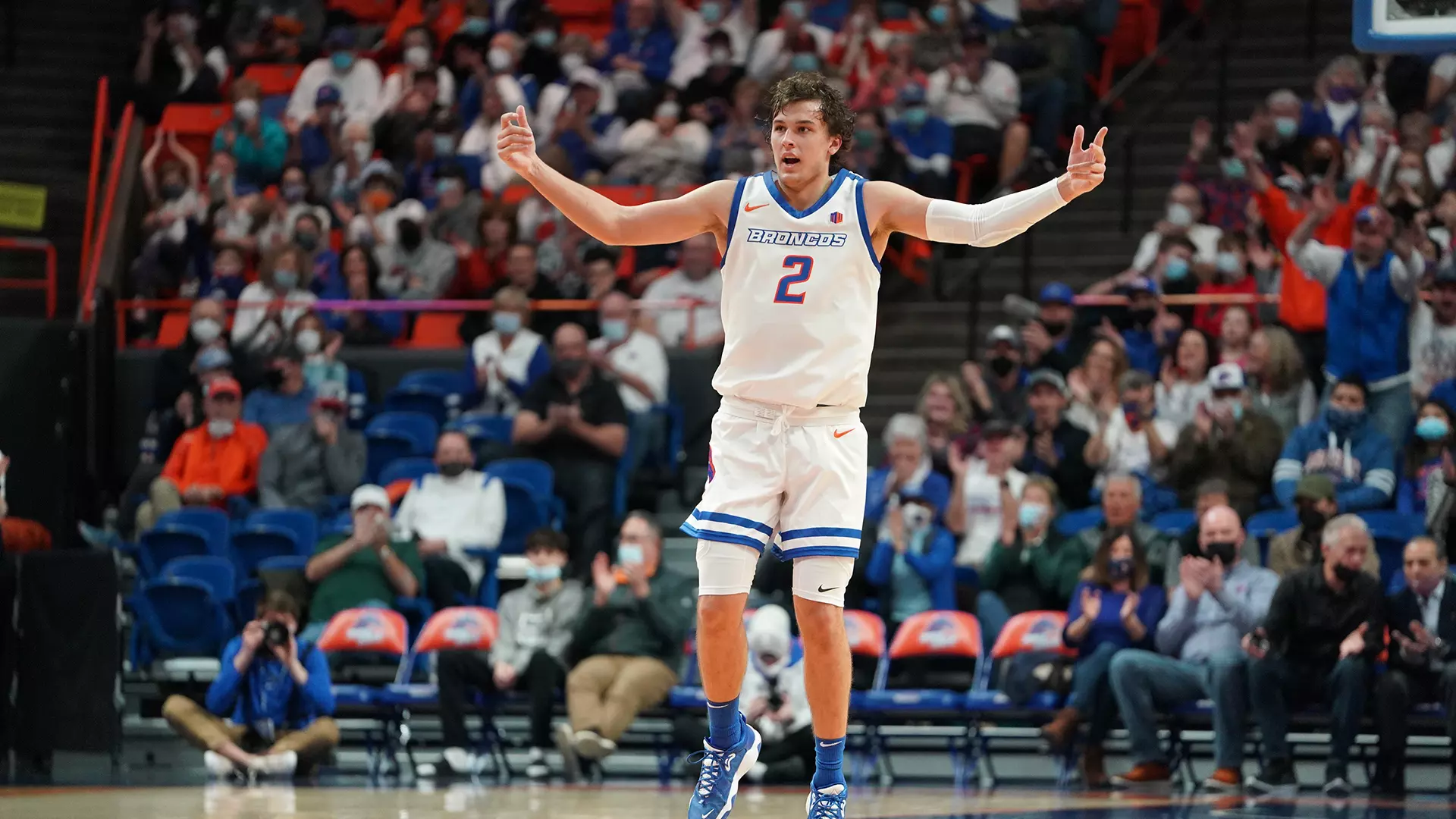
While Boise State has been winning all of those games and making their regular appearances in the NCAA Tournament, Tyson Degenhart has been evolving into arguably the best player in the Mountain West Conference. One of the most multifaceted forwards in the nation, Degenhart has been building the résumé of an all-time program legend. The MWC’s Rookie of the Year as a freshman and a first-team all-conference selection each of the past two seasons, he’s already scored 1,361 points. With another campaign similar to the one he put together last winter, Degenhart will be in line to etch his name as the leading scorer ever at Boise State. If he can do that and cap his career by bringing the Broncos their first true tourney success, Degenhart is going to go down as clearly the greatest player in program history. It’s a lot to heap onto one guy, but Degenhart has never been shy about discussing the goals ahead of him, and he’s taking a pragmatic approach this fall.
“It’s definitely a goal to get all those things but there’s only so much I can control. I can control my effort each day, you know, and my attitude,” Degenhart explained at MWC Media Day. “Hopefully by the end of the year, I end up getting those things…the Player of the Year, NCAA Tournament, the scoring record, but all you can do is just focus on the process no matter what the outcome is.”
A wonderfully efficient scorer, Degenhart has converted more than 50% of his shots from the floor in each of his three previous seasons. He’s a three-level scorer whose ability to exploit any advantage he gains makes Degenhart a genuine top threat, and he finds open teammates when opponents overcommit to covering him. It would be a boost to Boise’s offense if Degenhart could figure out his three-point stroke following a couple of streaky campaigns. He’s made 113 career triples, but after hitting 42.5% of his tries as a freshman, Degenhart has made just about 32% of his deep heaves in each of the two years since. He improved tremendously as a foul shooter last winter, though, making nearly six trips to the stripe each contest and sinking a career-high 79.1% of those attempts.
Defensively, Degenhart isn’t a rim-protecting enforcer, but he made clear strides in his positioning and aggressiveness in the passing lanes last year. Ideally, the coaching staff wants to use Degenhart as more of an old-school shooting forward. Will he be able to guard the modern ‘3’ guys which so many other teams employ? With Rice looking to run forwards at three or more positions at times, the more that Degenhart can lead by example at both ends, the better the Broncos will be.

On his podcast last summer, Degenhart beseeched Rice to get him some serious help in the post. As fortune had it, Rice obliged. Across two years at St. John’s, O’Mar Stanley was a quality big to bring off the bench, but he knew he could be more than that. Upon arriving in Spud City, Stanley started to show off all of the skills in his repertoire. By season’s end, Stanley had established himself as a second-team all-conference pick. Now that he’s back to be Degenhart’s rough-and-tumble co-star once again, Stanley is poised to help lead the Broncos to unprecedented things.
A physical presence on the glass, Stanley’s aggressiveness in the post was a key factor for Boise in his debut. Though he averaged just over 21 minutes per game through the first third of last season, Stanley proved nearly impossible to keep on the bench. His constantly-expanding role led to Stanley grabbing 92 offensive rebounds – fifth in the MWC – and tallying 37 putback stabs, per Hoop-Math. Over Boise’s final 22 games last year, Stanley averaged 14.2 points and 7.5 rebounds on 51.4% shooting. Stanley also blocked 38 shots in the team’s 33 games, giving the Broncos their most effective interior rim protector since Ryan Watkins roamed the paint a decade ago. He flashed increasingly dangerous range as an outside shooter; Stanley sank 15 deep balls last year, and over the final two-thirds of the year, he knocked them down at a 35.1% rate. As a feature duo, Stanley and Degenhart have the scoring versatility to become a two-headed monster when setting screens and then rolling for finishes or popping out to splash jumpers. As he did last offseason, Rice appears to have added exactly the right piece to make that threat a reality.
The most glaring issue with last year’s squad was the lack of an obvious go-to ballhandler who could create good shot opportunities for his teammates when the offense wasn’t clicking. Rice got a good look at former San José State point guard Álvaro Cardenas over the past three seasons in MWC play, though. When the Spanish guard hopped into the transfer portal this spring, Rice pounced. Now, the Broncos have a proven passer to run the show, and if the rapport between Stanley, Degenhart, and Cardenas develops as expected, Boise State will be able to pick-and-roll opponents into submission in a variety of entertaining ways.
A starter since his freshman year, Cardenas arrived in San José as a fairly nondescript prospect but quickly proved his worth. Three years later, he is one of the Mountain West’s best and most proven guards, and Cardenas has developed his game in clear and impressive ways following each successive offseason. Last year, without NBA lottery pick Omari Moore to lead SJSU, Cardenas took charge. He played the fifth-most minutes in the MWC, handed out the fifth-most assists, and posted career-best shooting splits of 45.7/38.5/80.9% from the floor, on three’s, and at the charity stripe. The Broncos generally play a halfcourt game and value their possessions, and Cardenas fits: he plays with a calm confidence and handed out 171 assists against just 64 turnovers last winter. The big difference in coming to Boise is that there will be a great deal more pressure on Cardenas this year to manufacture both good shots and wins. In going from an SJSU team which wasn’t a player in the MWC standings to a squad that’s on the cusp of a highly-anticipated breakout, Cardenas will need to be his very best, and if that’s what the Broncos get, look out.
If the rapport between Stanley, Degenhart, and Cardenas develops as expected, Boise State will be able to pick-and-roll opponents into submission
With a ‘big three’ firmly in place, Boise would have really loved to have the services of 6’7″ Chibuzo Agbo on the wing once again. He moved on to Southern Cal this spring, though, so Rice and his staff will need someone new to await kickouts and knock down triples. Fortunately, even without Agbo, Boise has a couple of similarly big perimeter players who will get their chance to fill a similar role.
As a freshman last year, Andrew Meadow didn’t see a ton of action, but he dropped hints that impact minutes were in his future. His 17 made triples a year ago constitute more than 25% of the made three’s that the Broncos are returning this season, and as such, Meadow is going to be counted on to fire away. He’ll have to prove that he can hang with quicker perimeter players defensively, but Meadow will be able to push some guys around if he so chooses. Offensively, there’s a lot to like about his approach. Despite averaging just 11 minutes per contest as a rookie, Meadow showed a solid understanding of moving without the ball and he didn’t waste the opportunities that came his way. He’s got a smooth, repeatable release that’s hard to block and will only become a greater asset as Meadow gets to it more quickly. The Broncos must replace not only Agbo but Max Rice, a duo which dropped in 150 combined triples a year ago. If Meadow can evolve into the team’s new deep threat, his value will skyrocket.
Javan Buchanan will attempt to pull a Ben Humricious this year by making the jump from NAIA star to Division I standout. Another big, long, wing player who can shoot it, Buchanan did absolutely everything at a high level for Illinois Wesleyan last year. Long enough to cause real problems out on the wing, Buchanan was an impact defensive playmaker last year. If he can prove quick enough to keep it up for the Broncos, it will be a big help in making up for the bunch of guards who were lost this spring. He’s also got a budding three-level scoring arsenal, and if Buchanan can knock down three’s, the floor should open up for him to score effectively around the paint. He’s comfortable handling the ball, and Buchanan should offer mismatch potential in isolation by continuing to post up smaller players. Now that he’s made the jump to the Mountain West, the Broncos would love to see Buchanan use his tapestry of skills to consistently help out on an every-game basis.
If Rice ends up using a three-forward starting lineup, Arizona transfer Dylan Anderson will likely get the nod as the biggest guy on the floor. He didn’t play a whole lot as a freshman two years ago and then had to redshirt last winter, but Anderson brings great size and the face-up skills that Rice loves from his big guys. A 4-star prospect in high school, Anderson passes the ball well and is comfortable operating on the perimeter. While many of the Broncos’ new players must prove themselves guarding on the outside, Anderson’s challenge will be to show that he can knock some folks around in the paint – no easy task in the Mountain West. Though he’s a bit of an unknown, Boise is hoping to get something close to 20 minutes per contest from Anderson this year. If he can give Boise a functional defensive lineup which features five different guys who can drill a three, Anderson will seem like a big matchup advantage.
| Five Stats Which Tell The Tale (with national ranks) |
| 78.5% – Defensive Rebounding Rate (12th) |
| 30.9% – Offensive Rebounding Rate (68th) |
| 2.4 – Blocks Per Game (320th) |
| 6.1 – Opponent 3FG Made Per Game (38th) |
| 11.7 – Assists Per Game (270th) |
Two new guys who settled for practicing with the Broncos instead of taking the floor last winter will do battle with returning swingman RJ Keene II for prime minutes off the bench. A rangy junior who gives Boise State another perimeter guy with more length than most teams feature, Keene averaged just under ten minutes in the 21 games he played last season. He had to take a redshirt in each of the first two years he spent with the program and overcome a shoulder injury which Keene has battled through to remain a quality shooter. Like Buchanan and Meadow, he will be part of a stretchy bunch of scoring wings for the Broncos, and if he can make shots, Rice will find minutes for Keene.
When Boise wants to use a more traditional pair of guards – or give Cardenas a rare breather – the best option will be Chris Lockett, Jr. He was the team’s top-rated freshman signee last fall but took a developmental redshirt, and it looks like Lockett put in good work during his year off. He’s a big, strong guard who has only gotten stronger lately, and Lockett has an assertive mindset to go with his physique. He was named Gatorade Player of the Year in his native Louisiana as a high school senior, and Lockett has never been shy about getting downhill to score around the rim. He’s confident as a ball screen operator and knows how to switch up his dribble to create space or catch defenders off guard with a quick pass, which should be valuable in complimenting Cardenas. If Lockett is prepared to keep defenses honest with his jumper, too, he could level up quickly into one of Boise’s key pieces.
It took a full year for Ugbo to be declared eligible, as he needed a waiver from the NCAA following his arrival from playing with a pro team in the Netherlands. Rice has gained a reputation for bringing his young big guys along notoriously slowly – Degenhart being a clear outlier – but Ugbo appears ready to roll. Even more so than Lockett, Ugbo is a physically strong dude who should be ready to battle with established players in the post. He’s got some skill, too, and has flashed range out to the three-point point arc in the past and during practices this fall. He might just end up being a perfect squire for Stanley, and if Ugbo can glean some things from his veteran teammates to augment his own abilities, he’s going to be a quality addition. It’s possible that Boise State will also get some from help from Dominic Parolin later on the season. At this point, though, the former Lehigh transfer appears slated to take a redshirt as he rehabs from a knee injury he suffered last year.
| Five Out-of-Conference Games to Keep an Eye on |
| N Saint Mary’s – December 14 |
| vs Clemson – November 17 |
| @ San Francisco – November 9 |
| N Washington State – December 7 |
| N Duquesne – November 25 |
Over the years, Rice has tended to play about seven or eight guys as his core rotation. There may be opportunities for this year’s freshmen to play, but with a veteran cast ahead of them, some of the kids may marinate for a redshirt season. Ethan Lathan and Moses Hipps, who were teammates last season at powerhouse Compass (AZ) Prep, are considered the most ready to help out. Lathan is a versatile big who will bring more shooting to Boise’s frontcourt, while Hipps is a quick and shifty guard who can play on or off the ball. Pearson Carmichael and Julian Bowie may take a developmental year before helping out in the paint and on the perimeter, respectively, but together the rookie quartet will eventually become solid parts of Boise’s next contenders.
The Mountain West was particularly strong last winter, and yet the Broncos won 13 conference games, beat VCU and Saint Mary’s in non-league play, and held Colorado’s high-octane offense to just 60 points in the NCAA Tournament. There are a host of positives which the guys who have returned this year can carry forward into the new season. What matters by far the most, though, is that they distill their experiences and talents into a meaningful run come March.
“There’s a lot of pressure, there’s a lot of people watching,” Degenhart said when asked this fall about breaking through one the Big Dance approaches. “You can’t put too much pressure on that one game.” On their way towards the latest chance to have the best season in program history, these Broncos are going to have some fun. While they might be stuck in superstar running back Ashton Jeanty’s considerable shadow for now, the Boise basketball team will be emerging by the time their best football player picks up his Heisman later this winter. It’s a good time to be a Bronco, and it sure looks like the good times are going to keep on rolling. If this group can measure up to the goals before them internally and externally, they will be able to chart their progress with clippings of net – the best trophy of all.
One response to “#34: Boise State Broncos”
-
[…] Boise State – December […]
One response to “#34: Boise State Broncos”
-
[…] Boise State – December […]
Leave a Reply