
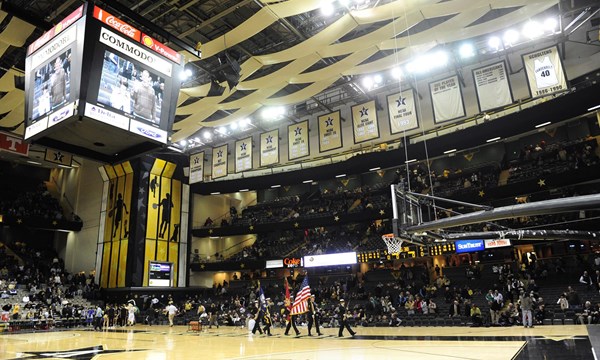
Last Year: 9-23; 4-14, 13th in the Southeastern Conference, No Postseason
Head Coach: Mark Byington (First Year; had been 82-36 in four years at James Madison, with one NCAA Tournament appearance)
Projected Starting Lineup
PG AJ Hoggard – 6’4″, 220 5th-year Senior
G Jason Edwards – 6’1″, 175 Junior
G Chris Mañon – 6’5″, 215 Senior
F Devin McGlockton – 6’7″, 230 Junior
F/C Jaylen Carey – 6’8″, 265 Sophomore
Experienced Reserves
G MJ Collins, Jr – 6’4″, 190 Junior
G Grant Huffman – 6’4″, 190 5th-year Senior
G Alex Hemenway – 6’4″, 190 5th-year Senior
W Tyler Nickel – 6’7″, 220 Junior
F JaQualon ‘JQ’ Roberts – 6’8″, 230 Sophomore
F/C Kijani Wright – 6’9″, 235 Junior

Remember last fall, when it sure looked like Vanderbilt was on the verge of a breakout under Jerry Stackhouse? Well, that didn’t exactly happen.
After two straight NIT appearances and 22 wins last season – the program’s best season in more than a decade – the Commodores had a great deal of positive momentum heading into the previous offseason. It ran out quickly once the season tipped, Vandy cratered to a 9-23 record, and Stackhouse was fired as head coach.
What would the next step be for a program which hasn’t sustained much success since Kevin Stallings left almost a decade ago? Well, Vanderbilt moved quickly to snap up Mark Byington from James Madison, where he had just wrapped up the Dukes’ most exciting season ever. It was an impressive hire, and has paid immediate dividends. Vandy may be one of the toughest jobs in the Southeastern Conference, but Byington has had no trouble luring proven, highly productive players to Nashville, TN.
The results of Byington’s summer haul are very nearly a completely new roster; just one guy returns who played substantive minutes for the ‘Dores last winter, sophomore forward JQ Roberts. He averaged 13.4 minutes and 2.3 points per game. That’s alright, because this is a program starting fresh, and its outlook will be viewed through new glasses. Riding a whole new type of momentum, Byington and his staff are out to change the way people think about Vandy hoops.
The ‘Dores had two real good guards last year, and it wasn’t enough to get the job done. So Byington signed five this time. This team’s backcourt should have the depth, contrast, complementary skills, and, in one case in particular, NCAA Tournament experience needed to raise the trajectory of things in Music City.
It’s not often that any coach gets to take over a new program and say ‘yeah I brought in a guy who spent four years learning from Tom Izzo how to run the point’.
It’s not often that any coach gets to take over a new program and say ‘yeah I brought in a guy who spent four years learning from Tom Izzo how to run the point’. Byington has that privilege this year, as former Michigan State floor general AJ Hoggard has chosen to play his final season at Vanderbilt. The thing about Hoggard is that, by the end of his fourth season under Izzo, he had acquired a reputation for not always laying it 100% on the line, and his legendary head coach had become frustrated by some things. For a program like Vanderbilt, Hoggard will bring plenty of pedigree – and as a veteran of eight NCAA Tournament games already in his career, the confidence that only comes with playing important games in March.
As a starter for Sparty the past two seasons, Hoggard averaged 11.8 points and 5.6 assists. By many of the usual metrics, Hoggard has been a classically successful point guard. He’s handed out 609 career assists against 251 turnovers, and Hoggard has made more than 200 free throws at a 79.7% rate the past two years. He’s also improved steadily as a deep shooter in each successive season, though Hoggard has remained consistently inconsistent from mid-range. When he’s right, Hoggard is also a standout defender whose size and strength are consistently difficult for other guards to deal with. Really, he has flashed all of the skills that a coach could want in a veteran leader by this point, and Hoggard has not yet hit his ceiling.
It may have happened at North Texas and this, mostly outside of the larger national spotlight, but last season Jason Edwards became a star. The former junior college combo guard stepped into the hole that Tylor Perry’s departure left in the Mean Green lineup, and he more than plugged the gap. From the new year until season’s end, Edwards went off, averaging 21.2 points on 35.1% shooting from the land of trey. Over those 22 games, Edwards made 59 triples, and he dropped five different 30-pieces plus a 29-point outing for good measure.
Like his predecessor Perry, Edwards proved to be a flat-out sniper, and he was fearless taking big shots in big moments for UNT. Given the tremendous volume of shots he attempted, Edwards was not an inefficient scorer in his first season of Division I ball. Edwards shot 59.0% inside, and an acceptable 37.3% on mid-range tries in addition to his work from the land of trey, and the hope is that playing alongside an experienced playmaker like Hoggard will provide Edwards with cleaner scoring opportunities this winter. Hoggard’s size is particularly useful given that Edwards is on the smaller side, and together they should match up just fine with most guard pairings they’ll see.
As if Hoggard wasn’t enough, Byington brought in three more big, proven, multi-skilled guards who know how to facilitate in order to share around the workload. Arriving from Davidson, Grant Huffman brings the most experience of the three, and was a solid four-year contributor for the Wildcats. Last season was Huffman’s best, as he led the Atlantic 10 in assists and became a consistent scoring threat. Most of Huffman’s best work is done inside the three-point arc, where his clever ballhandling and use of hesitation and fakes off the bounce lead to lots of scoring opportunities. Huffman plays with all of the savvy and toughness you would expect from a veteran, and he seems to convert a bucket or two each game by bowling through the lane and just flipping something towards the backboard. He can play it smooth, too, dribbling into short jumpers or slipping through the defense for blink-and-you-miss-it lay-in’s. As the 1-B to Hoggard’s 1-A at the point, Huffman should get to take some advantage of not seeing the best defensive attention the opponent has to offer for a change. Byington likes to press on defense, and when the press is working, he prefers to ratchet the attack up a few notches. Huffman and Vandy’s other new guards fit that intensity level – and should allow the ‘Dores the depth to go all-out whenever Byington chooses.
| Five Stats Which Tell The Tale (with national ranks) |
| -8.0 – Average Score Margin (321st) |
| 9.4 – Assists Per Game (355th) |
| 14.8 – Opponent Assists Per Game (313th) |
| 28.3% – Team 3FG Percentage (355th) |
| 37.4% – Opponent 3FG Percentage (349th) |
Like Huffman, former Cornell star Chris Mañon isn’t really a long-range bombardier. Instead, he’s been more efficient inside the arc than a great many classic low-post scorers, and that’s the type of reliable offense Byington was pleased to add to his roster.
A first-team All-Ivy League selection a year ago, Mañon has terrific size and has proven to be a major presence at both ends of the floor. Cornell subbed guys in like a hockey team the last couple of years under Brian Earl, and Mañon accomplished all of his standout plays in an average of just over 22 minutes per contest. In that role, Mañon racked up 63 steals each of the past two seasons, ranking first and then second in the Ivy League in thefts. With plenty of mobility to go with his size and great anticipation, Mañon is a tough defensive matchup and can cover a range of perimeter scorers. He’s also a very good passer, and Mañon reads the whole court while hustling around ball screens to find the best option. He should be able to help the ‘Dores in almost any lineup combination, and Mañon gives Byington the ability to play big at every spot on the floor while still having natural ballhandlers running the show.
The youngest of Vandy’s transfer guards, MJ Collins, who chose Nashville after two seasons at Virginia Tech. For parts of both years at VT, Collins started, and he was an important play-driver for two Hokies teams which didn’t always manufacture an abundance of points. Though he has the size and quickness to work his way to the rim or rise up over defenders from the outside, Collins has struggled to score efficiently so far. He shot less than 35.0% from the floor in each season as a Hokie, and while Collins will shoot it from deep, he’s at 27.4% from the land of trey so far. The pieces are in place for Collins to become a valuable part of Vandy’s rotation, and having plenty of proven passers and scorers around him should only help him to settle in.
A teammate of Collins at Tech, Tyler Nickel has come to Nashville to provide deadeye shooting on the wing. After hardly playing at North Carolina during his freshman year, Nickel flashed what he can do as a bombardier for the Hokies. As a sophomore, Nickel splashed 59 triples at a 39.9% rate – just what the scouts had been expecting when they rated him a Top 100 recruit coming out of high school. Nickel scored in double figures 17 times last winter and did some of his best work during VT’s stretch run to the NIT. With lots of guards looking to drive and do their thing, Nickel can space the floor and command the attention of bigger defenders.
Even more high major experience will come from Alex Hemenway, who arrives after five years at Clemson. He played just five games last year before being forced to redshirt due to injury, but prior to that, Hemenway had been a steady, productive piece off the Tigers’ bench. A career 42.9% shooter from the land of trey, Hemenway owns 124 career makes and even started 25 games at Clemson – he won’t be seeing anything for the first time at Vandy. As yet another valuable shooter who will disorder the opposing defense, Hemenway could muscle into the competition for prime minutes against his younger counterparts.
Roberts will be part of a young cast up front, where Byington has added a mix of experience levels and body types. Former Boston College forward Devin McGlockton has some attributes in common with Roberts. Both are long and bouncy, both can shoot it from the outside, and both will play an important role defensively. A two-way forward whose strong defensive skills allow him to cover bigger guys inside and also smaller perimeter players, Byington is expecting McGlockton to take even bigger steps forward in the near future.
| Five Out-of-Conference Games to Keep an Eye on |
| N VCU/Seton Hall – November 22 |
| N TCU – December 8 |
| N Nevada – November 21 |
| Shriner’s Charleston Classic 3rd game – November 24 |
| @ Virginia Tech – December 4 |
“Devin is super talented, and I feel he’ll be very successful for us and also be a successful professional,” Byington predicted upon McGlockton’s commitment to the ‘Dores. “He has an ability to affect the game in every way – scoring, passing, rebounding, defending and making game-changing toughness plays.” Last year in the ACC, McGlockton began to really show what he could do offensively. In emerging as a valuable and versatile secondary scorer, McGlockton did things like drop 30 points on 12/15 shooting at Georgia Tech in January. He also rattled home 22 triples, and McGlockton brings a 39.2% career rate from downtown to Nashville. McGlockton and Roberts are both strong on the glass; as a rookie, Roberts posted a solid 8.5% offensive rebounding rate, while McGlockton was even better with a 10.3% mark. They’re also both solid lob threats around the basket, and five of the seven field goals that Roberts made inside last year were dunks.
At the biggest spot, Byington has brought young Jaylen Carey along from James Madison to compete with former Southern Cal post Kijani Wright. Neither is yet a proven intimidator to strike fear into SEC bigs, but both have skills which the ‘Dores dearly need.
For the Dukes, Carey debuted in a backup role and more than held his own. A stout, wide-shouldered youngster who won’t get pushed around in the lane, Carey ought to shore things up on the glass. He grabbed 54 offensive rebounds last year despite averaging just under 15 minutes per game, and Carey is energetic enough to tussle for a board even when others have their hands on it first. He doesn’t play a particularly vertical game, but Carey will absolutely demolish the rim when he has a clear path. He threw down 16 dunks as a rookie, helping Carey to make an outstanding 66.9% of his attempts from the floor. He isn’t a one-dimensional dunker, either; Carey made six triples on his debut and has put in additional work on his shot this summer. If he can show that he’s quick and physical enough to hang with SEC competition, Carey could be the guy in the middle often in his first year at Vandy.
Considered a Top 50 prospect by some recruiting services coming out of high school, Wright is hoping for a chance to take command of the ‘Dores. He averaged just about 11 minutes per contest over two seasons at Southern Cal, but often his run was fairly sporadic. Things solidified a bit for Wright late last season, and he saw the floor with more regularity as USC played some of its best basketball of the year. More athletic and a more proven rim protector than Carey, Wright must lean into those advantages, because Byington needs all the help he can get out of his young post players. Vanderbilt ranked below 200th in most rebounding statistics last season, and while this team will be built upon guards and shooting, someone will have to chase down rebounds. Wright and Carey will also earn plenty of good scoring opportunities by setting granite screens and rolling assertively to the rim when that time comes.
As part of a spate of solid non-conference matchups this fall, Vandy will travel to Blacksburg, VA, to do battle with Collins and Nickel’s old team. The ‘Dores will also face solid challenges at the Shriner’s Charleston Classic before starting SEC play. If the host of new guards start gelling quickly, there might be a good bit of confidence brewing in Nashville by the new year. Despite getting burned by expectations so recently, the moves Byington has made have been substantial enough that there is plenty of excitement about this new team’s debut.
Vandy’s new coach showed some things at JMU the past couple of years. One of them was that, when he pressed and the press started working, Byington would press even more. With a cohort of legit guards who can bother their opponents and turn big plays on defense into bigger plays on offense, the game plan this year is plain. Byington is riding high on postseason momentum and the additions of good players who will combine to make Vandy better. There are an incredible number of conference foes in their way this season, but the Commodores have supplied themselves for a climb back up the SEC mountain.
One response to “#67: Vanderbilt Commodores”
-
[…] be Ven-Allen Lubin’s third program in three years. After taking solid steps at Notre Dame and Vanderbilt, Hubert Davis is excited to tell all about why he wanted to sign […]
Leave a Reply