
Last Year: 21-14; 9-9, Seventh in the Atlantic 10, lost in the first round of the NIT
Head Coach: Billy Lange (Sixth Year; 59-91 at St. Joe’s, with no NCAA Tournament appearances)
Projected Starting Lineup
G Xzayvier Brown – 6’2″, 170 Sophomore
G Derek Simpson – 6’3″, 165 Junior
G Erik Reynolds II – 6’2″, 170 Senior
F Rasheer Fleming – 6’9″, 235 Junior
C Justice Ajogbor – 6’10”, 255 Senior
Experienced Reserves
W Shawn Simmons II – 6’6″, 205 Sophomore
F Anthony Finkley- 6’6″, 240 Sophomore
Freshmen
G Khaafiq Myers – 5’10”, 150
G Mekai Johnson – 6’5″, 190
W DaSear Haskins – 6’8″, 200 (Redshirt)
F Kevin Kearney – 6’8″, 190
C Stephen Solano – 6’11”, 270

Confidence can be a confidence trick. Last year, after building up towards contention from the very depths of the standings, Saint Joseph’s began to play and act like a big-time program again. It got the players and their coaches feeling confident. When you’re feeling like that, sometimes you say things…and those things turn around and bite you right in the face.
The Hawks started very well last year. St. Joe’s had begun their fifth campaign under head coach Billy Lange 9-2. The Hawks had taken top-ten Kentucky to overtime at Rupp Arena and soundly beaten Villanova in Big 5 play. Their win over previously-unbeaten Princeton on a Sunday morning in December was one of the best games of the year up until that point, with can’t-look-away action for what felt like the entire final ten minutes. Around the new year, there was even talk of St. Joe’s being more like a high major program than anything else.
Then the Hawks stacked three losses in a row to begin Atlantic 10 Conference play, and the team stumbled to a 9-9 finish to league play. A couple of hard-fought wins brought them to the A10 tournament semifinals and an NIT berth, but that’s all. Unfortunately, Seton Hall would go on to be that tournament’s champion, and they began their run by knocking out St. Joe’s.
If judging things by high major standards, Lange is entering a rather make-or-break season. Over the first four years of his tenure on Hawk Hill, Lange’s teams went a combined 38-77. The group last winter simply had to show improvement, and they did so with 21 wins. All the same, it didn’t feel like the resounding statement of a year which had been imagined late in December. Lange has never struggled to attract good players to Hawk Hill, but the general consensus among the St. Joe’s faithful is that a more significant breakthrough must be made. It may be only a few months away, because Lange has one of the A10’s best starting lineups and a compelling group of talented youngsters on the rise. Will this be the year that Hawk fans have been waiting nearly a decade for?

To headline that high-end starting lineup, St. Joseph’s has an unquestioned star in senior guard Erik Reynolds II. A returning first-team All-Atlantic 10 pick, Reynolds has been one of the top scoring guards in the country over the past couple of years. He has averaged 18.4 points, 2.9 rebounds, and 2.6 assists on 37.9% shooting from the land of trey the last two seasons, and Reynolds played the most minutes in the league last winter.
As a junior, Reynolds became one of the nation’s foremost deep threats. After leading the A10 with 99 made triples two years back, Reynolds outdid himself by nailing 112 deep balls last winter. Not only was that the best tally in the conference for the second year running, it placed Reynolds ninth among all Division I players. With a bit more help from the youngsters around him, Reynolds didn’t have to shoulder such a vast amount of the Hawks’ scoring burden last season, but he was as capable as ever of delivering knockout blows. He made six of six free throws late to help St. Joe’s stay ahead of Princeton (he’s an 87.2% career foul shooter), and Reynolds was strong in the final minutes to close out Villanova in a game which saw him drop 24 points on five made triples. He spreads the defense out and is a constant worry, as Reynolds will let fly from just about anywhere. His passing skills have always helped Reynolds to be more than just a sniper, and Reynolds looks like a great fit running at the front of a retooled young backcourt.
“I think we can do a lot of special things together,” Reynolds told Big5Hoops.com this April, speaking about his younger counterparts. “I’m excited to get in the gym…The sky is the limit for us.”
The two young guards Reynolds is excited to play with are Xzayvier Brown, the reigning Atlantic 10 Rookie of the Year, and incoming Rutgers transfer Derek Simpson. Together, they should be able to cause all sorts of mayhem on defense, and the Hawks’ guard trio will drive everything their team does offensively.

In his debut on Hawk Hill, Xzayvier Brown didn’t take long to start cooking. He scored 21 points in the third college game he ever played, and Brown made his first start for St. Joe’s on November 20th at Kentucky. He finished strong, too. Over the final 12 games of his first season, Brown averaged 14.9 points and 3.8 assists. He proved to be an excellent running mate for Reynolds, who appreciated that Brown could reliably handle the main duties as a playmaker. Though he was a freshman who didn’t begin as a primary ballhandler, Brown’s 117 assists ranked 13th in the league by season’s end and he didn’t make too many poor decisions with the ball. In fact, Brown very nearly atoned for each mistake; he committed 67 turnovers, and nearly canceled them out by coming up with 62 steals, which ranked third in the A10. Philly-bred and Philly-tough, Brown relishes the chance to cover a top scorer or start the break after making an aggressive move for a steal.
Nearly as impressive as his poise running the point or defense, Brown proved to be a knockdown shooter from the outside. With 69 made triples (good for ninth in the A10), his consistent threat from beyond the arc helped pull defenders away from Reynolds almost as much as the passes Brown threw. If he can maintain his 40.4% rate from downtown over a bit higher volume (his usage rate was 20.7% for the year) as a sophomore, Brown will quickly take his place as one of the A10’s best guards.
In partnering up with Brown, Simpson may give the Hawks the best perimeter defense they’ve had in years. There have been some good individual stoppers since Lange arrived, but St. Joe’s has taken a bit to become a quality defensive outfit. Reynolds hasn’t always been the most consistent on-ball defender, but his massive role on offense accounts for some of that. Both Simpson and Brown have game-changing quickness and skill, and each of the guards takes pride in their reputation at that end of the floor. Last winter, the Hawks allowed opponents to shoot the heck out of the ball, as they gave up more than eight made triples per game. This winter should be a different story.
As a Scarlet Knight, Simpson was asked to do quite a bit for a backcourt ravaged by injuries and ineligibility last season. He did alright anyway – just don’t hold his shooting splits against him. The sophomore led Rutgers in assists and steals, and Simpson played the third-most minutes of anyone on the roster. Like Brown, Simpson almost cracked the 2:1 margin of assists to turnovers despite being thrown to the wolves, and he made some crafty plays even under pressure.
“I saw how there’s a lot of space for guards to make plays, get downhill and create stuff…I’m just looking forward to playing within that system and being able to thrive”
– Derek Simpson to Big5Hoops.com
He’s got to improve as a shooter, and Simpson has put up lots of attempts in the gym this summer in hopes of further balancing the floor alongside Reynolds and Xzayvier Brown. One of the Hawks’ main strengths last year was their ability to bomb away from deep, but Lange must now replace the 279 career triples made by graduated fifth-year wing Cameron Brown. If Simpson can simply be who he’s been and also make 40% of his shots overall and about 35% of his triples, he should become an impact player who solidifies things for the Hawks at both ends of the floor. He had his eyes on Lange’s system almost as soon as he was in the portal, and Simpson feels as though the fit on Hawk Hill will bring out his best.
“I saw how there’s a lot of space for guards to make plays, get downhill and create stuff,” Simpson told Aaron Bracy of Big5Hoops.com this summer. “I’m just looking forward to playing within that system and being able to thrive and stuff like that.”
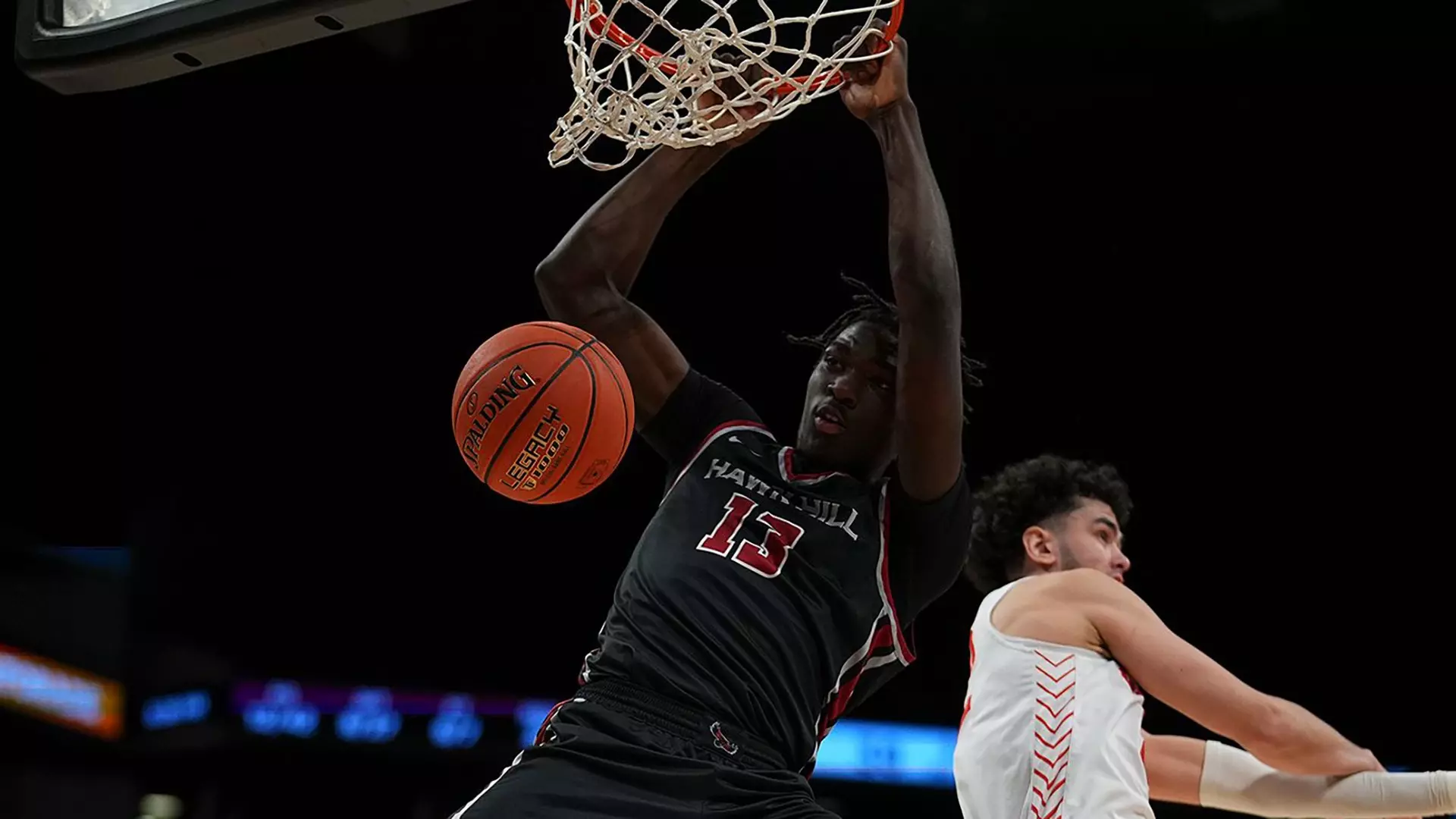
With the perimeter in good hands, Lange also has a couple of very impressive pieces up front. Like Simpson, junior forward Rasheer Fleming hails from New Jersey, and he started looking an awful lot like a potential star last year. Fleming stands 6’9″ and has the quick, potent hops to easily play above the rim, and so he does – loudly. As Fleming polishes his skills, the profile of a legitimate NBA Draft prospect is coming into focus. A live-wire defender who can cover a host of different frontcourt players, Fleming racked up 54 blocks last year and has proven to be a difficult matchup. As he’s gotten stronger, Fleming has been able to hold his own against bigger veterans, and it also shows on the boards.
When he’s got the defense worried about the long ball, Fleming can slash past closeout defenders and flat-out wreck the rim
As a sophomore, Fleming finished second in the conference in total rebounds and led the A10 in offensive boards with 88. He converted those extra chances into 26 putback tries, which Fleming converted at an 83.3% rate near the rim, per Hoop-Math. As much value as Fleming brings to the Hawks by doing all of that, it’s the budding range on his outside jumper which gives him extra-special promise. He sank 34 triples at a 32.4% rate last winter, and when he’s got the defense worried about the long ball, Fleming can slash past closeout defenders and flat-out wreck the rim. 36 of the 97 baskets he made near the hoop last year were dunks, and he can sky for two and change the Hawks’ momentum in an instant. He has the talent to be an all-conference guy, and as he puts in more work, Fleming is starting to look like a very special player.
To help Fleming out and anchor the post, Lange added Justice Ajogbor from Harvard this spring. The sturdy 6’10” veteran departs his place in the Ancient Eight ranked second all-time in block percentage, and he swatted almost three attempts per contest last year. Though his campaign was cut down to 20 games by a hand injury which required surgery, Ajogbor led the Ivy League in blocked shots for the season. He’s an irresistible force around the basket, and save injury, only foul trouble has been able to slow Ajogbor’s roll.
The power he shows in contesting shots also shows up on the boards, where Ajogbor establishes good position and doesn’t get moved around much against his will. He is limited offensively, and Ajogbor offers considerably less playmaking skill out of the post than Christ Essandoko, who departed for Providence following a big sophomore year. Almost exactly half of the 53 shots Ajogbor made near the rack last season were dunks, per Bart Torvik, and he fell off to post a career-low 47.8% rate at the free throw line last winter. If he can avoid whistles while finishing lobs and good looks – and there will be plenty – from the Hawks’ exciting guards, Ajogbor’s other talents should shine. There won’t be many teams in the country with a more intimidating pair of rim protectors than the Hawks, and having Ajogbor and Fleming near the hoop should allow Lange’s guards to be their aggressive best.
| Five Stats Which Tell The Tale (with national ranks) |
| 10.0 – Made 3FG’s Per Game (10th) |
| 8.3 – Opponent Made 3FG’s Per Game (299th) |
| 42.0% – Opponent FG Percentage (58th) |
| 0.287 – FT Attempts Per FG Attempt (291st) |
| 0.553 – Assists Per FG Made (69th) |
Based upon that starting five, St. Joe’s will be able to hang with just about anyone this season. For this to be a special year, though, the top guys are going to need help from a cohort of youngsters whose skills might cover a lot of their needs. What remains to be proven is whether they are ready, as individuals or a group, to make the kinds of contributions that earn a bid to the Big Dance.
Lange will be looking for the biggest contributions from two guys who were freshmen on last year’s team. Anthony Finkley and Shawn Simmons II have the contrasting size and skills to add great depth behind Ajogbor and Fleming. Though he checks in at a burly 6’6″, 240, Finkley is still most at home launching jumpers from the outside. Which is understandable, because Finkley can shoot the rock.
The more he focuses his efforts inside, the better a scorer he should become, because Finkey’s size and developing handle in the halfcourt present a host of potential mismatch options. He can post up smaller guys, and Finkley can give the Hawks a different look playing alongside either Fleming or Ajogbor. On a per-game basis, Simmons didn’t play as often as Finkley, but he did show some projectable potential all his own. A bouncy wing with quick feet, Simmons has the ability to contest larger guys defensively or force his way past them for a shot attempt. He isn’t the shooter that Finkley is so far, but as as Simmons refines his abilities, he should give Lange an abrasive defender on the wing who can do some damage in the paint, as well.
After taking a redshirt last year, Dasear Haskins leads a varied group of freshmen looking for a chance to step up when the older guys need some help. With Cameron Brown gone and minutes available on the wing, having a 6’8″ youngster with guard skills may be just what the doctor ordered. He played with Fleming at Camden (NJ) High School, and Haskins should be able to play off of his buddy for kickout looks from deep. With his great height, Haskins can elevate over just about anyone on the outside, and he had dangerous range even before the developmental year off. He focused on adding strength to his lithe frame last winter, and Haskins should be prepared to make an impact off the bench this fall. He was the 6th man for a terrific Camden squad during Fleming’s final season there, and that’s a role which Haskins may reprise this year. With power conference size and a fine jumper, he could be a perfect fit for St. Joe’s post-Cameron Brown.
| Five Out-of-Conference Games to Keep an Eye on |
| N Texas Tech – November 21 |
| N Texas/Syracuse – November 22 |
| vs Villanova – November 12 |
| vs Princeton – December 3 |
| N Virginia Tech – December 21 |
Among the true freshmen, Steven Solano arrives with the most prep accolades and a fistful of high major offers, too. A big, powerful, wide-shouldered pivot, Solano was offered by South Carolina, Georgia Tech, Nebraska, and Virginia Tech, but chose the Hawks. He’s physically ready to hang against older players right now, and Solano should provide quality minutes in the post when Ajogbor needs a breather. He’ll need to show that he can get from end to end quickly enough not to impede the tempo of the team’s guards, but Solano’s value as a rebounder, rim protector, and willing dunker will translate quickly. Like Haskins, Kevin Kearney is a lanky forward who can guard a variety of foes and has the lift to cause problems for all of them. He’s not quite as refined an outside shooter as his counterpart, but Kearney has athleticism and a nose for the ball that should be useful right away.
There are a pair of bookend guards coming aboard as rookies, too. With excellent quickness and turn-on-a-dime agility, Khaafiq Myers is exciting at the point. He was banged up a few different times during his high school career, but Myers has never let his diminutive frame stop him from attacking the lane. He can hang, spin, fall away and float tough shots up inside the arc, and if he finds consistency with the three-ball, Myers should be a problem to keep up with all over the halfcourt. At 6’5″, Mekai Johnson has a great deal of potential as a 3-and-D guard. He’s long and quick, and Johnson will launch from quite deep. The son of former NBA player and longtime college coach Kenny Johnson, Mekai Johnson is a savvy defender. He grew up around the game and understands how to put himself in good spots, and Johnson knows the risks which are worth taking to make big plays defensively.
There is no doubt that the Hawks have a starting lineup which can compete with teams which will play in the NCAA Tournament. They’ve got a talented batch of first or second-year players, too, and this is a program which looks like it is ready to take the next step. In order to prepare themselves for March, St. Joe’s has stitched together an ambitious non-conference schedule studded with quality power conference matchups, and the Hawks will face the usual stern tests from their Big 5 brethren.
A lack of talent will not be the reason St. Joe’s fails to reach this year’s NCAA Tournament. The Hawks have tremendous potential, but will need to get the best, most adaptable, most innovative, and most consistent coaching performance of Lange’s career. If this whole show comes together under thoughtful, steady leadership, this team could find itself playing on the second weekend of the NCAA Tournament. They say that the Hawk will never die, and this year, St. Joe’s has a chance to thrive instead. The hope is that this group lives up to a world of promise and grinds their way towards a whole new level of success.
One response to “#82: Saint Joseph’s Hawks”
-
[…] Texas Tech/St. Joe’s – November […]
Leave a Reply