
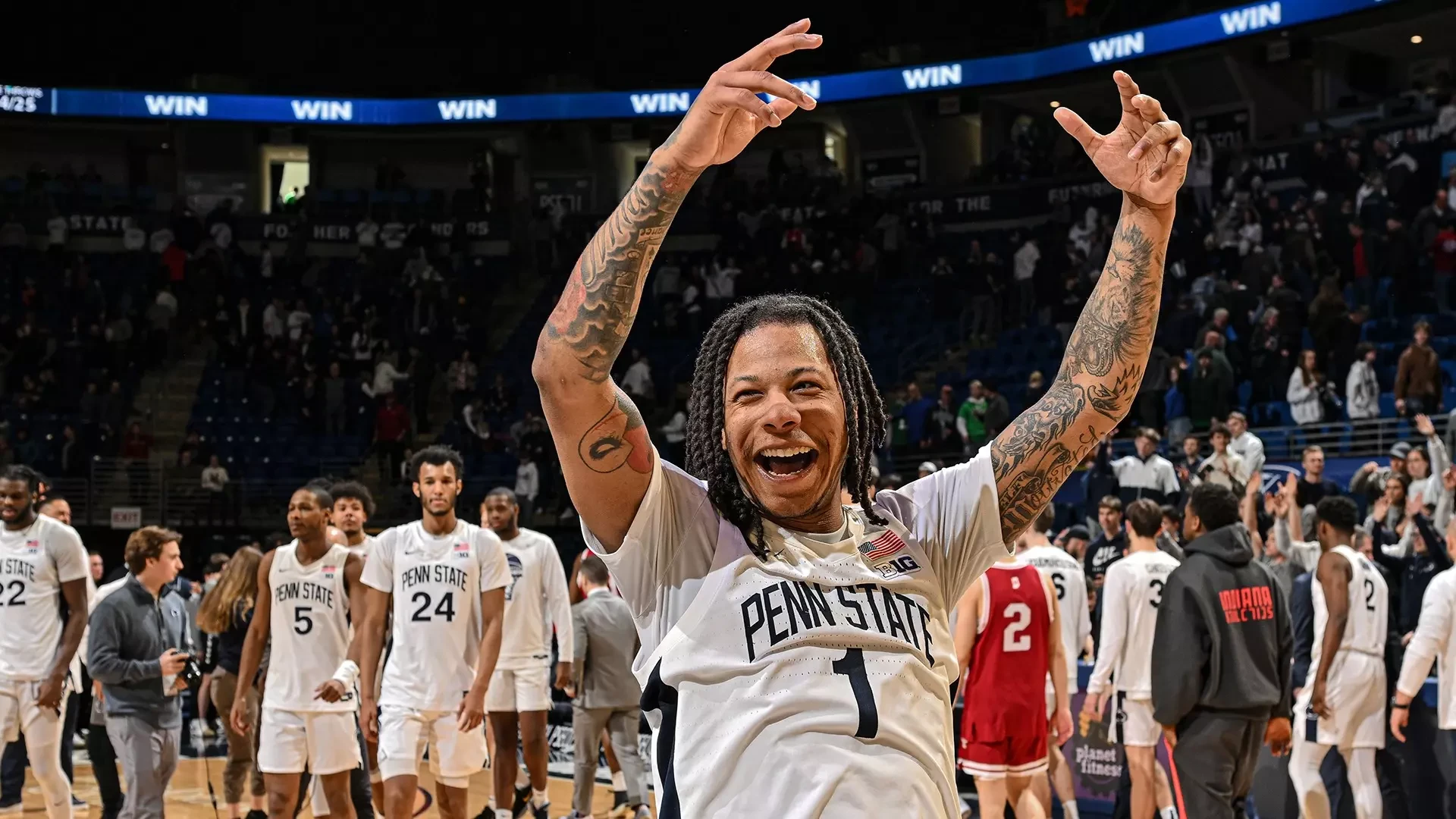
Last Year: 16-17; 9-11, Ninth in the Big Ten, No Postseason
Head Coach: Mike Rhoades (Second Year; 16-17 at Penn State, with no NCAA Tournament appearances)
Projected Starting Lineup
PG Ace Baldwin – 6’1″, 190 5th-year Senior
G D’Marco Dunn – 6’5″, 195 Senior
W Nick Kern, Jr – 6’6″, 200 Senior
F Zach Hicks – 6’8″, 200 Senior
C Yanic Niederhauser – 7’0″, 255 Junior
Experienced Reserves
G Freddie Dillione V – 6’5″, 195 Sophomore
G Eli Rice – 6’8″, 215 Sophomore
F Puff Johnson – 6’8″, 205 5th-year Senior
C Kachi Nzeh – 6’8″, 230 Sophomore
Freshmen
G Jahvin Carter – 6’3″, 180
G Dominick Stewart – 6’5″, 190
F Hudson Ward – 6’7″, 215
F/C Miles Goodman – 6’11”, 220

Growing pains are a thing. Penn State is hoping to have grown through the pain of a drop from 23 wins and a victory in the NCAA Tournament to back down below .500.
The Nittany Lions’ first year under Mike Rhoades was a bit of an adventure. After Micah Shrewsbury, his predecessor, jumped to Notre Dame and Penn State’s roster came apart at the seams, Rhoades got to experiment with putting together a completely new team. The results weren’t exactly a rousing success, and Rhoades dismissed the best player he had inherited – Kanye Clary, who’s now at Mississippi State – before the season was even over. There were ups along with the downs, but Rhoades would go on to describe a blown 23-point lead as “rock bottom” of the team’s season following a loss to Minnesota at the beginning of March.
Still, the Nittany Lions accomplished enough that most of the team which finished last year has come back. For his second act, Rhoades will have continuity on display. The hope and expectation is that two offseasons together and the growth that came with a full campaign relying upon one another has made Penn State a stronger team overall. There is reason to believe in that hope. Though it didn’t translate into a winning season, Penn State played some of its best basketball in the months of February and March. They even took down an Illinois team that would go on to win the Big Ten tournament and make a run to the Elite Eight. With the confidence they gained, the Nittany Lions are going to run it back. Oh, and they have a star to lead them.

The best thing Rhoades did after leaving VCU for Happy Valley was to bring Ace Baldwin along for a new adventure. Two years ago, Baldwin was the Atlantic 10’s Player of the Year. In his Big Ten debut, Baldwin led Penn State in scoring, ranked third in the B1G in assists, finished fifth nationally in steals, and took home his new league’s Defensive Player of the Year award. With a fifth year of eligibility to truly establish himself as a legend, Baldwin’s return gives the Nittany Lions one of America’s best point guards to build around.
A tough guy’s tough guy, Baldwin averaged the third-most minutes in the Big Ten last year and took on a who’s who of difficult defensive assignments. That he can guard other top players so relentlessly while still functioning as his team’s most important player on offense makes Baldwin one of the most valuable players anywhere in the country. He often sparks transition opportunities off of steals which keep his side in the game, and Baldwin’s ability to manufacture open looks for his teammates is elite. He doesn’t have prototype size, but Baldwin is very strong and compact, capable of exploding through tight spaces off the bounce or fighting through contact for a bucket when nothing else is working.
As extraordinary as Baldwin is, he really needs some consistent help. As a pick-and-roll maestro, there are few better than Baldwin, and Rhoades generally puts him in position to succeed. Last winter, Baldwin operated as a pick-and-roll ballhandler 8.1 times per game, one of the most frequent numbers in the country. Even so, Baldwin produced just .787 points per game in those situations, per Synergy Sports. If he hits a teammate with a perfect pass that becomes a brick, Baldwin isn’t exactly to blame. For example, Penn State returnees Puff Johnson and Nick Kern, Jr, tried 121 combined shots last year as play finishers off of feeds from Baldwin and Clary…but Johnson and Kern posted identical, middling 46.3% effective field goal rates on those chances, per Synergy. If the Nittany Lions’ other guys can raise their game this year, they’ve got a warhorse in Baldwin who will lead them to victory.

This will be the fourth year that Kern and Baldwin have played together. While he’s not the most natural shooter of all time, Kern took a noticeable stride forward last season, and does a bunch of different things well. A long, lanky wing with tremendous spring in his step, Kern is another strong defender, and his size allows him to check different players than his once and future teammate. His hops also help, and Kern is a perimeter shot blocker to beware of. Between them, Baldwin and Kern had a lot to do with Penn State having one of the country’s best three-point defenses. Though he doesn’t have a vast array of moves or a dominant skill as a scorer, Kern is assertive when he’s got a path to the hoop. He’s clearly worked to improve his game, and as a senior Kern will look to show it all off.
Two of the other Nittany Lions also used to play together elsewhere, adding yet more layers to the familiarity and cohesion of this team. Johnson and sharpshooting guard D’Marco Dunn were once Tar Heels, but together said ‘goodbye Carolina’ last year. On the other side of that Blue Ridge sky, they arrived in Happy Valley and each made important contributions last season. Baldwin did his best to get them involved, and this year should be the best for both veterans.
Once a high-end 4-star recruit, Johnson’s development has been slow but steady. As Rhoades and Baldwin tried to coax his talents to fruition last winter, Puff saw the highest percentage of looks as a play-finisher (58%) of any Big Ten player, per Synergy. While he produced rather pedestrian results as a spot-up shooter, Johnson was much more effective cashing in on cuts to the rim. A slender forward who can sky and make rather graceful plays on occasion, Johnson is not a classic post-up player. Still, he’s become effective near the rim, and even without great rates, Johnson was more reliable as a jump shooter than ever before last winter. If he can take the next step as an aggressor offensively, Johnson could evolve into the featured offensive player that he’s hinted at becoming. His minutes and usage fluctuated last year, but Johnson scored at least 13 points in three of PSU’s final four contests. If he can be that guy all year this time, Penn State will be considerably closer to true contention.
| Five Stats Which Tell The Tale (with national ranks) |
| 8.3 – Steals Per Game (29th) |
| 70.5% – Defensive Rebounding Rate (292nd) |
| 74.7% – Team Free Throw Percentage (75th) |
| 33.4% – Team 3FG Percentage (204th) |
| 30.3% – Opponent 3FG Percentage (15th) |
It was hoped that Dunn might pop following Clary’s departure, but that hasn’t happened yet. A ballyhooed recruit when he signed with UNC, Dunn has always been described as a scorer. Rhoades is hopping that this year, he can be exactly that. His first season in Happy Valley was Dunn’s finest statistically, and importantly he shot a career-high 36.6% from downtown. The Nittany Lions need Dunn to hit outside shots, and to do so efficiently. Exacerbating the team’s rebounding deficiency last season was that Penn State clanged the majority of their deep jumpers. The Nittany Lions took more than 23 shots per game from downtown last winter, but made just 33.4% of them. If Dunn can help lead a charge towards shoring that up, his senior year should be even better.
Forward Zach Hicks launched more triples than anyone on the team last year. He led the Nittany Lions (and ranked tenth in the B1G) with 67 makes from distance, but Hicks made them at a career-low 34.2% rate. It’s not as though he should stop shooting, though, because shooting is what Hicks does. He’s splashed 208 deep balls through three seasons, and Hicks is valuable in spacing things out for the rest of his buddies. Rhoades simply needs Hicks to go back to being a 37.4% shooter like he was a couple of years ago, or even improve upon that figure. It would also be helpful if Hicks can do more on the boards. Like Johnson, he doesn’t do a great deal on the offensive glass for a 6’8″ guy, and given how poorly the Nittany Lions were at chasing down rebounds last year, the players who have enough size to genuinely make a difference must do so.
Rhoades will be adding two new guards to the rotation this fall who debuted for other power conference teams last year. There weren’t many minutes available in Tennessee’s loaded backcourt last season, but Freddie Dillione V did what he could when he got on the floor. After first redshirting and then playing a deep reserve role, he hit the transfer portal this spring and may wind up getting a whole bunch of minutes this season in Happy Valley. At 6’5″, Dillione brings even more 4-star talent to PSU’s lineup, and he can do a variety of things.

Coming up as a prep star, Dillione showed real aptitude for driving towards the lane and creating looks for himself and his teammates as the defense collapsed. His playmaking should help Baldwin, especially if Dillione’s trips to the paint allow the older guard to float outside for more kick-out looks. His size and strength that should allow Dillione to pair effectively with Kern in bothering bigger guards, too. It’s been almost all practice and polish the past couple of years for Dillione, but now he’s going to have a chance to kick the training wheels off and make things happen for a team that could use more dynamism.
If Dillione and Kern are big guards, then inter-conference transfer Eli Rice is positively massive. He was lost for the rest of Nebraska’s season with an ankle injury in January, but Rice showed a few things early in his rookie year. He can shoot the ball out to the three-point arc; Rice made 10 triples at a 37.0% rate in the 17 games he played at Nebraska. He has a decent handle and can find room for looks, but Rice is largely a spot-up shooter right now. He’s shown potential in posting up smaller perimeter players, though, and Rice’s vision allows him to make slick passes, too. His frame offers tantalizing defensive possibilities, too, and Rice could become another impact player who largely ranges outside of the post at 6’8″. Given the Havoc Rhoades saw at VCU, his long and longer lineup could become a problem for opponents.
To shore up the boards, Rhoades is bringing in a couple of transfers in the paint, as well. Yanic Konan Niederhauser will be the biggest Nittany Lion at 7’0″, 255, and thus will be counted on to clean the glass. After making strides over his first two years at Northern Illinois, Niederhauser will get a serious challenge from the veteran bigs in his new league. Though about a third of the baskets he made last season were dunks, Niederhauser can step out to shoot from the perimeter. The one thing that Niederhauser has proven beyond doubt is that he can protect the rim. The Swiss youngster led the Mid-American Conference in blocks per game last season, and Niederhauser moves well enough to influence many more shots than he rejects. If he can anchor the Nittany Lions’ defense without getting into too much foul trouble and finish good looks inside, Niederhauser’s growth should continue.
| Five Out-of-Conference Games to Keep an Eye on |
| N Clemson/San Francisco – November 26 |
| N Virginia Tech – November 15 |
| vs Purdue-Fort Wayne – November 20 |
| N Fordham – November 25 |
| N Drexel – December 21 |
Kachi Nzeh is another of the 6’8″ guys Rhoades now has, and he plays a traditional post game. A physical and energetic rebounder who held his own last year in a small role for Xavier, Nzeh will battle Niederhauser for the prime minutes in the middle. Whoever plays the most will likely be the guy who does the most to change Penn State’s rebounding woes.
Also arriving to help on the glass is Miles Goodman, the crown jewel of Penn State’s freshman class. A 6’11” center out of the Seattle area, Goodman is a Top 100 prospect. An energetic, mobile big man, Goodman can play above the rim and guard all over the frontcourt. Rhoades sees him as a very switchable big who can do good work deep on the post as well, and Goodman has the foundation of a good scoring game already. Goodman was seen at practices with one arm in a sling in July, and there hasn’t been a great deal of information on when he will be 100%, but Rhoades is looking forward to deploying his star signee. Goodman’s fellow freshman, Hudson Ward, is a forward out of western Canada who has three-point range on his jumper and a good feel offensively. There are two new freshman guards coming in as well, as Rhoades has added Jahvin Carter and Dominick Stewart as rookies as well.
This year, continuity and improvement from within have been chosen as the ways forward. There haven’t been flashy additions to the roster, but Rhoades knows his guys and their chemistry, and the hope in Happy Valley is that the solid foundation of a winner has been built.
For five of the six years that Rhoades was in charge at VCU, the Rams held opponents to 65.2 points per game or fewer. Four times they were among the nation’s top 50 defenses by field goal percentage. The big negative outlier for both statistics was his first season running the Rams. Can he repeat that trend of getting things figured out? The Nittany Lions haven’t loaded up quite as packed a non-conference schedule as some of their Big Ten foes, and during the early part of the season, they will try to get rolling as one. It won’t be easy to climb the ranks of a bigger, tougher league, but Penn State has rallied around guys who know one another and want to play together. That counts for a lot these days, and the Nittany Lions are ready to show results.
One response to “#94: Penn State Nittany Lions”
-
[…] in Happy Valley may have ended a bit prematurely, but Kanye Clary’s sophomore performance at Penn State was enough to show what an exciting player he can be. After being dismissed from the Nittany Lions […]
Leave a Reply