
Last Year: 25-9; 14-4, Second in the American Athletic Conference, lost in the First Round of the NCAA Tournament
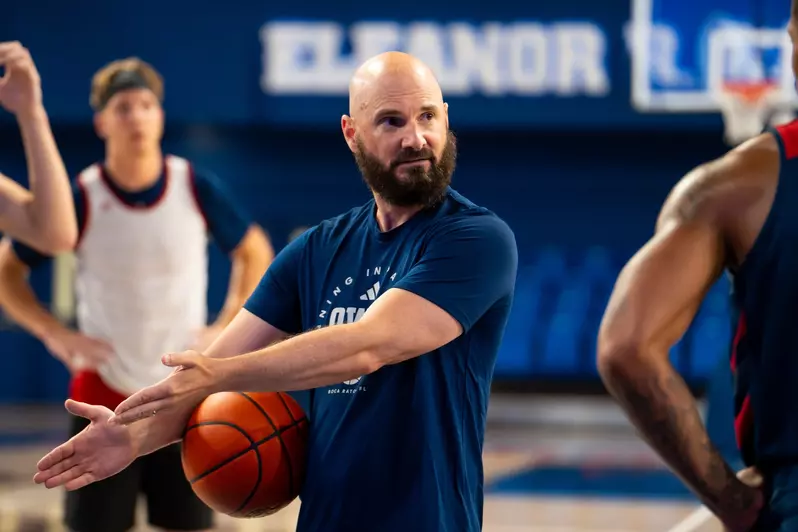
Head Coach: John Jakus (First Year; previously was the associate head coach at Baylor)
Projected Starting Lineup
PG Leland Walker – 6’1″, 185 Junior
G Kyky Tandy – 6’2″, 205 5th-year Senior
G Ken Evans, Jr – 6’5″, 205 5th-year Senior
F Kaleb Glenn – 6’7″, 210 Sophomore
F/C Baba Miller – 6’11”, 215 Junior
Experienced Reserves
G Niccolò Moretti – 6’1″, 175 Sophomore
F Tre Carroll – 6’7″, 223 Junior
Freshmen/International Sophomores
G Devin Vanterpool – 6’4″, 190 (Redshirt)
G Jakel Powell – 6’5″, 190 (Redshirt)
G Max Langenfeld – 6’6″, 195 Sophomore
W Amar Amkou – 6’7″, 210
C Mantas Kočanas – 6’11”, 235
C Matas Vokietaitis – 7’0″, 245 Sophomore

The only things that last long are the trophies and the memories. The past couple of seasons were legendary for Florida Atlantic. Over the final two years of Dusty May’s tenure, the Owls went 60-13 with back-to-back NCAA Tournament appearances and a Final Four.
One of the only true constants in college sports is change. Like the tides which wash the shores in beautiful Boca Raton, FL, the 2024 offseason has worn and reshaped FAU’s whole team. Last fall, despite switching conferences to join the American Athletic Conference, Florida Atlantic’s roster was a marvel of continuity. Despite the madness of the transfer portal, May’s roster from that Final Four returned largely intact.
That will not be the case this year. May has gone to Michigan, all of the stars have left, and John Jakus has been brought in from Baylor to build the Owls back up. Only one player who saw any action for Florida Atlantic last year remains. In an attempt to put a contender together in the present and also start cultivating a young foundation, Jakus and his staff have scoured both the portal and, apparently, a variety of maps.
The results of their efforts, on paper, look pretty solid. With experience coaching overseas and then working his way up to being Scott Drew’s top lieutenant with the Bears for the past couple of years, Jakus has an attractive blend of attributes for the current college game. Can he translate that pedigree into winning with a bunch of guys who are new to one another?
To be the featured scorer for his new-look Owls, Jakus snapped up Kyky Tandy, who’s coming off of a career season. A former 4-star recruit who spent his first four years at Xavier, Tandy stepped confidently in as the top dog for Jacksonville State last year. After dealing with foot injuries with the Musketeers and missing all but five games of the 2021-22 season, Tandy got healthy and lived his best life last winter. He led Conference USA in scoring average and free throw percentage, which is made more impressive when you notice that no other Gamecock averaged more than 8.7 points per contest.
Tandy got healthy and lived his best life last winter. He led Conference USA in scoring average and free throw percentage, which is made more impressive when you notice that no other Gamecock averaged more than 8.7 points per contest.
Thrust out ahead of his teammates as the guy to get things done because no one else could, Tandy looked the part of a star. He’s always been a strong shooter who struggled to convert at a high rate near the rim, and that did not change a great deal for Tandy at JSU. He became adept at driving his way into good looks inside the arc, though, and Tandy used a refined pull-up game to shoot a career-high 45.0% from mid-range, per Bart Torvik. A 36.5% career shooter from downtown, Tandy made 38.9% of his deep balls last year. If he can be that same knockdown shooter on the catch while continuing to make defenders pay for playing him to shoot, Tandy can be the scorer FAU relies on.
An interstate transfer from Tallahassee, Baba Miller is a big, long, improving player who was one of the most highly sought-after prospects of his freshman class just a couple of years ago. He didn’t become the instant rockstar some had foreseen Miller becoming at Florida State, but he did show that the skills which caught everyone’s attention remain intact. Standing 6’11” with perimeter skills and tremendous defensive potential, Miller has always been viewed as a potentially devastating force.
At FAU, he’s going to get the opportunity to show out as a featured option. A great athlete for his size, Miller’s area of effect is vast. He’s learning to anticipate the way opponents try to work around him, and Miller uses his length to swat shots and influence passes all over the halfcourt. He sank 24 triples a year ago, but Miller’s jumper remains an unfinished skill. He also must be better at the foul line than his 52.8% career mark, because Miller is going to be taking plenty of trips there this winter. Since he’s able to worry defenders with his range, Miller can buy himself room to operate inside, and he’s worked to add some post moves this summer. A big part of Miller growing as a player will involve him figuring out how to do all that he does without picking up unnecessary fouls at both ends of the floor. He was dismissed from four games last year and picked up four whistles in ten others, but if Miller can remain on the floor, he could explode. Everything he did at FSU was on about a 17% usage rate. That number should be closer to 25% as an Owl.

Two years ago, Leland Walker was a standout 6th man for Eastern Kentucky as they won 23 games. Last year, Walker became the maestro of EKU’s ‘most exciting 40 minutes in sports’ and never looked back. He improved throughout his sophomore campaign, and Walker finished by averaging 16.9 points on 43.9% shooting from the land of trey over the Colonels’ final 12 games as they clinched the Atlantic Sun regular season title. Now, the first-team All-ASUN selection will take over the point for FAU, and Walker gives Jakus the luxury to play as fast as he wants to. A
A tough, compact, powerful driver who’s very quick in the open floor, Walker also absorbs a great deal of defensive attention coming out of ball screens in the halfcourt. He can get a bit wild while trying to make big plays, but Walker brings a level of excitement to just about any situation. A high-volume mid-range weapon, Walker makes all sorts of floaters and runners once he’s got his man backpedaling, and his pull-up jumper is money in the bank. His downhill style should prove a nice fit with Tandy, and Walker’s own improvements as an outside shooter have set him on a course to becoming a fairly complete lead guard.
The scoring and playmaking talents of Ken Evans, Jr, look like a great fit between Walker and Tandy, and he brings the most size of the three. A sixth-year senior who first redshirted and then spent four seasons steadily improving at Jackson State, Evans burst out as the Southwest Athletic Conference’s Player of the Year last winter. His production over the years hasn’t always been the most efficient, but Evans has made himself into an impact player, and last year he became a quality outside shooter. In addition to leading the SWAC in scoring and minutes played, Evans was one of the league’s top marksmen last season with 62 triples and a 39.2% rate from distance.
As he stepped forward as the Tigers’ star, Evans showed more to his drive game as well, and last year he nearly doubled his career rate of free throw attempts. He’s another of FAU’s new guards who is very comfortable attacking defenses as a pick-and-roll facilitator, and Evans was one of Jackson State’s primary ballhandlers each of the past three years. With plenty of experience and overlapping talent, the guard trio which Jakus has brought together should drive the Owls.

The frontcourt around Miller is quite short on experience, but Jakus has brought in real talent to be molded. The guy who’s likely to be FAU’s fifth starter is Kaleb Glenn, and he was a 4-star recruit just last fall. As a freshman at Louisville, Glenn proved to be a strong rebounder and defender who can hold his own against bigger players near the basket. As an undersized power forward next to Miller, Glenn could be a great fit. He’s a sturdy young player who knows how to use his hips to get good positioning, and Glenn plays with helpful aggression. He’s developing a jump shot, but for now Glenn is likely to do most of his damage within about 12 feet of the rim. When he gets the ball in the lane, Glenn goes straight to the rim, and he’s a powerful dunker who should function as a great play finisher after setting screens for his new friends. His energy on the glass should be a real help to Miller, and Glenn has the awareness and skill to start the offense after securing a rebound. He’s not a finished product yet, but the skills Glenn has already developed will translate seamlessly to the AAC.
The only real holdover from the Owls’ Final Four squad, Tre Carroll will have a greater opportunity to play a big role this year than ever before. A native of Punta Gorda, FL, Carroll was a prep star whose commitment to FAU excited local fans, and he’s been super-productive with the minutes he’s gotten thus far. Through two seasons, Carroll has averaged 21.9 points per 40 minutes on 54.5% shooting from the floor, but he’s played just 289 total minutes. Now that Florida Atlantic is truly in need of secondary scoring, Carroll must show that he can put up numbers against top competition for closer to 20 minutes per game. He can shoot the ball out to the three point arc, and Carroll has learned nuance near the basket by going up against Vladislav Goldin and Giancarlo Rosado – two guys who will start for other teams this year. If he can prove his talents in a much larger role this year, Carroll could be a key to this team reaching its potential.
It would be great to have an experienced college pivot around to support Miller, but FAU should be able to get by quite well with a seven-footer who has considerable international experience. Lithuanian center Matas Vokietaitis played with the top pro team – Zalgeris – in his home country the past two seasons, and turned in an impressive campaign last year. In addition to showing out against other top young talent in FIBA competition, Vokietaitis has traveled with Zalgeris to face other rosters full of older, proven players – he even went toe to toe against Creighton and their star pivot Ryan Kalkbrenner during an exhibition matchup last year in the Bahamas.
| Five Stats Which Tell The Tale (with national ranks) |
| 82.0 – Points Per Game (14th) |
| 72.6% – Defensive Rebounding Percentage (200th) |
| 0.389 – Opponent Assists Per FG Made (3rd) |
| 3.1 – Blocked Shots Per Game (212th) |
| 47.8% – Team FG Percentage (23rd) |
The NCAA considers him a sophomore in terms of eligibility given his participation with pro teams, and Jakus is hoping that Vokietaitis is ready to hit the ground running in Boca. A good positional rebounder and defender, Vokietaitis takes advantage of his great length and growing strength to make more than just the usual plays. He’s mobile and quite coordinated for his size and age, and Vokietaitis holds the ball high while operating inside and has flashed some clean footwork. If he can handle 15+ solid minutes per game and play some of that time alongside Miller, Vokietaitis will be very valuable to a young, thin frontcourt.
The other two guys back from last year’s team, Jakel Powell and Devin Vanterpool, both took a developmental redshirt season. Now that they’re ready to hit the floor for a new coaching staff, each will get a chance to show that they are ready to make a meaningful impact. Both can shoot the ball, with Vanterpool as the more consistent and fluid marksman at this stage. He’s also got natural playmaking ability, and often played on the ball at prep powerhouse Christ the King in Queens, NY. With good quickness overall and some burst off of his first step, Vanterpool has the makings of a fairly well-rounded set of skills offensively. While he’s a bit less refined right now, Powell is also bigger and longer than his redshirt classmate, and took a bit longer to garner genuine Division I recruiting interest. He can play above the rim and hit deep jumpers, and Powell may operate as something of a 3-and-D guard until the rest of his game comes into focus.
Niccolò Moretti arrives from Illinois after two years competing in practice against a stacked Big Ten roster, and Jakus is hoping that those experiences will pay off. He redshirted two years ago and played sporadically off the bench last year, but Moretti has shown quality passing skills and a solid pull-up jumper. With Walker and the other veteran guards capable of facilitating the majority of FAU’s offense, Moretti should slot in as the backup point guard. His handle is good and Moretti looks to keep things calm in the halfcourt. He can get downhill and slither through the trees while still keeping his head up and looking for opportunities to feed a teammate, too. As he continues to add consistency to his deep range, Moretti should help by giving the Owls another distributor who can space the floor or attack the lane.
| Five Out-of-Conferences Games to Keep an Eye on |
| @ Michigan State – December 21 |
| N Miami (FL)/Drake – November 22 |
| N Shriner’s Charleston Classic 3rd game – November 24 |
| @ College of Charleston – November 15 |
| N Oklahoma State – November 21 |
Three more newcomers will vie for backup minutes after arriving from overseas. Like Vokietaitis, German wing Max Langenfeld is going to be a sophomore for his America collegiate debut. With very good size and a volume approach from the land of trey, Langenfeld could be a great microwave floor-spacer off the bench. He passes the ball well also, and Langenfeld put up big numbers playing against professionals a year ago. An even bigger wing, 6’7″ Amar Diop hails from Senegal. He boasts good quickness for his size and a reported 7’3″ wingspan, and Diop can shoot it effectively out to the land of trey. He showed off real potential as a defender playing at the NBA Academy Africa last year, and Diop’s growth should accelerate with solid veteran pieces around him. Joining his countryman Vokietaitis, Mantas Kočanas is a younger Lithuanian post who brings more great size to the Owls. He isn’t as far along in terms of being ready to handle big minutes against a bunch of 23 and 24-year-olds just yet, but Jakus and his staff see a great deal of offensive potential in Kočanas to be brought forth.
With all of the success FAU has achieved lately, scheduling has become an adventure. The Owls managed to pull some big-time opponents last year, but largely by going on the road and playing at neutral sites. They’ll be doing so again this winter, and there are some stern tests coming up for this newly-constructed crew.
There’s just no way to compare the cohesion and experience of the past couple of Owl squads to this one. For all of the changes, though, Jakus and Co have assembled a team that can compete right now while developing a legitimately talented batch of young players. They did good work with the blank canvas they were given, and have built some versatility – and real defensive variety – into their first group. If Tandy, Evans, and Walker can take care of most of the scoring and draw defenses away from the lane, Miller, Vokietaitis, and Glenn should be able to take advantage of the space created and the solid setups which will be coming their way.
Jakus has, for years, coached a team known for its defense and resolve in late winter, and he’s going to expect those same things from this crew of his own making. It may take a bit to start cooking with gas like they had been, but Florida Atlantic is still going to be good this year. They’ve learned how to win big in Boca, and the right people are in place to carry the Owls towards an exciting new horizon.
2 responses to “#96: Florida Atlantic Owls”
-
[…] have found a path back to the promised land by joining the Gators. Over the course of four years at Florida Atlantic, Martin played a starring role in helping the Owls rise to national prominence. His combined […]
-
[…] of the Hogs’ new players is as accomplished and more of a flat-out dude than Florida Atlantic transfer Johnell Davis. He nearly stayed in the NBA Draft after trying out for scouts this spring, […]
Leave a Reply