
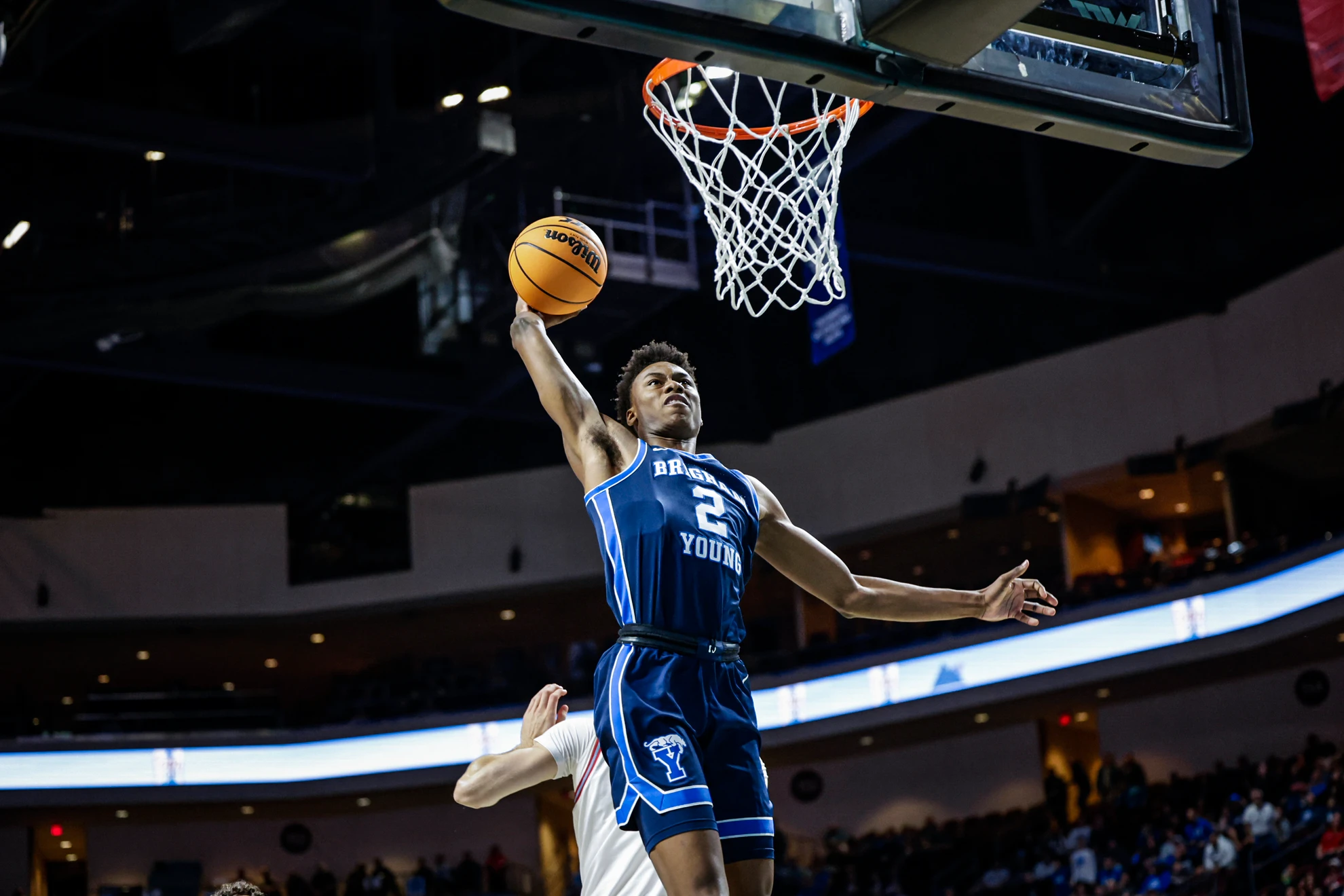
23-10; 10-8, Fifth in the Big 12 Conference
Back in September a lot of folks expected that, having finally earned a spot in the big-time Big 12 Conference, BYU was about to catch just a bit more smoke than they were really prepared to handle. Turns out, the Cougars were ready to absorb quite a few blows, stay standing, and land some knockout blasts of their own.
The program from Provo has proven they belong in America’s top league, and they have ended a three-year absence from the NCAA Tournament. It’s not because head coach Mark Pope has uncovered a new Jimmer Fredette to perform heroic feats, either. BYU boasts a lineup with as much depth and versatility as nearly any you’ll find; for example, the Cougars’ leading scorer has only started six games all year. Their adaptability, cohesion, and comparative ability to stay fresh has been a problem for even the best teams on the Cougars’ schedule – and the absolute bombardments BYU has unleashed from three-point territory haven’t hurt their cause, either.
Pope’s rotation is loaded with shooters on the perimeter, and with such an advantage, why not lean into it? The coach has seen fit to spread his offense out more than ever before, eschewing the ball screen-focused attack that he’s utilized before in favor of a wide-open approach. With ballhandlers and playmakers everywhere and the middle left largely open, BYU’s shooters have also become aggressive cutters, and the threat from downtown has created seemingly innumerable easy layup opportunities near the basket. The Cougars shoot 58.3% as a team on 2FG attempts, the eighth-best rate in the country; and the Cougars rank third in America by handing out nearly 19 assists per contest. It’s a stylistic shift that clearly fits the personnel, and one for which only a handful of opponents have found solutions.
The Cougars’ ensemble cast is primarily led by Spencer Johnson, Dallin Hall, and Jaxson Robinson. After bouncing between two SEC programs but barely seeing the floor, Robinson has found a home in Provo. He’s the aforementioned top reserve/top scorer, and is also the team’s most dangerous three-level threat. A smooth 6’7″ wing who has canned the most deep heaves of any Cougar, Robinson has grown much more confident in himself this year and shown an increased assertiveness when driving the ball. Hall and Johnson – the team’s primary ballhandlers – have smoothly adapted to the offensive tweaks. Sixth-year veteran Johnson began to assume more playmaking duties last year after coming up as an off-guard. A career 42.2% shooter from the land of trey coming into this season, Johnson’s percentage has oddly plummeted to 30.1% this year, even as his teammates have bombed away. His many contributions outside of knocking down triples have kept Johnson on the floor for the second-most minutes on the team, though, and when playing alongside Hall and center Aly Khalifa, the Cougar offense really hums.
Just a sophomore, Hall has quickly gotten comfortable at the controls of Pope’s attack. He’s started 48 games already for the Cougars, and Hall has posted an excellent 155:55 assist to turnover ratio so far this season. BYU’s guards have good size across the board; at 6’4″ Hall sees the floor well and routinely lobs or spins passes over the top of post defenders to his cutting teammates. Regularly on the receiving end of slick feeds from the outside, scoring guards Trevin Knell and Richie Saunders have settled into a nice orbit as contrasting options. Each can hit from the outside, of course, but Knell is the more natural marksman. After losing all of last year to injury, Knell has returned with a breakout campaign this winter. He finished sixth in the Big 12 in made 3FG’s despite not even averaging 25 minutes played per contest, and Knell’s 61.5% true shooting rate placed fourth. Saunders provides useful athleticism and quickness defensively, toughing out all sorts of difficult assignments against the Big 12’s best perimeter scorers. More of a drive-first scorer, Saunders gets his buckets in a variety of ways. Late in the year, he’s also hit his stride from deep like never before. In the 14 games since the Cougars January 20 tilt against the Red Raiders, Saunders has made 42.9% of his triple tries.
When burly forward Fousseyni Traoré exited BYU’s November win over NC State with a hamstring injury and then missed a handful of games, Provo held its collective breath. While he was out, BYU experimented with some things, and found that they’ve got another big man who seems a tailored fit for Pope’s five-out approach. They call him the ‘Egyptian Magician’, and there are times when Alexandria product Aly Khalifa is truly that with the ball in his hands. Poised and patient with a flair for the exciting, Khalifa is a playmaker who happens to possess a 6’10”, 255-pound frame. He’s proven adept at running BYU’s offense from the top of the key, and though not a master shot blocker, can also mix it up in the paint. Khalifa inverts the Cougars attack with both snappy passes and regular deep jumpers, and has cemented BYU’s advantage in spreading the floor.
Fortunately for Traoré and his backers, he’s returned to health and played some of the best basketball of his career over the final few weeks of this season. Over BYU’s last 12 games, he has been posting 13.4 points on 66.1% true shooting. Traoré brings the noise inside as reliably as any Cougar; and his work in the lane and on the offensive boards is invaluable to a team which doesn’t have as much of an edge as some of their Big 12 rivals. Atiki Ally Atiki is taller and bouncier than Traoré, but has seen his role diminished this year with BYU’s full-hearted shift towards playing a five-out game. A traditional post defender and the team’s most talented rim protector, Atiki may come up clutch should the Cougars need to play matchups in the tournament. Quite a few of the minutes Atiki played last year have instead gone to Noah Waterman, a 6’11” forward with guard skills. After playing a backup role and drawing some ire for bot playing a more physical post game, Waterman has broken out when allowed to play more to his natural gifts.
The Cougars have both attempted and made the second-most deep balls of any team in the country this year; they average almost 35 points per game solely from beyond the arc. Seven different players average at least one made triple per game, and the Cougars have devastated opponents by scoring more than 90 points in a game nine times this year. The point is: if you catch the Cougs on a good shooting day, you’re in for one heck of a battle. The other side of that coin is that BYU can be beaten if an opponent defends the perimeter with particular tenacity or has an abundance of size in the wing – though of course, it’s rarely as simple as all that. BYU is dangerous, and could prove to be one of the more entertaining teams to watch in this year’s Big Dance as they set their sights on the second weekend.
Leave a Reply