
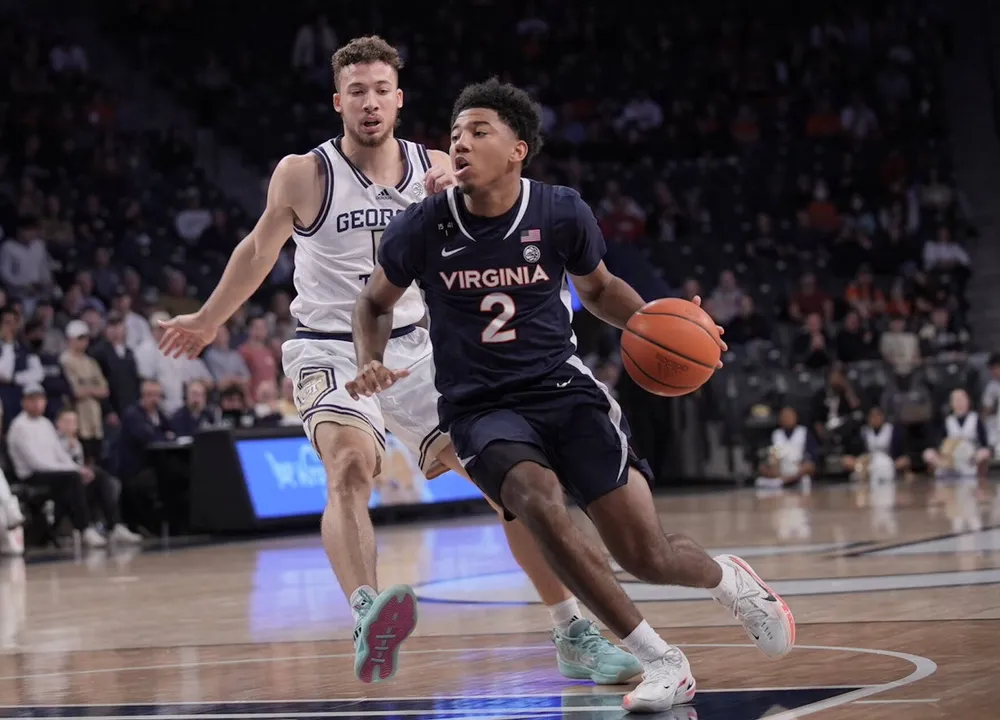
23-10; 13-7, Third in the Atlantic Coast Conference
There is good Virginia, and there is bad Virginia.
Good Virginia is artwork of execution, a display which would no doubt make Dr. James Naismith smile at the crisp, intelligent, high-effort way that the Cavaliers play his game. Bad Virginia would make him cringe.
The Hoos are renowned for the quality of their defense, but often their offense lags behind. This year’s model in particular has been, at times, so putrid offensively and from the foul line, that it has actually managed to undo all of that world-class defensive energy.
Virginia’s defense is spearheaded by Reece Beekman, a two-time ACC Defensive Player of the Year point guard who has shown a career-long penchant for memorable moments. He’s played nearly 30 minutes per game since first stepping onto a collegiate floor, and Beekman has made game-winning baskets and game-clinching stops in each of his four seasons. Beekman is a dribble-drive dynamo who, on a team which doesn’t feature many players who thrive on attacking the rim, creates the vast majority of Virginia’s offense. He converts tough buckets around the lane, and Beekman’s elite quickness and agility serve him well in slipping through the opposing defense. For a Cavs team which doesn’t score many points, Beekman is absolutely invaluable. Not only did he lead Virginia in scoring this season; Beekman also facilitated UVA’s offense and provided buckets to his buddies to the tune of a 44.7% assist rate, the best in the nation.
Outside of Beekman, Virginia’s clear second-best scorer is sharpshooter Isaac McKneely. A sophomore from West Virginia, McKneely has been seen as a key to the Hoos’ offensive future since he first arrived in Charlottesville, and especially down the stretch, he has begun to show why. McKneely ranked seventh in the ACC with 79 made triples (more than 36% of all the 3FG’s made by the team this season), and McKneely converted them at a terrific 44.9% rate. Since the calendar turned to 2024, McKneely has truly assumed the mantle of co-scoring star alongside Beekman, averaging 13.5 points per game. Head coach Tony Bennett has been so impressed with the playmaking and length Andrew Rohde has brought to the wing that the St. Thomas transfer has started 27 games and averaged almost 26 minutes per game. Unfortunately, Rohde’s shooting has been a bit of an issue; he’s at 29.6% from the floor and seven of 16 (43.8%) from the charity stripe – part of a larger issue.
The Cavaliers seem to be allergic to free points. They get to the free throw line less than all but nine teams in the country, which has been a further hindrance to an inconsistent offense. Once there, the Hoos have converted the fourth-fewest freebies in the nation, at the seventh-worst percentage. It’s a huge problem; most recently, Virginia was knocked out of the ACC Tournament by virtue of not making a five-point lead over NC State stand up.
Thankfully for a team which needs any unique advantages they can get, Bennett’s team has a true x-factor in Ryan Dunn. With such outstanding size, athleticism, and high-impact defensive skills, Dunn has enjoyed a major breakout season despite scoring just 8.2 points on average. An excellent rebounder and one of the nation’s quickest, rangiest shot blockers, Dunn does things defensively that others couldn’t even attempt. He’s an electric dunk artist whose length makes it difficult to contain Dunn when he gets the ball close to the rim, and at both ends of the floor, Dunn has shown an extraordinary ability to make winning plays when plan and scheme have come up short. Taine Murray, a high-energy Kiwi, has made some big triples late in the season and never minds adding some physical play off the bench. Similarly, Leon Bond has contributed some highlight-reel plays, and adds more Dunn-like athleticism to the wing.
The post is home to three quite different players, and Bennett has needed all the production he can get from them. Jacob Groves is a veteran stretch-4 who has tossed in some incredibly important deep balls over the second half of the season. Though not a big-time scorer, Groves has averaged 8.5 points on 49.0% shooting from the land of trey over Virginia’s final 13 games. His threat is a vital floor-spacing element for UVA’s attack, and if the Cabs are going to advance, they need Groves to get buckets. Blake Buchanan is the team’s tallest player and has provided effective rim protection as a rookie. This team would likely have really benefited from having a more-experienced version of Buchanan, but the freshman held his own this year and has some useful range on his jumper. Mired in frustration with their stagnant offense in mid-January, Bennett decided to try Merrimack transfer Jordan Minor in a larger role up front, and his play gave the Hoos a serious boost. Minor is tough on the block, and can finish good looks assertively, even through contact: and that has translated into vital minutes ever since. Over Virginia’s final 18 games, Minor has kicked in nine or more points a half dozen times while doing a stout job on defense despite constant size mismatches.
Against Colorado State, a team which lacks elite size up front, UVA will be better off than in many matchups. Nique Clifford and Ryan Dunn are similar talents, and Beekman versus Isaiah Stevens is a matchup of elite point guards. It’s likely that Virginia’s March experience will prevail, but the Rams are an exceptional passing team and they don’t make glaring mistakes – you know, like missing more than half of your free throw attempts in a close game. This First Four matchup will be one of contrasts, and one which the Cavs can win: if they don’t self-destruct.
Leave a Reply