
Conference races around the country are heating up, and in many leagues, only one or two teams may get a chance to Dance. As a result, conference rivalries old and new mean more with each passing game. It’s time to take a closer look at the top contenders across some of the country’s most exciting leagues as familiar foes seek a prime seed for the prelude to Madness which league play and then conference tournament action will be.
In the Big West Conference, half a dozen teams have already given indications that they will be heard from before the league’s champion is crowned. Over the past ten NCAA Tournaments, seven different schools have represented the Big West as conference tournament champion, and it’s looking like this year’s race will be just as widely contested.
UC Davis Aggies
This is the 13th season for head coach Jim Les at UC Davis. Over the last three seasons, his team has been steadily rising, and these Aggies would love to become his fourth squad to win a conference title. By knocking off UC Irvine last weekend, they earned a share of first place. On Saturday, they will fight to remain on that perch as UC San Diego comes calling. With another win over a top conference foe, the Aggies will be well-positioned heading into February.
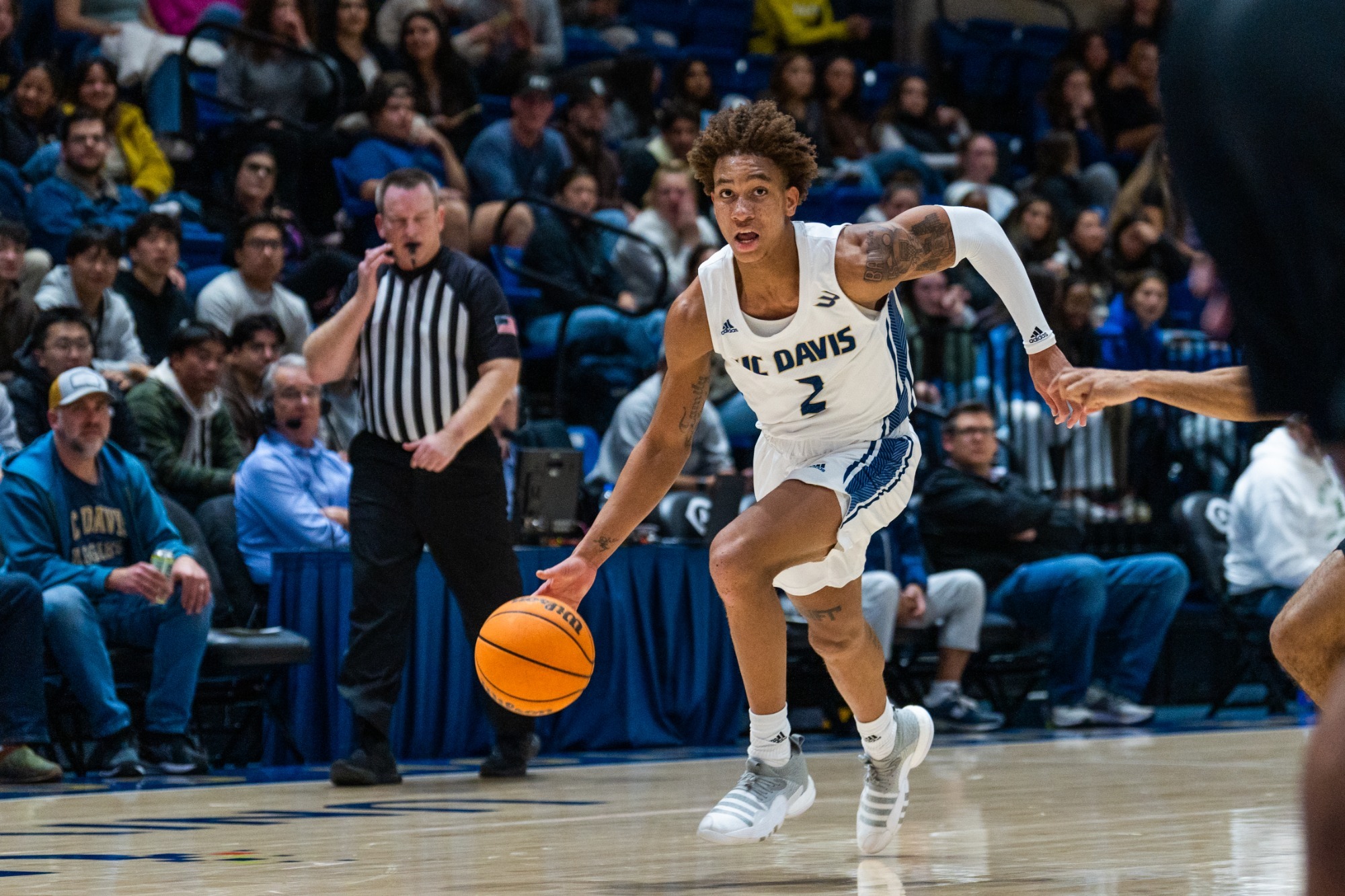
Soon after Les took over in Davis, he had an incredible player – 2015 Big West Player of the Year Corey Hawkins – who led the team to 25 wins and a regular season league championship. These days, the star guard in Davis is named Elijah Pepper, and he gives the Aggies that same sort of potential. Whenever there is analysis of UC Davis, it must begin with Pepper, who is a leading contender to be this year’s Big West Player of the Year. The Aggies’ top weapon is one of the nation’s most accomplished deep threats, the leading scorer in program history, and, as of this past Saturday, a member of the career 2,000 point club. The Selah, WA, native is the proud owner of 251 made triples for his career, and this year, he’s hitting them at a 39.8% rate. An elite scorer who can take over games and carry the Aggies to victory even when they’re having an off-day, Pepper has averaged 22.1 points and made 132 triples over his last 50 games played. In fact, his 14 points against Irvine to cross the 2K threshold were his fewest in nearly a month – Pepper has been scoring 23.5 points over the Aggies’ past eight contests. A talented passer with good awareness and the willingness to find his teammates when he’s drawn the defense, Pepper is a smart offensive player who is very much the heartbeat of his team.
Increasingly, Les has also learned to rely upon former Loyola Chicago transfer Ty Johnson. Across his year and a half in Davis, the Chicago native has found a fit on the West Coast, and is establishing himself as one of the Big West’s best guards in his own right. A combo guard who can really heat up, Johnson has assumed most of the primary duties facilitating the Aggies’ offense this year. He ranks top ten in the league in both points and assists per game, and he’s top five in both free throw attempts and makes. As a genuine threat to make things happen in a variety of ways, Johnson has eased some of the burden on Pepper. Last season, there were three other decent scorers who Les could turn to when Pepper or Johnson weren’t clicking. This time around, UC Davis doesn’t have that level of scoring depth, but Kane Milling is a proven veteran who has filled in capably. The French guard spent two years as a part of Nevada’s rotation before becoming a fixture in Davis, and now in his fifth season, Milling helps out everywhere. Though Les would love to see him shoot a higher percentage overall, Milling came up huge with 27 points in the Aggies’ win over CSUN a couple of weeks ago.
Though Johnson in particular has a talent for getting into the lane and scoring near the rim, Davis lacks a go-to post scorer. Niko Rocak is a capable defender in the paint, though, as he proved by swatting a school-record six shots in the key win over UC Irvine. He’s not a bruiser, but the Swiss big Rocak stays in good position, has good mobility, and is a tougher customer than most under the hoop. A former UCSB transfer, Rocak is settling into his role as a first-time starter, and Les is hoping to feature him more regularly down the stretch. Italian pivot Francesco Borra is the team’s biggest player, and has proven that he can handle a solid backup role. He’s got some touch around the rim, and the more physical Borra plays, the better Davis generally is. Ade Adebayo and Leo DeBruhl play important minutes and provide contrast to the Aggies’ four-out sets. DeBruhl is a playmaking guard who takes a regular turn helping the Aggies’ offense to chug along. He’s a 35.3% career shooter from distance, but DeBruhl spends more of his time closer to the basket. Adebayo is the team’s unsung hero, a feisty and physical defender who often goes up against larger players and wins. Though he doesn’t look to score much, Adebayo earns his 25 minutes per game by bringing the noise everywhere else – and his teammates love him as a result.
If the Aggies want to stay in first place through the end of the season, the biggest thing they must do is stop beating themselves. Davis plays good defense, rebounds fairly well as a team, and does a great job of getting to the charity stripe. The most glaring negatives with this group are that they commit way too many fouls and turnovers. The Aggies have allowed their opponents to attempt nearly 22 free throws per game, and rank 288th nationally in freebies allowed. Worse than that, UC Davis has consistently given away valuable opportunities in close games. The Aggies rank 61st nationally by forcing a steal on 9.9% of opponents’ possessions and 15th in the country by forcing turnovers of any type at a 19.3% rate. Unfortunately, when they have the ball, UC Davis coughs it up on 17.5% of their chances: 317th in all the land. If Davis can play clean basketball over the final months of the season, this team has the star power and defensive ability to capture a title. The next week will be key to the Aggies’ title chances, as after facing UC San Diego they travel to Santa Barbara.
UC San Diego Tritons
It was only a few years ago that the Tritons were competing at the Division II level. These days, they’re in contention for a Big West championship. As has been much-publicized lately with James Madison’s run at an undefeated season in football, UCSD is barred from competing in the NCAA Tournament until next season due to their move up in Division. There’s nothing stopping the Tritons from earning their conference crown, though – and so far, this team is playing very well.
There’s nothing exactly new about UCSD playing well to fans of the program. 11th-year head coach Eric Olen oversaw a group which consistently went to the NCAA Tournament and advanced once there while at the lower level. After their transition, Olen’s team struggled to get above .500 for the past couple of years – but now things are rolling along smoothly. Fifth-year guard Bryce Pope is the go-to guy in La Jolla. After being rewarded with a second-team All-Big West selection after his breakout season last year, Pope is hoping to add some team hardware to his individual accolades. The Tritons have reeled off seven wins in their last eight tries, and over that stretch, Pope has been potting 20 points per game. He’s a dangerous shooter who is particularly adept from mid-range, and Pope does a nice job of darting and weaving into the paint to keep defenders honest and earn trips to the charity stripe. Since he joined the team in mid-December, Tyler McGhie has provided a great compliment to Pope. A proven three-point threat, McGhie has made his own jump from the Division II level. Last year at Southern Nazarene, he shot 44.8% from the land of trey, and McGhie has been converting his deep heaves at a 42.6% clip so far in La Jolla.

Francis Nwaokorie is a deep threat too, even though he’s a forward. An inside-out scorer who either gets to the cup or bombs away from deep, Nwaokorie has actually attempted 19 more 3FG’s than two’s this year. A starter since early in his freshman year, Nwaokorie is a 37.4% career shooter from distance and a strong rebounder – especially on the offensive glass. Like McGhie, both Hayden Gray and Aniwaniwa Tait-Jones played at the Division II level the past couple of seasons, but they now form UCSD’s big, versatile pair of playmakers. Also a solid deep shooter, Gray is a good defender who runs a very tidy point. UCSD ranks 21st nationally by giving up just 9.8 turnovers per contest, and Gray contributes as a primary ballhandler who sports a 68:29 assist to turnover ratio so far. New Zealand product Tait-Jones is crafty and skilled in the paint, using his size and vision well. He’s shooting 63.7% near the rim, per Bart Torvik, and Tait-Jones has been getting to the free throw line almost five times per game. His own 67:39 ratio of helpers to miscues provides Olen options, and the Tritons can run their sets through a couple different types of players. Emmanuel Tshimanga and J’Raan Brooks largely share the center spot, and are another pair who compliment one another well. A hulking presence inside, the Quebecois pivot Tshimanga is a former UC Irvine transfer who has hit his stride in La Jolla. Though he comes off the bench, Tshimanga can be very effective when the Tritons are able to feature him in favorable matchups. Once a Top 100 prep recruit, Brooks has found a home with the Tritons after previous stops at USC and Washington. With springy athleticism inside and a legit three-point stroke outside, Brooks gives the other team a whole different look when he’s on the floor. The biggest thing that Olen needs his bigs to improve upon is their tendency to rack up fouls.
With a strong perimeter attack that’s gotten more dangerous now that McGhie is in the fold – UCSD is making almost nine triples per game as a team – the Tritons are discovering that they can hang as a Big West contender. They’ll continue to be challenged by a couple of teams which have largely rolled them since joining the top Division, but Olen’s team has already proven that they’re ready to meet the Big West as equals this season. The team’s next five games will reveal a lot: after Saturday’s matchup at UC Davis, the Tritons host CSUN before road tilts in Long Beach and Hawai’i, and then they return home to face Santa Barbara. With their low turnover numbers, scoring versatility, and good free throw shooting, UCSD does a lot of things which can tip the scales in their favor when games are close. The Tritons feature hungry veterans who are enjoying a whole new kind of success, and together, they’re proving why UC San Diego had the ambition to move up to the top level of competition.
Long Beach State Beach
The Beach own some of the Big West’s most name-brand victories this year, but are still caught in a fight to stay above .500 in league play. Longtime head coach Dan Monson has another talented, experienced team – a group that has already won road games at DePaul, Michigan, and Southern Cal. LBSU is just 4-4 in Big West play after dropping a home game against UC Irvine on Thursday, though, and will have to fight in order to get back into the league race.
The darndest thing about the Beach’s struggles is, this team has both star power and good supporting pieces. Former Washington and VCU guard Marcus Tsohonis has emerged as a prime-time scorer the last two years in Long Beach. One of the more creative and dangerous mid-range scorers around, Tsohonis is terrific off the bounce and routinely makes tough shots. A streaky outside shooter, Tsohonis prefers to do his work from more like 10-12 feet from the rim, often with multiple defenders struggling to keep up with him. Long Beach gets to the free throw line more than 24 times per game – 21st in the nation – and Tsohonis leads the way by averaging 5.6 tries per game. Having already been named the Big West Player of the Week twice this year, Tsohonis has been at his best under the brightest lights. In Ann Arbor, Tsohonis stole the show with 35 points. Despite being denied the start against USC because Monson wasn’t pleased with his practice habits, Tsohonis entered the game after 10 minutes of action and proceeded to hang 28 on the Trojans in front of LeBron James, who was there rooting for USC.

Though they are not related by blood, Aboubacar and Lassina Traoré are brothers on the boards. The Beach’s dynamic post duo are two of the Big West’s top rebounders, and together they give LBSU an advantage on the glass in nearly every contest. Aboubacar has so much game that he ranks third in the conference in assists per game, second in steals, and leads the Big West in blocks. There’s nowhere on the court that he doesn’t make a highly visible impact, and Aboubacar has been oh-so-close to posting a triple-double on multiple occasions. He produced a 23-point, 22-rebound – plus six assists – game against Cal State Fullerton earlier this year, and is one of the more valuable players in the conference. Lassina, while not quite such a playmaker, is an absolute monster on the boards. Across his 52 games for the Beach, Lassina averages 12.6 points and 10.3 rebounds, and he’s recorded a double-double in exactly half of those contests. He was named first-team All-Big West last year after ranking 17th among all Division I players with 112 offensive rebounds, and the reloads which Lassina and Aboubacar consistently provide the LBSU offense are invaluable to a team which struggles mightily overall to shoot three’s.
Two years ago, Jadon Jones was named the Big West’s Defensive Player of the Year, and he’s giving Aboubacar Traoré a run for the honor this year as well. In addition to his standout work on that end, Jones is also the Beach’s best long-range artillerist and a good ball-mover and playmaker. He’s enjoying a career year and provides vital spacing to the LBSU offense by forcing opponents to guard the perimeter. Sophomore AJ George is wing forward with some of the same do-everything skill that Aboubacar Traoré brings to the Beach. He’s been very good shooting the ball from outside, though on low volume. George is much more likely to use his athleticism and bounce closer to the rim, where he’s shooting 69.6% this year. While most of LBSU’s guys are big and have great length, Messiah Thompson stands 5’8″. The veteran point guard is a reliable ballhandler, talented passer, and 36.9% career shooter from the land of trey – all vital attributes to Monson’s rotation.
Long Beach likes to get out and go more than most teams in their league, but they also struggle defensively. The Beach ranks 200th or worst in a majority of important defensive metrics; and the team’s own 67.5% rate at the foul line (304th nationally) does them no favors. If Monson’s crew can tighten things up a bit, they have the ability to cause plenty of mayhem while climbing the conference standings over the final couple of months of this season. And as they’ve proven already on courts all over the country, the Beach will keep things exciting all the way through March.
Leave a Reply