
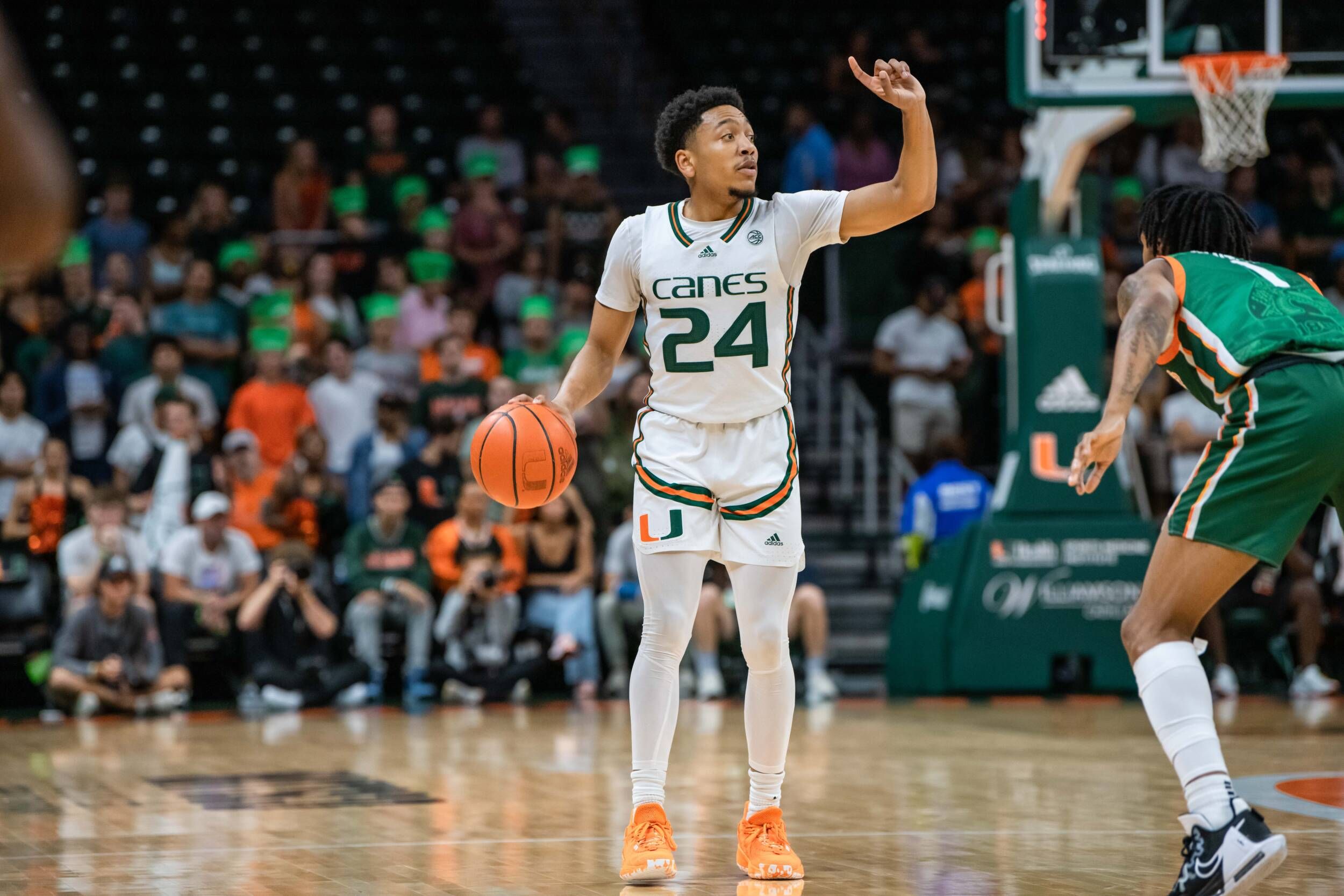
Last Year: 29-8; Atlantic Coast Conference Regular Season (15-5) Champions, lost in the Final Four of the NCAA Tournament
Head Coach: Jim Larrañaga (13th Year; 255-149 at Miami, with six NCAA Tournament appearances)
Projected Starting Lineup
| G Bensley Joseph – 6’2″, 196 – Junior |
| G Nijel Pack – 6’0″, 185 – Senior |
| G Wooga Poplar – 6’5″, 197 – Junior |
| W Matthew Cleveland – 6’7″, 208 – Junior |
| F/C Norchad Omier – 6’7″, 240 – Senior |
Projected Starters’ 2022-23 Stats
Bensley Joseph: 5.3 ppg, 2.1 rpg, 2.0 apg, 0.6 spg – 39.8% 3FG
Nijel Pack: 13.6 ppg, 2.7 rpg, 2.3 apg, 1.0 spg – 40.4% 3FG
Wooga Poplar: 8.4 ppg, 3.3 rpg, 1.5 apg, 1.1 spg – 37.5% 3FG
Matthew Cleveland:
Norchad Omier: 13.1 ppg, 10.0 rpg, 1.1 bpg, 1.1 spg – 57.4% FG
Experienced Reserves
| W Christian Watson – 6’7″, 211 – Sophomore |
| G Jakai Robinson – 6’5″, 208 – Sophomore |
| F AJ Casey – 6’9″, 221 – Sophomore |
Experienced Reserves’ 2022-23 Stats
Christian Watson: 1.5 ppg, 0.5 rpg – 33.3% FG in 11 games played
Jakai Robinson: 0.6 ppg, 0.3 rpg – 50.0% FG in seven games played
AJ Casey: 0.9 ppg, 1.0 rpg, 0.2 apg, 0.2 bpg – 33.3% FG
Freshmen
| W Kyshawn George – 6’8″, 205 – Freshman |
| C Michael Nwoko – 6’10”, 245 – Freshman |
| G Paul Djobet – 6’7″, 195 – Freshman |

The debate about whether or not ‘The U’ is back on the football field rages on, but fortunately for sports fans in South Florida, Miami is a basketball town now. The Hurricanes under head coach Jim Larrañaga have officially entered an unprecedented golden age on the hardwood.
After starting off his career in Coral Gables very strongly, leading the ‘Canes to their second and third-ever Sweet Sixteen appearances in his first six seasons. One of the longest-serving, most successful and well-like coaches in the game today, Larrañaga had a bit of trouble sustaining that level in the years which followed, but he kept the Canes mostly above water; after all, the program was not a traditional hoops powerhouse among the heavyweights in their Atlantic Coast Conference.
Since the advent of NIL, though, Larrañaga the outstanding coach hasn’t had to work quite as hard to be an outstanding recruiter. And the results the past couple of years have been, well, outstanding.
Two years ago, Miami went to the Elite Eight for the first time. It was so much fun that, even though Larrañaga lost three of his top five scorers, the Canes reloaded and went on another, even better run last year. The U won the ACC regular season title, 29 total games (tied with Larrañaga’s 2012-13 team for their most ever), and advanced to the first Final Four in program history. This year, though they’re losing the top scorers off of last winter’s excellent team, Miami has restocked the roster yet again. Now, all that remains is to see if the Canes can continue their sequential progression towards a natty.

When he showed up in Coral Gables last year, there were some doubts about Arkansas State transfer Norchad Omier. Sure, he had been spectacularly productive in his first two seasons, and was both the Sun Belt’s Defensive Player of the Year and Player of the Year. He was shorter than most post players, though; and those awards came from the Sun Belt, not the ACC. In Larrañaga’s preferred 4-out, guard-oriented attack, could Omier really be an effective starter for the Canes? Omier didn’t just answer the question; he showed his work. Omier averaged a double-double for the third time in three collegiate seasons, grabbed an ACC-leading 371 total rebounds, and ranked second in the league by shooting 57% from the floor. The Nicaraguan big man further ranked fifth in the ACC in Player Efficiency Rating and True Shooting Percentage, sixth in blocks, and made the tenth-most free throws in the league. Even in a league stuffed full of quality bigs, Omier completely took over games in the paint at times last year – especially down the stretch. Though he departed after just one minute against Duke in the game which knocked Miami out of the NCAA Tournament and finished the year on a squeeky wheel, Omier averaged 10 points, 12 boards and 1.8 steals across Miami’s five NCAA Tournament games. “I don’t know if they thought about Miami being physical,” Omier said with a smirk after the Canes knocked off Houston to reach the Elite Eight last year. “But I think I’m pretty physical and I love the physicality. I think my teammates, too.”
With Omier back to keep on bringing the noise, Miami is going to continue having that physical edge. Though he tested out the NBA Draft process this summer, Omier decided that another year of honing the finer points of his game – and stacking double-doubles against ACC foes – would be the better option. Though he remains undersized for a full-time post player, Omier measures mere fractions of an inch shy of a seven foot wingspan, possesses outstanding strength and solidity, and proved last year that he’s smarter and savvier than many of the bigger bigs he faced. A terrific rebounder at both ends, he tied UNC’s Armando Bacot for the ACC lead with 133 offensive boards, and Omier came up with 47 putbacks, per Hoop-Math. He’s athletic enough to make all sorts of plays above the rim, and despite all of his physical board work, Omier is yet nimble working around defenders deep in the paint and has a soft touch which enabled him to shoot both 63% at the rim and 46% on all other 2FG’s, per Bart Torvik. That second number is big; NBA scouts said that they would like to see a more consistent jump shot from Omier this year. Since he has shown that ability in flashes already, Omier will likely be showing off a lot more range – and more confident ballhandling both inside and out of the lane. And if he can cut down on a few of the 111 fouls he racked up last season, Omier could well be adding his new league’s Defensive Player of the Year trophy to his case, also.
There were times last season when Nijel Pack was just about as good as any shooter in the country
There were times last season when Nijel Pack was just about as good as any shooter in the country. Take the Sweet Sixteen contest against a Houston program coming off of back-to-back Elite Eights and wanted to go for a third ride. Pack didn’t care, because he was busy ripping off seven triples and 26 points to lead Miami to victory. Or look to his 22, 23 & 24-point performances, all in a row, a couple of weeks before the ACC Tournament began; he made at least four triples in each of those games, too. When Pack is percolating, he can hit from virtually anywhere. “He was ridiculous,” Larrañaga told reporters after the Houston game. “I don’t know how far those shots are, but people say to me, ‘What do you say to him when he misses one of those long shots?’ What I say is, ‘Keep shooting.’ The guy is a great shooter.”
Last year, Pack was able to get nice and comfy in Miami’s ball-moving, shot-taking three guard lineup. Pack loves to work free of his defenders around screening action and curl or cut to his spots, and he forces the defense to guard well beyoulnd the three point arc. Though he prefers to spot up from deep, Pack has been steadily improving the consistency and confidence in his jumper off the bounce. Pack was assisted on 89% of his three’s as a freshman, but that figure was down to 62% last year, per Barttorvik. A capable playmaker and ballhandler, thus far Pack has been more of an initiator and distributor than a primary playmaker. Without departed ACC Player of the Year Isaiah Wong, this winter Pack will be asked to create even more of his own shots, while shifting a larger focus towards feeding his teammates, as well. An opportunistic and playmaking defender, Pack will also be asked for his best-yet performance on that side of the ball, as Miami’s backcourt will be significantly smaller this season – especially when Pack is operating off the ball. It’s a lot to ask of the fourth-year guard, but Pack is a talent who should be up to the task.
Without do-it-all wing Jordan Miller, Larrañaga needs a new x-factor. Wooga Poplar is a former 4-star recruit and a highlight reel in human form, and Larrañaga thinks he is on the verge of extraordinary things.

With great size, length and athleticism, last season Poplar showed off some absolutely tantalizing previews of what’s to come. He tripled pretty much all of his core statistics last year, starting all but one of Miami’s games and guarding a variety of opposing players along the way. Poplar can be a menace defensively, with great awareness, quick-twitch coordination and the explosiveness to catch up and knock the ball away even when he gets beaten. As he gains muscle and experience, Poplar is going to emerge as one of the ACC’s best stoppers. His athleticism really shows up on the other end, too. Poplar is one of the bounciest guards around, and even on a team last year which had some prolific dunkers, Poplar stood out. “He’s fantastic,” Larrañaga told the Miami Herald of Poplar this fall. “He’s got this year and one more, but I’m not sure we’ll be able to hold onto him. He’s definitely an NBA prospect.”
He scored in double figures 13 times last season, and Poplar was at his best the final month-plus of the season, when it mattered most. Outside of the Hurricanes’ final game, in which he did not score against the eventful champ, UConn, Poplar averaged 10.4 points on 61% True Shooting between the end of January and Miami’s ouster. The most exciting part of his scoring last season – aside from, you know, the atomic dunks – was that Poplar came a long way as a shooter as a sophomore, and began to display a clear understanding of where to be and how to move into the spots that would result in high-percentage touches. Poplar shot 61% around the rim (with 19 dunks), 46% on all other 2FG’s, and 38% from the land of trey – and he made a cool 87% of his foul shots, too. He’s got one of the cleanest pull-up jumpers you will see, and Poplar’s craftsmanship from 15 feet and out will be something to watch this winter. Poplar was one of the most improved players in the ACC from his first to second season; if he can maintain those shooting splits over 10+ shots and 28+ minutes rather than the 6.7 & 23.5 he averaged last year, Poplar’s junior season may register on a seismic level.
Former ACC 6th Man of the Year Matthew Cleveland is a big, explosive scoring wing who used to play for a Florida school. He still does, but he used to, too. The Atlanta native caused quite a stir when he elected to jump to another school that’s not just in the same state, but the same conference.
| Five Stats Which Tell The Tale (with national ranks) |
| 48.0% – Team FG Percentage (20th) |
| 51.8% – Opponent 2FG Percentage (284th) |
| 78.4% – Team FT Percentage (10th) |
| 24.4 – Defensive Rebounds Per Game (224th) |
| 11.1 – Turnovers Per Game (52nd) |
Not only that, but he’s stepping into some of the biggest shoes in recent Miami history. 1,824-point career scorer Jordan Miller had a terrific two years in Coral Gables, and was one of the best all-around wing players in the country last year in an All-ACC performance. One of the most obvious reasons why Miami poached Cleveland is that he brings a lot of familiar skills to Larrañaga’s lineup. Long and rangy, Cleveland is an elite athlete who has grown stronger each season and is very much at home operating either in the post or on the wing. A terrific rebounder who routinely beats out bigger players for loose balls, Cleveland ranked seventh in the ACC in both defensive rebounds and total average rebounds per game. He also led the Seminoles in scoring, and started to show that he’s got a legit three ball to keep defenses honest. Cleveland is at home in the mid-range, mixing his drives through the paint with a series of pull-up and step-back jumpers. A creative scorer in isolation, Cleveland can also draw defenders and dish off to his teammates. His work with Miami’s training staff this summer should pay off for Cleveland defensively, as will having a bit more overall energy left in the tank this year – he was on the floor for more than 33 minutes per game last year. Now that he can be more selective and fit into a role which should play up his skills, Cleveland shoukd have his biggest season yet.
New to the starting lineup but not Coral Gables, junior point guard Bensley Joseph is ready to play his biggest role yet. A solidly-built playmaker from Arlington, Massachusetts, Joseph has been a contributor in each of his first two seasons, playing the role of 6th man last year. Joseph improved markedly around the rim last year, making 67% of his attempts after finishing just 36% as a freshman. With a confident handle and an increasingly aggressive mindset, Joseph should only become a better scorer with higher volume and the experience of playing deep into March in each of his first two seasons; especially because he’s unlikely to shoot just 20% on mid-range attempts two years in a row. Joseph has made 40% of his triples in each of his campaigns, and with that threat established, he can attack defenders who close out too quickly. Joseph can create for himself and others, and Larrañaga will need him to help Pack keep the ball moving effectively. With a 103:67 assist to turnover ratio so far, he’s shown the poise as a youngster to become a steady starter going forward. A physically strong guard, Joseph will likely absorb a great deal of bigger defensive matchups so that the smaller Pack can stay fresh for the offensive end; thankfully he’s been a good defender so far. Joseph has shown all the right things in developing over his first two seasons, and if this trajectory continues, he will step seamlessly into a prominent role.
On the bench, Larrañaga will be turning to youngsters who played sparingly last year, and a variety of new freshmen. It’s a group with a great deal of potential, but in the event of injury to the starting lineup, the Hurricanes will be seeing what most of their reserves can do in serious situations for the first time.
| Five Out-of-Conference Games to Keep an Eye on |
| @ Kentucky – November 28 |
| N – Colorado – December 10 |
| N – Providence / Kansas State – November 19 |
| N – Georgia – November 17 |
| vs Central Florida – November 10 |
Jakai Robinson and Christian Watson played for the Canes last year, but they combined to make just 18 appearances and pick up 53 total minutes between them. Just like NFL receiver with whom he shares a name, Watson has length and athleticism on his side in the race for minutes. By offering more physicality and strength, he gives the lineup a much different look than Pack or Joseph. Watson can shoot the three, and almost half of his shot attempts as a rookie came from deep. “I think Christian Watson learned a lot last year,” Larranaga said. “We’re very hopeful that he will become an outstanding defender and rebounder. He certainly has the athletic capability of doing that…has a good feel for the game. On offense probably the biggest thing is trying to figure out what shots he should shoot and what shots he should pass up because we have a lot of very good shooters.” The DMV product projects as a 3-and-D sort to start, but given his increased confidence slashing towards the cup, Watson should grow into a legit three-level scorer. His length shows up on defense as well, and Watson should provide options for Larrañaga to experiment with lineups early on.
While both sophomore wings were 4-star prospects, Robinson was rated just outside of the Top 50 by some services, and brings a world of potential to the lineup after a year’s marination. Newton can knock down jumpers or get to the rim, and will get the chance to carve out a real spot for himself this year. The main exception to so much inexperience is forward AJ Casey, a returning reserve who did see a consistent role last winter. “I’m working with AJ very specifically to help him with his offensive game,” Larranaga told 247 Sports this summer. “AJ has a lot of physical talent with his size and athletic ability. His offense has a lot of potential, but it has not been realized quite yet. He needs to become a more efficient offensive player, more of a plan of attack with what shots he’s going to take and that actually happens even before the game begins.” Casey can play both big spots, and though he saw just 6.4 minutes on average, played in 29 games last season. If he can bring a consistent impact, Casey may allow the Canes to play bigger on occasion this year.
Larrañaga expects a true contribution from at least two of this year’s true freshmen. Kyshawn George is a 6’8″ rookie wing from Switzerland, and has competed with a French professional team for four years. That experience has shown both on Miami’s summer exhibition series in – of course – France, as well as preseason practices. George has shown a good handle and easy athleticism, and it’s possible that he will get a chance to be Miami’s 6th man this year. “He can shoot the 3, can handle the ball, he’s very versatile,” Larrañaga said of George this summer. With guard skills at his size, George could combine with Watson in some lineups which will all but negate Pack’s lack of great height. Speaking of, Nwoko is the biggest Cane, and his new coach is looking forward to having a post player in reserve who looks the part this year. “Michael Nwoko is 6’10”, 240 pounds, he’s the tallest guy on the team by several inches,” Larranaga said this summer. “I think he’s going to be a nice contribution as a freshman.” Nwoko isn’t exactly graceful, but he’s strong on the glass, defensively, and physically. With a true center to bring in for even ten minutes per game this year, Miami’s frontcourt will have a different look. Nwoko is a consensus Top 150 recruit, and should be able to hold his own for stretches right away. Paul Djobet is another freshman from France, though he finished his prep career in Florida. He is not considered as ready to make an immediate impact, but adds even more length and skill going forward.

After back-to-back best seasons in program history, Miami has undeniably arrived. Not just the team and its fans, but opponents too, have taken note of the Hurricanes’ success. “We have a big target on our backs now,” Pack told the Miami Herald this fall.
“We’re not where we’re going to need to be defensively in order to compete with the best teams in our league and some of the best teams in the country,” Larrañaga said just a couple of weeks before the season. But then, that’s the type of thing that a two-time Final Four coach would say.
The Canes have been good enough lately that their coach can be a bit nitpick-y; and they will be again. Miami has a couple of tournament-proven stars heading the attack, and if Poplar and Cleveland make the smooth transitions to their new roles that Pack and Omier did last fall, the Canes should hardly skip a beat. There is some concern about depth at a time when many top programs are loaded with starting-quality veterans through the end of their bench, but Larrañaga has already proven that he doesn’t need a 10-deep lineup to hang with absolutely anybody. Besides, if George and Nwoko are as good as some reports have indicated, the Canes will have some surprises in store for the ACC this year regardless. Life is good these days in Coral Gables, and the Canes are out to continue their run as one of the best teams in the country.
Leave a Reply