
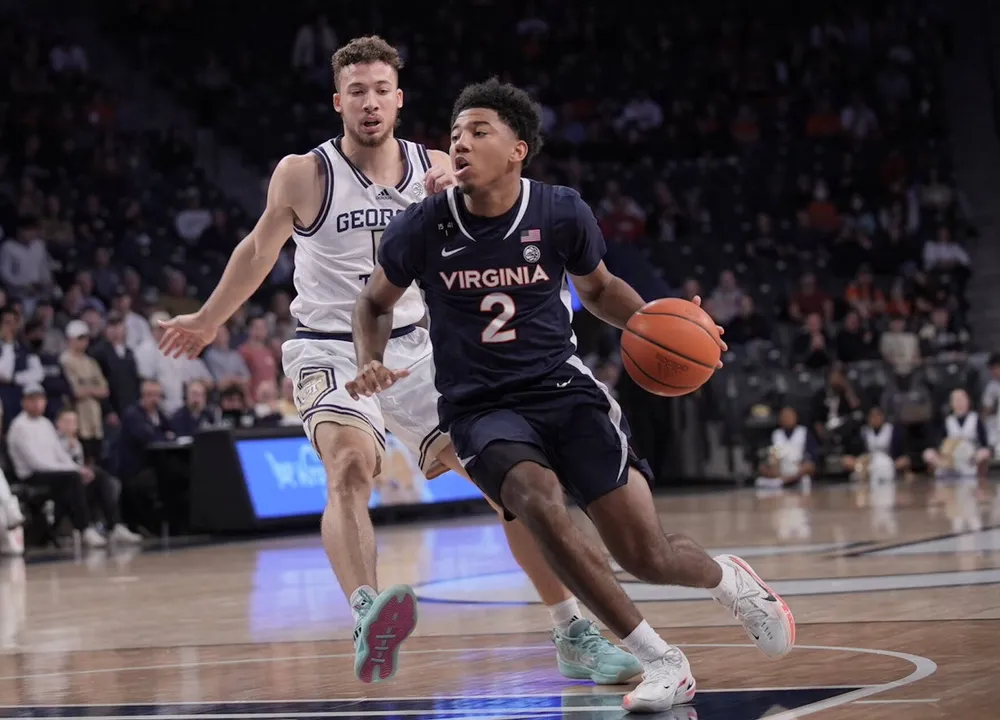
Last Year: 25-8; Atlantic Coast Conference regular season (15-5) Champions, lost in the first round of the NCAA Tournament
Head Coach: Tony Bennett (15th Year; 341-125 at Virginia, with nine NCAA Tournament appearances)
Projected Starting Lineup
| G Reece Beekman – 6’3″, 194 – Senior |
| G Isaac McKneely – 6’4″, 188 – Sophomore |
| W Andrew Rohde – 6’6″, 202 – Sophomore |
| F Ryan Dunn – 6’8″, 216 – Sophomore |
| F/C Jordan Minor – 6’8″, 242 – Senior (5th) |
Projected Starters’ 2022-23 Stats
Reece Beekman: 9.5 ppg, 3.0 rpg, 5.3 apg, 1.8 spg – 40.5% FG
Isaac McKneely: 6.7 ppg, 2.2 rpg, 0.7 apg, 0.4 spg – 39.2% 3FG
Andrew Rohde: 17.1 ppg, 3.7 rpg, 3.6 apg, 1.7 spg – 44.8% FG @ St. Thomas
Ryan Dunn: 2.6 ppg, 2.9 rpg, 1.1 bpg, 0.4 spg – 53.2% FG
Jordan Minor: 17.4 ppg, 9.4 rpg, 2.3 apg, 2.6 bpg – 51.5% FG @ Merrimack
Experienced Reserves
| G Dante Harris – 6’0″, 171 – Junior |
| F Jacob Groves – 6’9″, 211 – Senior (5th) |
| W Taine Murray – 6’5″, 208 – Junior |
Experienced Reserves’ 2022-23 Stats
Dante Harris: 11.9 ppg, 3.6 rpg, 4.1 apg, 1.5 spg – 37.5% FG @ Georgetown in 2021-22
Jacob Groves: 6.8 ppg, 2.5 rpg, 0.8 apg, 0.4 spg – 38.1% 3FG @ Oklahoma
Taine Murray: 1.4 ppg, 0.9 rpg, 0.2 apg, 0.2 bpg – 31.6% FG
Freshmen
| G Elijah Gertrude – 6’4″, 185 – Freshman – Consensus Top 100 recruit |
| F/C Blake Buchanan – 6’11”, 225 – Freshman – Consensus Top 100 recruit |
| G Christian Bliss – 6’4″, 198 – Freshman – Consensus Top 150 recruit |
| W Leon Bond III – 6’5″, 203 – Redshirt Freshman |
| F/C Anthony Robinson – 6’10”, 238 – Freshman |

A new chapter in Virginia basketball will begin this fall. That’s because the last on-court connections to the Cavaliers’ 2018-19 national championship team have gone, and the Hoos are set to be a rather young crew.
Since that most sublime performance five years ago, a lot has happened in the world, but expectations of a Hoos dynasty never quite materialized. Not just that, but a certain amount of frustration has set in. While the program has remained solid, lots of people thought that, after breaking through and winning it all, UVA would become a fixture as an annual Final Four contender. Head coach Tony Bennett, after all, is comparatively young, and he’s recruited quite well. And, always, there’s that unique brand of stifling defense which the Cavaliers play.
Instead of all that, Virginia has not won a single NCAA Tournament game since Bennett ascended a ladder to cut down the mightiest net of them all in Minneapolis. Everyone around Charlottesville would really like that to change, and though the Hoos are replacing some big names from the era of a natty, this year’s team has the chance to contend for postseason success.
That is, if a young group can establish their own identity as the faces of Bennett’s program. “A lot of people will count us out and say they lost all this experience, but it excites me to be able to work with these new guys that I think have the same vision as I do,” Bennett told The Athletic this spring. Thankfully, there is one individual who can do virtually everything that will be needed of a leader in such changing times and that individual will wear a Cavaliers jersey one final time this winter. If the Hoos are to chart a brave new course into the Madness this season, Reece Beekman shall lead them – and that’s got to be a comfort for the folks in orange & blue.

Beekman is, quite simply, one of the most outstanding all-around guards in the nation. The reigning Atlantic Coast Conference Defensive Player of the Year and a second-team all-conference pick, Beekman has proven that he can win games for the Hoos at either end of the floor. He’s also given Virginia fans some truly iconic moments over the years. From his first buzzer-beater to knock Syracuse out of the ACC tourney as a rookie right up through that time he silenced Cameron Indoor Stadium with a walkoff triple, Beekman has shown that he has the clutch gene. He nearly departed for the NBA this spring, but after gauging the Association’s interest, Beekman has opted to play one more year with the Cavaliers. And this time around, after playing beside so many excellent veterans, there is no doubt who’s team this will be. “Reece obviously has the most experience,” UVA associate head coach Williford told Jeff White for VirginiaSports.com, “and now he’ll be our bona fide leader.”
Beekman is sensationally crafty with the ball in his hands. He plays at just the pace he chooses, and brilliantly mixes his handle, hesitation, angles and athleticism to lure defenders and then leave them behind. Though he played alongside Kihei Clark for the last few seasons and thus was not the only point guard handing out helpers, Beekman racked up 168 assists (5.3 per game), which was good enough to rank fourth in the ACC. And such wonderfully good care did Beekman take of the ball, that he ranked second in assist to turnover ratio among all Division I players. Now, with his co-captain Clark out of eligibility, it will be up to Beekman to guide Bennett’s precise offense even more effectively while managing the increased pressure he will see from opponents. He’s not an outstanding scorer, and Beekman has yet to truly step forward as a dangerous jump shooter – though he’s certainly made strides. As a freshman, Beekman averaged more than 29 minutes per game but only hit seven triples all season. By the end of his third year, Beekman was up to 27 makes from the land of trey, at a career-high 35.1% rate. Now a senior, Beekman is hoping to correct the biggest flaw which NBA scouts have identified in his game. “That’s been a big focus and something I’ve been working on,” Beekman told VirginiaSports.com of his efforts shooting the ball this summer.
Not just an exceptional on-ball defender who can shut down star scorers, Beekman is a defensive playmaker who has ranked first and then second in the ACC in steals per game each of the past two seasons
When Beekman isn’t reading ball screens to make great passes or highlight drives to the cup – say, remember that time he dunked all over Virginia Tech right before halftime? – he’s playing some of the best defense around. Bennett’s teams are as defense-oriented as any in the country, and Beekman is going to be counted on to remain UVA’s spearhead at that end of the floor, as well. Not just an exceptional on-ball defender who can shut down star scorers, Beekman is a defensive playmaker who has ranked first and then second in the ACC in steals per game each of the past two seasons. At 6’3″, he’s even got 52 career blocked shots to his credit. Beekman has done a terrific job of facilitating things for a veteran core, and now it will be his priority to do nearly everything for the Hoos as his young teammates get settled. Thankfully, Beekman has yet to reach his full potential, and Virginia’s coaches are excited to see what’s next.
Two second-year guards are going to be relied upon as primary scorers this year. Bennett’s is not generally thought of as one of the freest-flowing offensive systems in the country; some players have alleged it to be too rigid, and it isn’t always easy for youngsters to grasp its nuances. And with the departures of Clark and his fellow veterans who combined to score more than 72% of UVA’s points last year, the Cavaliers are largely starting over with new guys in vital roles. Though their pedigrees and experiences are different, Bennett is hoping that Isaac McKneely and Andrew Rohde are ready to step into big roles as a couple of Virginia’s offensive focal points.
Rated a Top 50 prospect last year, McKneely arrived from neighboring West Virginia last season with a reputation as a knock-down shooter. Entering his second season, McKneely’s reputation is very much intact, and he’s going to get all sorts of chances to let fly this winter. Functioning as Bennett’s 6th man for most of his rookie year, McKneely scored in double figures just eight times last year. He still managed to finish second on the Hoos in made triples (51), though, and to lead all of his veteran counterparts with a team-best 39.2% mark from downtown. He improved as the year went on; after Bennett gave his freshman sniper permission to ‘take the parking brake off’, McKneely posted nearly eight points per game on 62.6% true shooting over Virginia’s final 20 games.

McKneely has the size and quick, easy release to get off a jumper pretty much whenever he wants it. His size also helps defensively, and McKneely had started to become familiar with elements of Bennett’s famed pack-line defense during his prep career. Now that he’s spent a year coming to an understanding of what Bennett needs from his guys and that his coach will be looking to him for reliable point production, McKneely will have one of the greenest lights around in his second campaign. “I’m getting more and more comfortable every single game,” he told reporters late last year. “So I’m just going got keep letting them fly when they are there.”
While he wasn’t nearly as hyped a prospect as McKneely coming out of high school, Rohde made the scouts look a bit silly with his show-stopping freshman performance in the Summit League. As a rookie at St. Thomas last season, all Rohde did was lead the Tommies to 19 wins in 31 games and the semifinals of the conference tournament semifinals in just their second season of Division I competition. Along the way, Rohde led the Tommies in scoring, assists, steals and free throws both attempted and made. For his efforts, Rohde was awarded Summit Rookie of the Year, was named first-team all-conference, and Rohde received all sorts of the big-time scholarship offers which weren’t there just a year ago.
“I thought he got so much better as the year progressed,” North Dakota coach Paul Sather, who had the task of defending Rohde last year, told 247 Sports this summer when discussing Rohde. “Very talented player. It’s going to be interesting to see after just the one year what type of impact he could have there. It’s a great example of a young guy who’s no-doubt talented and good enough. But the role he had at St. Thomas was 37 minutes per game, the ball is in his hands a lot. What’s his role going to be at Virginia?”
| Five Stats Which Tell The Tale (with national ranks) |
| 60.5 – Opponent Points Per Game (5th) |
| 70.3% – Team Free Throw Percentage (238th) |
| 1.847 – Team Assists Per Turnover (1st) |
| 53.5 – Field Goal Attempts Per Game (326th) |
| 10.2 – Opponent FT Made Per Game (14th) |
Rohde ended up averaging about 33 minutes for the season, but to Sather’s point, he was on the floor as often as possible down the home stretch of last season. That responsibility, plus the amount of different types of defenders he saw during his first season, should only help Rohde as he transitions into a significant role with the Hoos. Larger than McKneely, Rohde is yet lanky and more of a tall guard than some sort of imposing, physical wing. Last year, Rohde proved that he can check a variety of opponents due to his reach and mobility; now he’ll have to show that he can hang with the tough covers and NBA lottery prospects he will face in the ACC. The wealth of offensive skills Rohde has shown are too tantalizing for Bennett not to give the sophomore a try, though, and it may be that the Hoos are about to uncover another hidden gem.
The frontcourt which Bennett had once envisioned for this season will no longer be, as three bigs with eligibility remaining transferred away from Virginia this spring. That’s in addition to the graduations of Jayden Gardner and Ben Vander Plas. As a result, the Hoos are going to have a very new, young, and/or largely inexperienced frontcourt this year. Except, that is, for Jordan Minor.
Minor arrives in Charlottesville from Merrimack as the proud owner of 1,349 career points, 791 career rebounds, and 202 career blocked shots from his time spent transforming the Warriors from a Division II power to a Division I conference champion. Since Merrimack was barred from postseason play last year as part of their transition up to the higher level, Minor wants to play in the NCAA Tournament before his excellent career is over – and he’s coming to Grounds to make that dream a reality. “I think UVA was a no-brainer for me,” Minor told VirginiaSports.com upon signing. “The amazing coaching staff and winning culture is something that’s important to me. I believe in Coach Bennett’s vision for the team and myself, and we want to be back in the Final Four competing for a national championship.” Minor is already familiar with his team playing at a slower pace and relying on aggressive, swarming defense. Merrimack ranked among the nation’s bottom ten teams in field goal tries per game, and they led the entire nation in both steals per game and steals per play. The Warriors were in the 250’s nationally in possessions per game and Evan Miya’s True Tempo stat, though, so Minor will have to slow it down to Virginia’s bottom-five paces.
| Five Out-of-Conference Games to Keep an Eye on |
| vs Texas A&M – November 29 |
| N – Florida – November 10 |
| @ Memphis – December 19 |
| N – Wisconsin – November 20 |
| N – West Virginia / SMU – November 22 |
Minor is both a strong individual defender and a proven finisher around the goal. He’s made 52.1% of his shots over the last two seasons, taking nearly six trips to the foul line and averaging 16.2 points, 8.8 boards and 2.5 blocks across those 58 games. The question ‘how cleanly will that production translate to the ACC?’ is one of Virginia’s biggest this season. If you’re a glass-half-full sort, Minor has managed to defend at a high enough level to stay on the court for an average of 31.2 minutes per game over his last three seasons combined, despite every opponent driving at him in hopes of removing his shot-blocking presence from the floor. Meanwhile, Minor has thrown down 71 dunks over the last couple of years as the go-to post scorer for a team that has had to do everything the hard way. And among his NEC-leading 91 offensive boards a year ago came 34 putback stabs, per Hoop-Math.
To take a slightly less rosy view, Minor is limited as a scorer; he’s made just 15 shots away from the basket’s immediate vicinity each of the past two seasons, per Bart Torvik, and is a 58.9% career foul shooter. There is also concern about Minor – for all of his excellent timing, anticipation and length as one of the nation’s premier rim protectors – will hold up as Virginia’s main 5 man at 6’8″, 240. “He is a great athlete with a strong work ethic. Jordan had an excellent four-year career at Merrimack, and we look forward to him joining our program,” Bennett said upon Minor joining the Hoos. The hope is that Minor’s proven abilities, toughness and resolve to ascend some future ladder and get himself a piece of NCAA Tournament net will give the Cavaliers something to rally around up front.
Joining Minor around the paint will be the one frontcourt player Virginia has coming back; and aside from Beekman, there may be no player Hoos fans are more excited to see more from than Ryan Dunn. A student-athlete who wanted so badly to play for Virginia and Bennett that he offered to walk on when scholarships ran low, Dunn is going to get as much of the spotlight as he wants this year. Where Minor’s priven veteran production is his calling card, Dunn has the combination of smarts, hops and shooting ability that NBA teams crave these days – and he’s going to get a prime opportunity to showcase everything this winter. Dunn is a rangy wing player first and foremost, and it’s away from the basket that two of his purest skills shine: deep shooting and defensive versatility. He didn’t make many jumpers last season, but then again Dunn only attempted 17 shots away from the basket, per Bart Torvik. As a freshman, Dunn’s offense came at the rim; well, technically, from above it. Dunn flushed 17 of the 25 buckets he scored in close last year, and he has the easy athleticism to get up and mirror Minor as an even better lob threat on the opposite side of the lane.

If Dunn can rediscover the shooting touch he showed in high school, the former 4-star recruit will swiftly rise to become one of this team’s best players. The versatility he could present as a dunker when shots aren’t falling and floor-stretcher when they are makes Dunn a potentially invaluable contributor to a Hoos team which doesn’t always manufacture a lot of cheap points. And his defensive potential in Bennett’s suffocating defense is vast. Dunn moves very well for his size, and his clean leaping ability combined with a nearly seven foot wingspan could transform him into an absolute offense-wrecker. Despite playing less than 13 minutes on average, Dunn had the same block rate as the departed Kadin Shedrick – a 6’11” post player who finished fifth in the ACC in rejections. Despite the Cavaliers being undersized up front this year, opponents won’t have much of an advantage with both Minor and Dunn coming at them from all angles to alter shot attempts. “We need Ryan’s passion, his heart, his quickness, his mobility on defense, getting offensive rebounds and making some of the hustle plays,” Bennett told NBC 29 News late last season, and he’ll be asking even more from the exciting sophomore this year.
Redshirt freshman Leon Bond III is going to be expected to give the Hoos a bit of the same energy and excitement that Dunn will now that he’s ready to play. A live wire who can make things happen in the open floor and around the lane, Bond will give Bennett another long, agile defender to play matchups with – and that’s fairly unsettling news for the rest of the ACC. Rated as very nearly a consensus Top 50 national prospect, Bond took a year off to develop his skills and shooting in particular while UVA’s veterans played their final season. “Not known for his shooting range, Bond is dangerous in the midrange and at the basket,” Jerry Meyer of 247 Sports wote of Bond in 2022, saying that the young wing “is a powerful straight line driver while also having an effective post up game.” Though he’s not yet a finished product offensively, Bond can get out and get up, and he has consistently been described as playing larger and more physically than his listed size. Now that he’s familiar with Virginia’s plan of attack at both ends of the floor, Bond is going to get the opportunity to play big minutes – and make a big impact.
Much like Bond was last fall, Gertrude is this year’s big guard who oozes athleticism and defensive potential. Also like Bond, Gertrude has been rated a Top 50 recruit by some services, but he’s been forced to spend the last year recovering from a torn ACL towards the end of 2022. He isn’t yet a dangerous shooter, but Gertrude can knock down a variety of shots near the painted area and really knows how to finish closer to the rim. UVA’s coaches are confident that Gertrude will be ready and healthy to start his first college season, and if that’s the case, competition for minutes on the wing in Charlottesville will be fierce indeed. Taine Murray brings additional physicality off the bench. The veteran from New Zealand can knock down open jumpers and tends to bring the noise when he’s in the game, bu has yet to play a large role. One player who won’t be joining the race this season is Christian Bliss, a highly regarded wing who has reclassified from the class of 2024 to join the Hoos with the intention of redshirting this winter.

With Clark gone and a more significant honus on Beekman to score the ball this year, it would sure be a comfort if Bennett had another veteran point guard to bring in and help to run the show. It would be even better if that veteran playmaker already knew the Hoos’ offense, and some inborn shot-making ability to boot. Happily for the Cavaliers, that’s precisely what Bennett has in Dante Harris. The Washington, DC product spent his first two seasons at Georgetown, and averaged 10 points, 3.6 assists and 1.3 steals over those 55 games, earning a Big East Tournament MVP award along the way. While a Hoya, Harris was the captain of an inconsistent and sometimes ugly offense, though the team’s struggles ran far deeper than his own play. Now that he’s been steeping in Bennett’s offense and developing a rapport with his teammates for a full year, the hope around Charlottesville is that Harris is ready to step onto the floor as the best version of himself anyone has yet seen. Though Harris small, he’s not as little as Clark, and that could help some when UVA goes with Harris and Beekman on the floor together. Like Beekman, Harris likes to get downhill and create good shots off the bounce. If his jumper – Harris is under 30% from the land of trey so far for his career – has improved, Harris should make a smooth transition into the 1-B spot running Virginia’s offense, and provide some meaningful help to Beekman.
Jacob Groves is the most experienced of the three other new bigs, and arrives in Charlottesville after two years each at Eastern Washington and Oklahoma. On a team with a board-crashing, obvious #1 pivot, Groves might be a great compliment at the 4 spot. Such as it is, Bennett is likely going to be asking Groves to masquerade as a 5 man for stretches, and that will be a bit of a different ballgame. Groves is a good outside shooter; he’s made 78 career triples at a 33.8% rate, and nearly half of them came last season as Groves converted them at a 38.1% percentage. Additionally, whereas Minor is not particularly a mid-range threat, Groves has made a solid 43.1% of his tries from the in-between spots over his past three years, per Bart Torvik. Though he’s not a particularly physical post defender or rebounder, Groves wouldn’t have started 34 games over the past two years for Porter Moser or been recruited by Bennett if he wasn’t useful in those areas. This year, UVA is hoping to get the best season ever from Groves, and if he’s up to the challenge, the veteran will get to play a big role.
The other bigs that Bennett will have at his disposal are both freshmen. The more highly-rated of the two is Blake Buchanan, a lanky pivot from Idaho who’s grown a couple of inches over the past year and now checks in at 6’11”. A consensus Top 100 center with both the smarts and size to help out immediately at both ends, Buchanan excites scouts and coaches alike by already doing many of the things which can take some young pivots awhile to figure out. “Buchanan is an ultra-reliable big who is productive on both ends of the floor and has a very high floor at the next level. In short, you know exactly what you’re going to get from him,” says Adam Finkelstein of 247 Sports. “His game is about substance over style…he’s a good screener, threat rolling to the rim, and solid passer. He’s an especially good offensive rebounder who can also rim-run extremely well.” His jumper is still developing, but Buchanan has good hands and is assertive either passing or trying to score the ball.
While not as hyped a prospect as Buchanan, Anthony Robinson adds a further talented piece for the Hoos to develop up front. Robinson had been committed to South Florida, but his decision to reopen his recruitment came at a highly opportune time for the Cavaliers. Bennett pounced on the opportunity to bring Robinson in, with Georgia and Vanderbilt reported to have been in pursuit of the young center. “He sees my potential,” Robinson told 247 Sports of his connection with Bennett. “He likes my defense, shot blocking, running the floor, rebounding.” With the Hoos in need of all that and more up front this winter, Robinson will get a chance to show off those skills.

The fairytale which was begun when UVA knocked off Texas Tech to win it all may not have had a perfect ending, but multi-year dynasties in college sports are exceptionally difficult to achieve. Now, with a largely new team, Bennett and his staff are ready to get down to the true task of collegiate coaches: rolling along with change and building for a brighter future. “I’m going to double down on what we believe is the way to do it at Virginia, and that’s through retention,” Bennett told The Athletic. “Can we do everything in our power to keep these guys together for two or three years?”
Eight of the Cavaliers’ players will be playing their first or second seasons of college basketball this year, and it is with that group that Bennett believes he’s begun to build the foundation of his next great contender. Not that this group won’t contend; the Hoos are always going to D-up, and they’re going to get into rock fights with the best teams around and then beat them with that defense and a few timely buckets.
If Beekman takes the next step as a shooter, Harris handles the secondary playmaking, and the new-look frontcourt continues to defend at the elite level Bennett demands, Virginia will continue to win. And if this younger group can shake off the weight of expectations which others before them carried, the path to a whole lot of fun in early spring may open before them.
Leave a Reply