
Last Year: 20-13; Sixth (10-8) in the Atlantic 10 Conference, lost in the first round of the CBI
Head Coach: Keith Dambrot (Seventh Year; 91-84 at Duquesne with no NCAA Tournament appearances)
Projected Starting Lineup
| PG Dae Dae Grant – 6’2″, 185 – Senior (5th) |
| SG Jimmy ‘Tre’ Clark III – 6’3″, 185 – Senior |
| SF Fousseyni Drame – 6’7″, 210 – Senior (5th) |
| PF Andrei Savrasov – 6’7″, 225 – Senior (5th) |
| C Tre Williams – 6’7″, 250 – Senior (5th) |
Projected Starters’ 2022-23 Stats
Dae Dae Grant: 15.5 ppg, 4.6 rpg, 2.5 apg, 1.2 spg – 40.3% 3FG
Tre Clark: 12.2 ppg, 4.0 rpg, 2.5 apg, 2.3 spg – 34.2% 3FG
Fousseyni Drame: 8.8 ppg, 5.3 rpg, 1.0 spg, 0.8 bpg – 43.0% FG @ La Salle
Andrei Savrasov: 14.3 ppg, 7.3 rpg, 1.2 apg, 1.3 spg – 35.9% 3FG
Tre Williams: 6.6 ppg, 4.5 rpg, 1.5 apg, 1.0 bpg – 48.6% FG
Experienced Reserves
| G Kareem Rozier – 5’9″, 160 – Sophomore |
| F/C Dusan Mahorćić – 6’10”, 235 – Senior (5th) |
| F David Dixon – 6’9″, 215 – Sophomre |
| W Matúš Hronský – 6’7″, 210 – Sophomore |
| F Hassan Drame – 6’7″, 200 – Senior (5th) |
| F Halil Barre – 6’9″, 220 – Sophomore |
Experienced Reserves’ 2022-23 Stats
Kareem Rozier: 3.9 ppg, 1.2 rpg, 2.1 apg, 0.7 spg – 39.1% 3FG
Dusan Mahorćić: 8.7 ppg, 6.6 rpg, 1.2 apg, 0.7 bpg in 10 games @ NC State
David Dixon: 4.5 ppg, 3.0 rpg, 0.3 apg, 0.3 bpg – 59.0% FG
Matúš Hronský: 2.9 ppg, 1.1 rpg, 0.4 apg, 0.4 spg – 39.2% FG
Hassan Drame: 6.4 ppg, 4.3 rpg, 0.7 apg, 1.0 spg – 31.3% 3FG
Halil Barre: 2.4 ppg, 2.4 rpg, 0.4 bpg, 0.2 spg – 56.0% FG
Freshmen
| G Kailon Nichols – 6’0″, 175 – Freshman |
| F Jakub Necas – 6’8″, 210 – Freshman |

It is March of 1977. Jimmy Carter is just two months into his presidency, science has just discovered the cause of Legionnaires disease, and the Allman Brothers Band is fractured, its refugees going on to perform as Sea Level and Great Southern.
Duquesne is in the NCAA Tournament, despite a 12-14 regular season record and 4-7 mark in conference play. The Dukes went on a run in the Atlantic 10 Conference Tournament, though…back when it was called the Eastern Collegiate Basketball League. Unfortunately, the Dukes will go on to lose this Tourney game to Virginia Military Institute, and even more unfortunately, it will be the last NCAA Tournament game the Dukes play until…well, they haven’t been back since.
This season, head coach Keith Dambrot returns an experienced team led by a pair of star guards and a quartet of experienced transfers. It’s felt to Dukes fans like Duquesne has spent the last few years developing strong players for other schools; players like Primo Spears, Tavian Dunn-Martin, even Tyson Acuff have gone elsewhere and gone off, while Duquesne has struggled. This time around, Dambrot kept his best talent, and he’s sprinkled in enough upgrades around them that it seems as though the Dukes have one of the A-10’s best rosters. After nearly 50 years waiting out in the cold, people around The Bluff are ready to get back in on all the excitement which consequential hoops – played in the month of March – can offer.
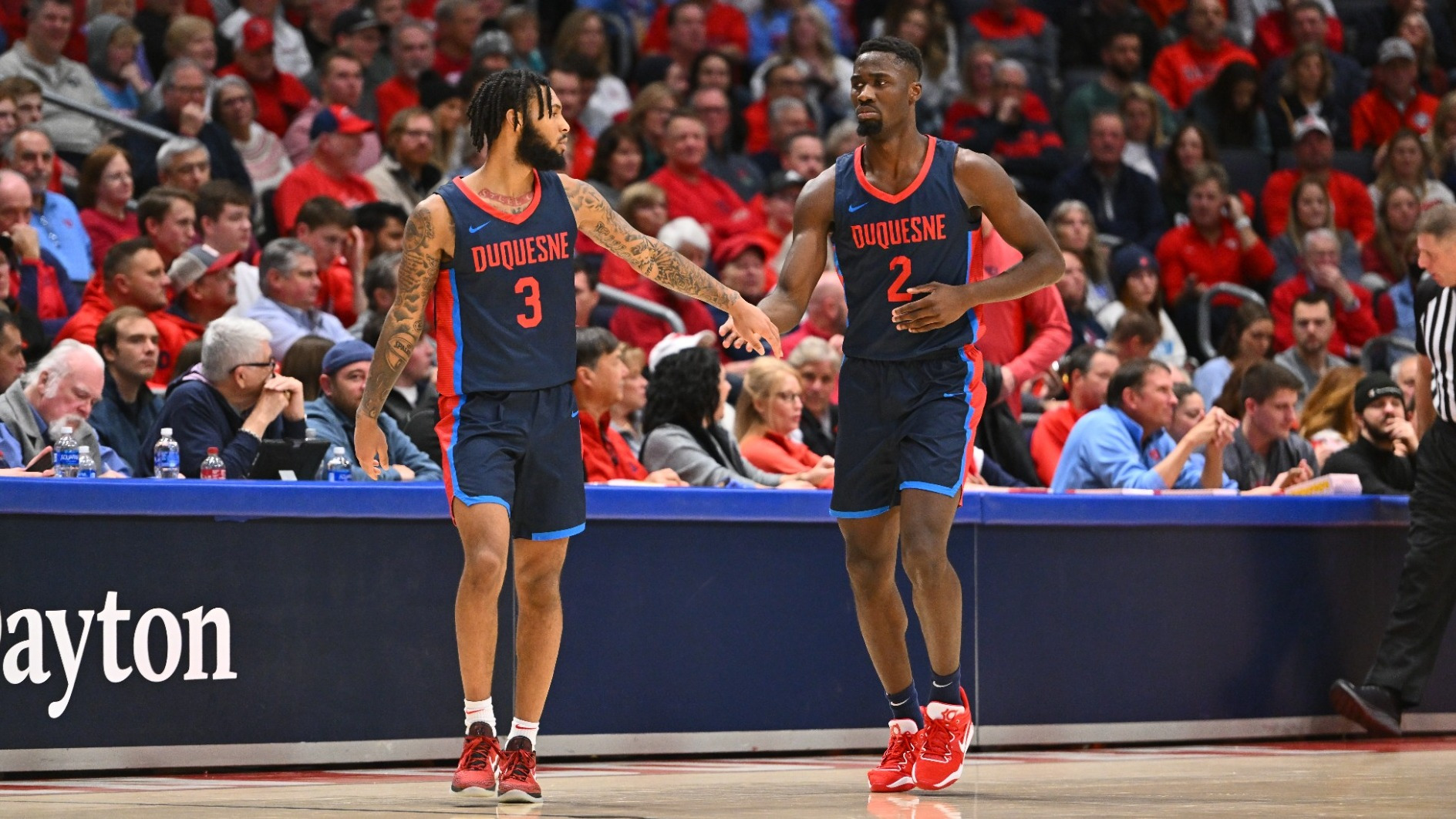
Those star guards both arrived at Duquesne last year, and they immediately gelled. Now, Dae Dae Grant and Jimmy ‘Tre’ Clark III are back to lead the Dukes towards the top of the A-10. The duo combined to average 27.7 points, 8.6 boards, 5.0 assists and 3.5 steals in their first season, and this year, they will look to drive the offense while integrating Duquesne’s four new veteran transfers into the rotation.

Grant, a former Mid-American Conference Freshman of the Year and All-MAC selection, is one of the most prolific returning three point shooters in America. With 259 career made triples at a 37.7% mark from distance, Grant is a threat to let fly nearly any time the ball is in his hands. His very first game wearing a Dukes jersey, Grant didn’t miss a shot from the floor, and he hit 6 out of 6 triple tries. 18 times last year, he hit 3 or more treys in a game, and he led the A-10 with a 40.3% clip from deep. The man wears #3 for a reason. Grant is such a pure marksman that, like a character rolling for a ranged attack upon an enemy only a few feet away, sometimes he is only effective from long range. After hitting a solid 94 of 210 (44.8%) at the rim his first three seasons combined, Grant made just 12 of 43 (27.9%) such attempts last year, per Bart Torvik. His jump shot is pure, though, and Grant is deadly curling off of screens to catch and let fly anywhere outside of the paint. If he can do a bit more damage off the bounce and closer to the lane, Grant will be that much more dangerous. Despite his struggle last year, Grant is smooth in traffic, using his dribble to create good looks from 15 feet and beyond; and he will sneak through tight spaces to squeeze off looks even when closely guarded. He made better than 41% of his mid-range tries a year ago, and Grant has the ability to draw defenders and then find his open teammates.
Clark used to play for A-10 rival VCU, but was dismissed from the program for unspecified reasons. As a result, two years back, he joined Northwest Florida State College, where he won a Junior College National Championship and worked hard to improve offensively. The JuCo year was quite a success for Clark as an individual as well, and he arrived back in the A-10 in style last fall. In his first season with the Dukes, Clark finished second on the team in scoring, led the conference in steals, and was named to the league All-Defense team. In his only matchup of the season against his former team, Clark went off for 26 points, 6 boards and 5 steals against VCU. “He looked like he was on a different level,” Dambrot told reporters, speaking of Clark after his performance against the Rams. “They could not keep him in front. Every time the game got close; he made an unbelievable play. When people go through some things in their life, that redemption factor is a big thing and that’s one of the reasons he came to Duquesne. He wanted to play in the Atlantic 10 again. He’s been a really good player. Most importantly, he’s been a really good guy.”

Last season, Tevin Brewer was the primary point guard for the Dukes, but since he’s gone now, Grant and Clark will often share the point. Which is just fine, since both of them have natural playmaking talent. Grant, who owns an 18.7% career assist rate and 213:114 assist to turnover ratio the last couple of years, shared point duties with Mekhi Lairy and Isaiah Coleman-Lands at Miami (OH). He should do just fine sharing ballhandling duties with Clark and others, and each of them should continue to play off of one another to create looks. Grant has improved over the years as a defender, and is always looking for a chance to poach a pass and start something for his guys. Grant has already expressed what he feels will be a winning formula for the Dukes going forward. “Just continue to have that extra effort and push,” he told Pittsburgh Sports Now. “And then continue to just like, keep grindin’ man. We gotta just believe in each other and trust each other and just keep going forward…and be consistent, most of all.”
When Grant had a tough day in the A-10 Tourney, Clark tried to will the Dukes to victory with 27 points, 6 rebounds, 4 more thefts and six made triples; and when Duquesne was down in the final seconds against Ball State, Clark found a way to heave up a well-defended three which found the hoop and stole a win for the Dukes. One of the most outstanding perimeter defenders around, Clark is very quick, very strong, and very athletic, and he puts a tremendous amount of pressure on the other team’s top guard each game. Clark further showed a great deal more consistency on his jumper last year than during his time at VCU. After hitting just nine out of 39 (23.1%) triple tries as a Ram, Clark hit 51 treys last year at a 34.2% rate. With his springy athleticism and relentless approach around the rim, Clark is a 52.8% career shooter on all two-point attempts. That, combined with the departure of Joseph Reese (who saw the team’s highest usage rate) and Clark’s 72.7% career percentage at the foul stripe, should make Clark an even more high-impact scorer this year. If he can make another leap as a shooter, Clark should emerge as one of the A-10’s best all-around players this winter. With his pair of fifth-year lead guards in charge, Dambrot feels he’s got leaders who give the Dukes a chance to win every time they take the floor.
David Dixon and Kareem Rozier return for their sophomore seasons looking to grow into bigger roles now that they’ve proven that the A-10 isn’t too big a stage. Rozier may well come to occupy a space very similar to that which Tevin Brewer filled last season. The diminutive guard is a heady, pass-first point guard with great awareness and vision. Despite his size, Rozier will drive the ball inside and finish at the rim. He shot the ball quite poorly from mid-range last year, but hit 57.1% around the rim, 39.1% from deep and 80.6% at the line, leading Dambrot to expect better overall shooting from his young playmaker in his second go-round. Despite playing 16 minutes on average off the bench, Rozier handed out 3 or more assists 11 times as a rookie, and the freshmen point guard racked up a 22.6% assist rate across his first campaign. With greater confidence in his shot this winter and the experience he’s gained, Rozier could well emerge as a solid third guard to help Clark and Grant run the show.
| Five Stats Which Tell The Tale (with national ranks) |
| 15.3 – Assists Per Game (30th) |
| .264 – Free Throw Attempts Per Field Goal Attempt (327th) |
| 36.6% – Team 3FG Percentage (44th) |
| 35.2% – Opponent 3FG Percentage (256th) |
| 49.6% – Team Rebounding Rate (205th) |
Dixon played both spots up front last year and showed that he’s got a tremendous amount of defensive ability to offer. Despite playing just 11 minutes per game, Dixon managed to snag 20 steals and block 24 shots. His mobility, high-revving motor and length are great assets, and Dambrot hopes that the young big can put them to extended use on the other end this year, also. He’s shown the ability to spot up and make jump shots, and Dixon made a terrific 68.4% of his shots around the cup in his first season. With the potential that Rozier and Dixon showed throughout last season, Dambrot has every reason to expect that they will be even better for the experience as he blends talented, established newcomers into the rotation around them.
Up front there are a bunch of new faces. “We felt that if we could have scored more consistently on the block, or on the inside – be it with a big man or a guard – that we could have won four or five more games last year,” Dambrot opined this summer when introducing the new additions to his upcoming roster. “We really went out of our way to shore up the frontcourt.” The new guys will find their orbits around a fellow veteran, though. Tre Williams is back to help hold down the paint and, like Clark, he is one of the Dukes’ most important defenders. While Williams didn’t have to play 32 minutes per night last season as he did two years ago, Williams has averaged 8.5 points, 5.1 rebounds and 1.5 blocks since arriving as a transfer from Indiana State. Not a huge pivot, Williams instead relies on great strength, quick feet and a seven-foot wingspan to get the job done inside. Williams likes to set up deep in the post and go to work with his back to the basket, and he’s great on the offensive glass. He ranked ninth in the conference in offensive rebounds last year, but converted just 12 putbacks on those 71 reloads, and Dambrot would love to see more easy buckets this winter. Not simply a guy who dunks all of his points, Williams has developed a reliable right-handed hook shot and has at times shown a turnaround jumper. This year, he will have to fight more than ever for minutes, but Williams is a tough customer who has earned Dambrot’s trust.
Dušan Mahorčič, once he’s recovered from surgery to repair his right Patella tendon last season, will give Dambrot a stout 1-2 punch in the middle. The well-traveled Serbian big man will be on his 6th American college when he dons a Dukes jersey for the first time. Unfortunately, recovering from injury is something that Mahorčič is all too familiar with the past couple of years. While with Utah two years ago, he hurt his right knee before being suspended indefinitely from the team. When healthy, Mahorčič is a physical and energetic post player who can really finish around the rim and has focused more each year on doing just that. Mahorčič can make short jumpers, but he’s adept at carving out space under the rim and has made 67% of his career attempts there, so why not focus his efforts there? He can be made to turn it over, but when Mahorčič takes his time, he’s highly effective. On the other end of the court, Mahorčič brings physicality and high-major size, and he’s proven to be strong on the glass. “Dusan was playing very well at NC State before he hurt his knee,” Dambrot recalled this summer. “He was really rebounding at a very high level at the time of the injury. We’re not sure when we’ll have him back, as he is still recovering. He’s a tough player with great size and experience who plays hard. We look forward to getting him back on the floor.” Last year, Mahorčič made a bigger impact as a rim protector as well. If Dambrot can end up getting 20 or so quality minutes each night from both of his pivots by the New Year, the coach will feel good about his team’s chances down the stretch.
When Saint Peter’s went on an incredible run to the Sweet Sixteen a couple of years ago, Fousseyni and Hassan Drame were two of the top six players in Shaheen Holloway’s rotation
When Saint Peter’s went on an incredible run to the Sweet Sixteen a couple of years ago, Fousseyni and Hassan Drame were two of the top six players in Shaheen Holloway’s rotation. Last year, the Malian twins took their talents to Philly, and got a taste of the A-10 at La Salle. Now, for their extra ‘Covid Year’, Fousseyni and Hassan will look to cap their careers with another postseason run that the home fans will remember for generations. “Fousseyni is more of an inside player, while Hassan is more perimeter-oriented,” Dambrot analyzed his addition of the twins. “They are both very competitive and they really know how to play the right way. Fousseyni and Hassan bring unbelievable versatility because they can guard just about any position on the floor. They will also help our ability to rebound more effectively. Their knowledge of the A-10 should also ease their transition.” Fousseyni is expected to start at one forward spot, as he did in 25 games for the Explorers a year ago. He’s bouncy and strong, and has good defensive instincts. A good interior scorer who hits the boards at both ends of the floor, Fousseyni is the more physical of the brothers. He began to show a lot more to his offensive game as an Explorer, and then continued that arc on the international stage this summer. Two years ago, Fousseyni made just 16 of his 64 (32%) shot attempts away from the rim, per Bart Torvik. He’s improved each year since, and last season Fousseyni knocked down a strong 47.2% of his longer shots inside the arc; he even hit 20 triples. Playing for Mali’s national team in Olympic qualifying during the offseason, Fousseyni averaged 16.3 points, 6.7 boards and 2.3 steals for his home country. This winter, Fousseyni is hoping to continue being a force defensively and put it all well and truly together on offense.
Hassan is a bit more focused on the outside action when his team has the ball, and though not as pugnacious, brings the same long arms, mobility and willingness to work as his brother on the defensive end. After nearly mirroring one another in playstyle for their first couple of seasons, Hassan began to play more to his strength as a shooter last winter. While he’s made only 32% of his triples the past two years, Hassan has demonstrated that opponents need to guard him on the three point arc, as he’s quite dangerous when he gets a shot in rhythm. Best catching and shooting, as opposed to dribbling into a look, Hassan should get plenty of kick-out opportunities with the Dukes’ improved interior scoring and from Grant or Clark driving and collapsing the defense. Dambrot has shown before that he likes to trap inbounds plays, will trap ballhandlers soon as they’ve crossed halfcourt, and will extend his defense out to apply pressure full-court. With Fousseyni at the 3 spot and Hassan’s length at the 2 occasionally, Duquesne’s defense could become truly fearsome for teams who don’t move the ball smartly out of harm’s way. The Drame brothers didn’t come to Pittsburgh for their final season just to miss out on the Tourney; with lots of wins already under their belts, they believe in Dambrot’s vision for success.
| Five Out-of-Conference Games to Keep an Eye on |
| @ Nebraska – November 22 |
| vs Charleston – November 10 |
| vs Bradley – December 18 |
| vs Santa Clara – December 23 |
| @ UC Irvine – November 29 |
Dambrot will also welcome Andrei Savrasov and Kailon Nicholls to the rotation this year, in different roles. Savrasov, who began his career at Texas Tech before transferring to Georgia Southern for the past three years, is a stretch forward who should give Dambrot his first true shooting big since Baylee Steele in 2019. During his time in Statesboro, Savrasov improved significantly each season, and has averaged 12.5 points, 6.4 rebounds and a steal on 34.2% shooting from downtown over the past two years while being named All-Sun Belt last winter. While the Russian forward isn’t a tremendous rim protector, he’s a good and sturdy defender who moves his feet well and has done a great job of avoiding foul trouble the last couple of years – especially knowing that he was the Eagles’ top scoring option at the other end. “Andrei is big and strong and has been really well coached,” surmises Dambrot. “He can shoot it from the three line as well as score inside. I can see him playing the three, four or even the five if needed. He’s shown he can score at a high level.”
Nicholls, a Canadian point guard who played at the prestigious Hargrave Military Academy last year, is hoping to follow in the footsteps of Rozier last year and grow his role in spite of his youth. Nicholls has some scoring potential from all three levels, though his jumper can still be streaky. Nicholls uses his terrific 6’7 wingspan smartly on both ends of the court, and can make some surprising plays both at the rim and defensively. There won’t be many minutes available outside of the top three guards, but Nicholls has a great deal of potential.

As the 2019-20 season came to a close, Dambrot had guided his Dukes to a 21-9 regular season record. Though they were set to be the six seed in a strong A-10 tourney that March, the Covid-19 Pandemic wiped away all of the tourney fun and denied the Dukes a chance to go on a run.
This season, Dambrot and Pittsburgh area fans feel like they’ve got their best squad since then, and the Dukes are out to make up for lost time and the wide span since they last cut down any consequential nets. Though their run last year didn’t end in March glory, the Dukes ranked 6th nationally in Evan Miya’s ‘kill shots’ stat. Their aggressive defense should be ratcheted up another couple of notches this winter, and the defenses around the painted area have been enhanced. If Duquesne can maintain their 36.6% rate from downtown, the Dukes will put their opponents on the mat with momentum-swinging runs with even greater regularity this year.
The A-10 will be a battle once more, but with Grant and Clark leading the way, this team has star power. Dambrot & Co have significantly improved the size and versatility up front, and the twins who are looking to go out on top provide tremendous defensive potential. Add it all up, and Duquesne is confident that this will be the group to go where few other Dukes have gone before.
Leave a Reply