
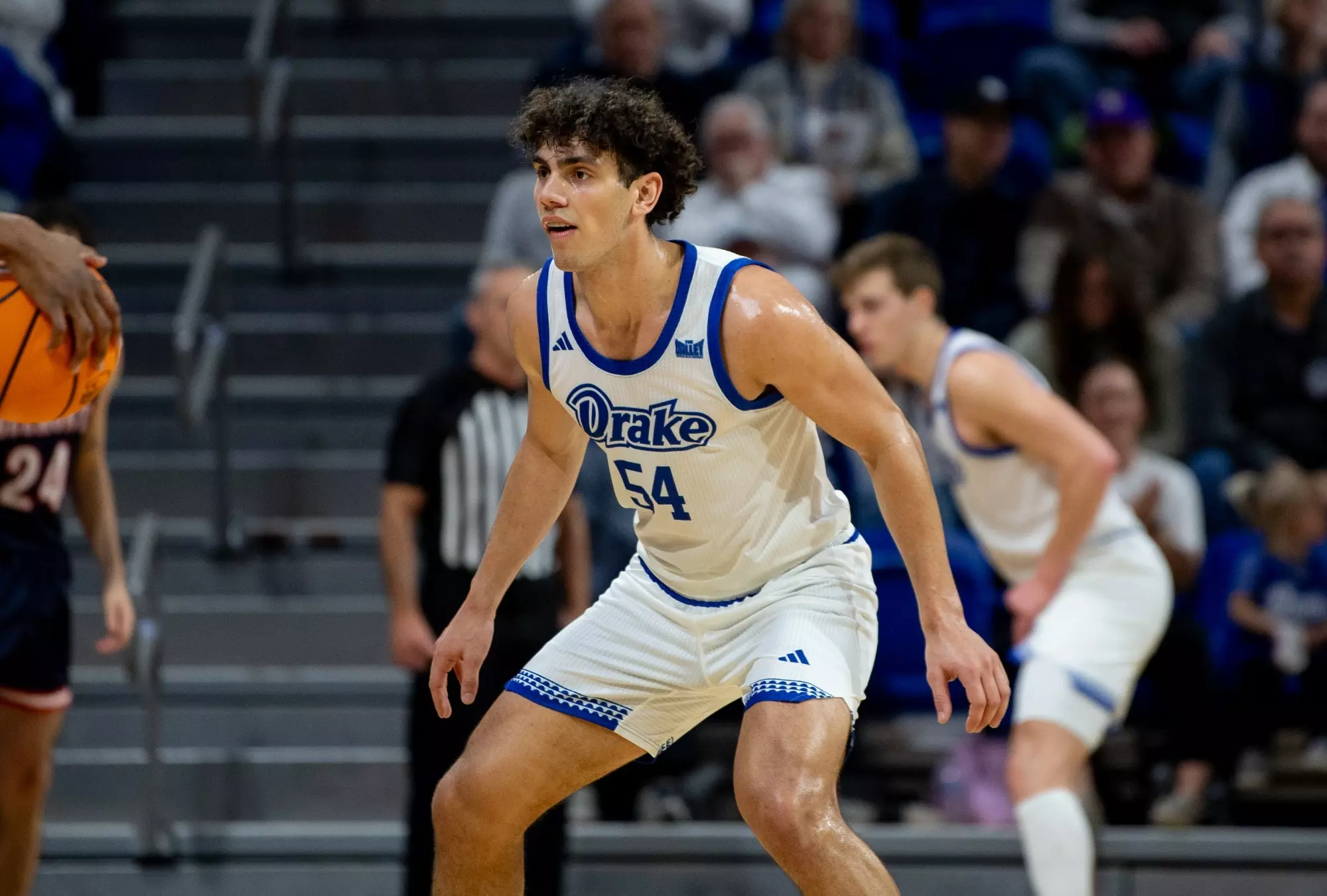
Almost nothing was supposed to go this way for the Bulldogs. This year’s series of Drake Basketball has been off-script since back in November. Hasn’t it been exhilarating?
The sturdy little team from Des Moines, IA, that had been steadily building momentum over the past five-plus years ran into pretty much an extinction event this past spring. Not only did Darian DeVries – a rising star in the coaching ranks – leave for West Virginia, nearly every player from last season’s roster departed as well. That included two-time Missouri Valley Conference Player of the Year Tucker DeVries, star guard Atin Wright – who spent the year leading 24-win North Texas in scoring – and impact youngster Kevin Overton, who is now the 6th man for 25-win Texas Tech. To replace all that was lost, Drake brought in Iowa native and 4-time Division II national champion Ben McCollum to take over as head coach. McCollum has wasted no time whatsoever in putting his own stamp on the program, and in the process, he’s changed the narrative on what quick success in the NIL era can look like.
Instead of trying to add unfamiliar faces with proven Division I credentials, McCollum focused on bringing the best pieces from the team he had constructed at Northwest Missouri State, the school he led to a quartet of natty’s. Turns out, if you can play at a championship level and truly know the game, your skills can translate from Division II to the thick of competition at the highest levels. Mitch Mascari, Daniel Abreu, and Isaiah Jackson have all made key contributions to the Bulldogs’ success, but it’s the youngest of the four former Bearcats who stole the show in the Valley this year, and it’s upon the many talents of Bennett Stirtz that Drake will most hang it’s hopes of continuing their remarkable run. In his first year of Division I ball, Stirtz has emerged as a prototype fit for McCollum’s approach.
A ball screen-reading maestro, Stirtz constantly puts the opposing defense on its heels and manufactures scoring chances for a team which doesn’t have a host of offensive weapons. Just as importantly, Stirtz doesn’t make mistakes despite being on the floor all the time. He’s played more minutes (1,298, or 39.3 per 40-minute game) than anyone in the nation this year – and Stirtz has proven his mettle in the clutch all season. He averaged 16 points and 7.7 assists to lead Drake to the Shriner’s Charleston Classic championship early in the year. Stirtz scored 29 points in his first career Missouri Valley game against Valparaiso, and a couple of weeks later he ripped off eight points – including the game-winning triple – in overtime at Kansas State.
“I’ve had a lot of good guards and I remember each of their ‘we’re not going to lose this game’ moments and that was one of those moments,” McCollum said of Stirtz’s heroics after the game. “That says a lot about him and that says a lot about his teammates to trust him to be able to do that.” Down the stretch of the year, Stirtz hasn’t worn down (he’s scored 20+ in 10 of the Bulldogs’ final 13 contests) and opponents have yet to figure out a way of really shutting him down. He’ll shut others down, though. Despite his incredible workload as the team’s offensive engine and his yeoman minutes total, Stirtz also finds energy to be a standout defender who routinely rattles the best guards on the other team. Evidence? He led the Valley with 71 steals.
The teammates that trust Stirtz have chipped in some major contributions of their own, too. Mascari is a sharpshooting veteran whose awareness on the floor and sixth sense for moving without the ball are outstanding. With points always at a premium, Mascari has quickly become a vital deep threat for Drake. After making 47.4% of his triple tries over his last two years combined as a Bearcat, Mascari has translated his value from NWMSU despite the jump up in competition. In his lone season as a Bulldog, Mascari ranked second in the MVC with a 41.0% rate from downtown, and he hit the third-most triples (86) in the league. Though he doesn’t play with the ball in his hands constantly like Stirtz, Mascari’s deep understanding of McCollum’s gameplan and ability to execute meant that he saw the third-most minutes of any Division I player. Abreu is a tough-minded forward who can also step out to the perimeter, and was the biggest surprise among Drake’s new arrivals as a steady scoring option. It’s not as though he wasn’t a key for the Bearcats; Abreu started 56 games over the two previous seasons at NWMSU. He was never really counted on as a prime scoring threat, though. Abreu has changed his reputation as a Bulldog, finishing second on the team in scoring.

Led by McCollum’s experienced core, Drake was the fastest school in the nation to reach 30 wins this year. There’s a bit of humor to be found in that accomplishment – mostly because it’s probably the only thing the Bulldogs did all year that was quicker than anyone else. In their First Round matchup against Missouri, McCollum’s squad will find themselves in a contest of contrasting styles the likes of which we’ve rarely seen all year. Among all Division I teams, Drake ranks dead-last in possessions per game and in Evan Miya’s True Tempo statistic. The Tigers, however, play fast. They average nearly ten more possessions per game than the Bulldogs, and love to push the pace. Missouri ranks fifth in all the land with an average of 84.5 points per game…Drake attempts the second-fewest field goals per 40 minutes of any team in the country. Fortunately for the Bulldogs, they do an exemplary job of getting to the foul line given how few shots they attempt overall. Drake sits 11th nationally with .430 free throw attempts per field goal try, and they’re 63rd in the country with 21.4 trips to the charity stripe per game this year. What’s more, Missouri will commit fouls. They’ve been whistled 18.2 times per game this year (281st), and the Tigers allow more than 20 free throw attempts per game on average.
Rebounding their opponents’ misses as well as their own has been a huge part of Drake’s success this year, and it’s something that must continue if their season is to last. With so few shots going up, the Bulldogs’ consistency in grabbing 77.0% (18th nationally) of available defensive rebounds and an outstanding 35.9% (10th) of their own missed shots had been integral. Any lead that Drake gets can end up feeling insurmountable due to the thousand cuts of their physical defense, abrasively slow pace, and regular trips to the foul line. In facing Missouri, the Bulldogs are facing a bigger, more athletic team, but the Tigers aren’t as overwhelmingly large in the lane as some of their SEC counterparts, and Drake must turn that element to their advantage on the glass.
McCollum’s team has been at a physical disadvantage plenty of times before this year, and that deficiency hasn’t gotten in the way much so far. All the same, against the deep and skilled Tigers the Bulldogs will need to count on their top wildcard. Tavion Banks, the Valley’s 6th Man of the Year, is a physical 6’7″ wing who hits the boards with alacrity and can be a difficult matchup defensively. He showed out a year ago in helping Northwest Florida State to the national junior college Sweet Sixteen, and Banks will give the Bulldogs a matchup option against Mizzou’s wings and forwards. An added element in the matchup between Drake and the Tigers is that McCollum spent more than a decade recruiting in and around the Show Me state, and is familiar with the majority of the players who will be on both benches. It will mean a bit more than the average first NCAA Tournament win of most coaches’ careers if McCollum is able to cap his incredible debut in Des Moines with a March Madness dub over the biggest school in Missouri.
A potential matchup against Overton and the Red Raiders looms if the Bulldogs can advance past Missouri. If that bout comes to fruition, it promises one of the more gritty, grinding games of the whole tournament. Tech is also a team that’s comfortable slowing the pace, making good reads and quality shots in the halfcourt, and working the boards. The Red Raiders won’t be thrown off by getting down in the mud and playing a game that sees both teams score in the high 50’s or low 60’s. It’s probable that Stirtz’s dynamism and Drake’s overall execution against the shot clock on their side of the floor may be even more vital if they get to take on Tech, who will themselves see a legit challenge from UNC Wilmington.
There’s no reason in the world to bet against Drake at this point. All they’ve done this season is smash expectations and gain confidence. They’ve taken on high major teams, stared down mismatches, forced opponents to play their preferred style, and won 30 out of the 33 games they’ve played. There are a whole bunch of different recipes for success across the college basketball landscape, and Drake’s is as rock-solid as they come. This is a team that believes in its identity, has forged deep bonds both over the years before and since summer practices began, and executes its missions with precision. Don’t be surprised if the Bulldogs find their way to the second weekend of NCAA competition: it will simply be the most recent instance of Ben McCollum’s first Drake team smashing expectations.
Leave a Reply